Executive Summary
The 2026 ACC/AHA multisociety dyslipidemia guideline replaces the older Pooled Cohort Equations with the American Heart Association PREVENT-ASCVD equations for primary-prevention lipid decisions in the population for which PREVENT was designed.
PREVENT was developed and validated using contemporary U.S. data and incorporates cardiovascular, kidney and metabolic health. Unlike the older race-specific approach, the equations are race-free and include kidney function as part of the core model.
For dyslipidemia decisions, the guideline classifies 10-year PREVENT-ASCVD risk as low below 3%, borderline 3% to below 5%, intermediate 5% to below 10%, and high at 10% or above. Lipid-lowering therapy becomes progressively more strongly favored as absolute risk rises.
For adults aged 30–59, the 30-year estimate matters when 10-year risk looks deceptively low. In selected people with 10-year risk below 3%, a moderate-intensity statin is reasonable when LDL-C is 160–189 mg/dL or 30-year PREVENT-ASCVD risk is at least 10%.
PREVENT is not a universal permission slip to ignore everything else. Known ASCVD, LDL-C at least 190 mg/dL, established subclinical atherosclerosis, and several high-risk conditions follow specific pathways rather than a simple calculator-only decision.
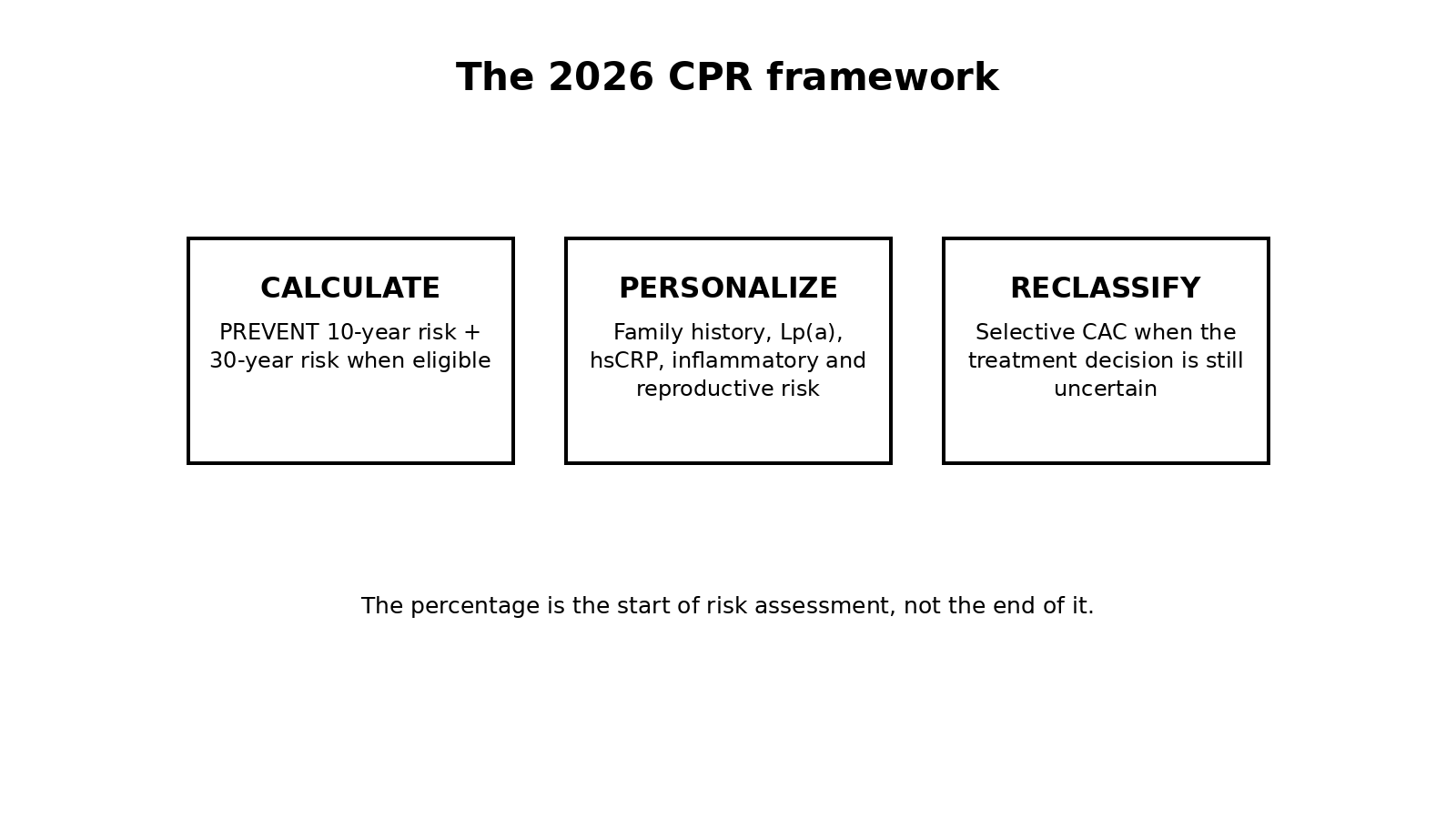
The guideline therefore uses the CPR framework: Calculate, Personalize, Reclassify. Family history of premature ASCVD, elevated Lp(a), hsCRP, inflammatory disease and reproductive risk markers can personalize the estimate; CAC can reclassify risk when a treatment decision remains uncertain.
A calculator is most useful when it changes a decision. If the clinical answer is already clear because disease is present or LDL-C is severely elevated, calculating another decimal point adds noise rather than precision.
Related guides: family history of premature heart disease • polygenic risk scores for heart disease • preventive cardiology blood tests • coronary calcium score guide
1. What PREVENT actually estimates
The PREVENT family of equations was developed for adults aged 30–79 years without known cardiovascular disease. The 2026 lipid guideline specifically uses PREVENT-ASCVD to estimate fatal and nonfatal myocardial infarction and stroke, with a 10-year estimate for ages 30–79 and a 30-year estimate for ages 30–59.
The model uses routinely available variables including age, cholesterol measures, systolic blood pressure, smoking, diabetes, medication use and estimated glomerular filtration rate. Some PREVENT implementations can incorporate additional cardiovascular-kidney-metabolic information. The point is contemporary absolute risk estimation, not a genetic or imaging diagnosis.
2. The new 2026 risk thresholds
The categories are lower than many people remember from the prior Pooled Cohort era: low is below 3%, borderline is 3% to below 5%, intermediate is 5% to below 10%, and high is at least 10% over 10 years. In the guideline, statin therapy is reasonable after discussion at borderline risk and recommended from intermediate risk upward.
These are decision thresholds, not biological cliffs. A calculated 4.9% and 5.0% risk are practically neighbors. The correct interpretation includes treatment preferences, expected LDL reduction, risk enhancers and how confident the estimate is for the individual in front of you.
3. Why the 30-year number matters
Young adults can have low short-term risk almost automatically because age dominates near-term event probability. That does not mean decades of LDL exposure are harmless. PREVENT gives a 30-year estimate for ages 30–59 to expose this blind spot.
In selected adults aged 30–59 with 10-year risk below 3%, the guideline says a moderate-intensity statin is reasonable when LDL-C is 160–189 mg/dL or 30-year PREVENT-ASCVD risk is at least 10%. This is the practical expression of the “lower sooner” concept.
4. Calculate, Personalize, Reclassify
PREVENT does not include every meaningful risk signal. The 2026 guideline explicitly asks clinicians to personalize risk using factors such as premature family history, elevated Lp(a), hsCRP, chronic inflammatory disease and female-specific reproductive risk markers.
If the decision is still uncertain, CAC can reclassify risk in appropriate adults. This is why a PREVENT score and a CAC result should not be treated as competing tests. They answer different questions: predicted clinical risk versus directly detected calcified coronary atherosclerosis.
5. When PREVENT is the wrong tool
Do not use PREVENT as a reason to downplay established disease. A person with clinical ASCVD is already in secondary prevention. LDL-C at least 190 mg/dL triggers a severe-hypercholesterolemia pathway, and known subclinical atherosclerosis changes the premise of primary risk estimation.
Likewise, diabetes, stage 3 or 4 chronic kidney disease and HIV have specific guideline recommendations. PREVENT can still help characterize risk intensity in some of these groups, but it should not erase a recommendation that already exists because of the condition itself.
| Question | 2026 answer |
|---|---|
| Who is the core population? | Adults without known ASCVD or subclinical atherosclerosis, LDL-C 70–189 mg/dL |
| 10-year PREVENT-ASCVD age range | 30–79 years |
| 30-year PREVENT-ASCVD age range | 30–59 years |
| Borderline / intermediate / high | 3–<5% / 5–<10% / ≥10% |
| Low 10-year risk but younger adult | Consider 30-year risk and LDL-C 160–189 mg/dL |
| When uncertainty remains | Personalize with risk enhancers, then selectively reclassify with CAC |
If you are making a primary-prevention decision, calculate PREVENT-ASCVD only if you fit the intended population. Write down both the 10-year and, if age 30–59, the 30-year result. Then list risk enhancers separately. If the treatment decision is still genuinely uncertain, that is the point at which CAC may add value.
6. FAQ
Is PREVENT the same as the old ASCVD Risk Estimator?
No. The 2026 guideline replaces the Pooled Cohort Equations with PREVENT-ASCVD for the relevant primary-prevention population. PREVENT uses more contemporary data and incorporates kidney function.
Why can my PREVENT risk be lower than my old PCE risk?
The equations were recalibrated using contemporary populations. The ACC/AHA guideline authors note that older PCE estimates often overestimated risk in current populations. A lower number does not erase risk enhancers or existing plaque.
Should everyone with a 5% risk take a statin?
The guideline recommends lipid-lowering therapy at intermediate risk, but implementation still requires a clinician-patient discussion, treatment tolerance, competing conditions and the broader risk picture.
Can I use PREVENT if my LDL-C is 210 mg/dL?
That is not the use case for risk-based deferral. LDL-C at least 190 mg/dL is severe hypercholesterolemia and has its own guideline treatment pathway regardless of a low calculated short-term risk.
References
1. Blumenthal RS, Morris PB, Gaudino M, et al. 2026 ACC/AHA/AACVPR/ABC/ACPM/ADA/AGS/APhA/ASPC/NLA/PCNA Guideline on the Management of Dyslipidemia. Circulation. 2026;153(17):e1154-e1276. doi:10.1161/CIR.0000000000001423.
2. Khan SS, Matsushita K, Sang Y, et al. Development and Validation of the American Heart Association's PREVENT Equations. Circulation. 2024;149(6):430-449. doi:10.1161/CIRCULATIONAHA.123.067626. Correction: Circulation. 2024;149(11):e956. doi:10.1161/CIR.0000000000001230.
3. American Heart Association. Top Take-Home Messages for Clinicians: Using PREVENT-ASCVD Equations for Risk-Based Lipid Management. March 2026. https://professional.heart.org/en/science-news/2026-guideline-on-the-management-of-dyslipidemia.
4. American Heart Association. PREVENT Equations Frequently Asked Questions. 2026. https://professional.heart.org/en/guidelines-and-statements/about-prevent-calculator.