Executive Summary
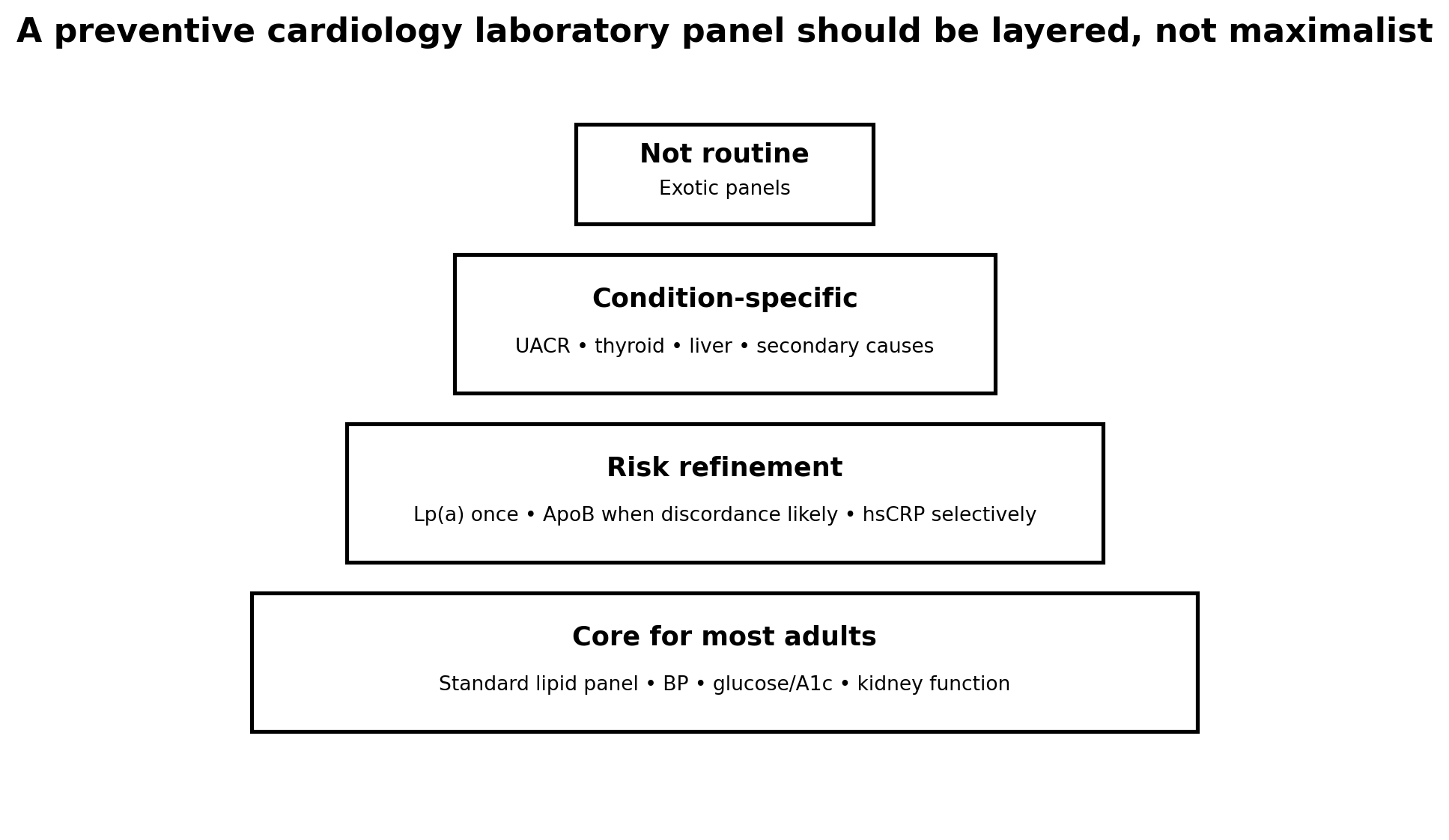
The 2026 ACC/AHA dyslipidemia guideline recommends at least one adult Lp(a) measurement and selective ApoB measurement, particularly in ASCVD, cardiometabolic disease, diabetes, elevated triglycerides or low achieved LDL-C.
The standard lipid profile remains the foundation: total cholesterol, HDL-C, triglycerides and calculated LDL-C, with non-HDL-C derived from total cholesterol minus HDL-C.
ApoB is most valuable when LDL-C may underestimate the number of atherogenic particles—for example with high triglycerides, diabetes, obesity or very low achieved LDL-C.
hsCRP can refine risk when uncertainty remains. The 2026 guideline states that if hsCRP is ≥2 mg/L on two occasions without another cause in borderline-risk adults, high-intensity statin therapy can be useful.
Glucose/A1c, creatinine/eGFR, urine albumin-to-creatinine ratio in appropriate patients, liver enzymes and thyroid testing can identify major risk states or secondary causes that affect treatment.
Tests such as LDL particle size, oxidized LDL, Lp-PLA2, MPO, fibrinogen, homocysteine, broad cytokine panels and “endothelial function” blood tests are not routine first-line screening tests for most adults.
| Tier | Test | Who needs it / why |
|---|---|---|
| Core | Standard lipid profile | Most adults; foundation for LDL-C, non-HDL-C and triglycerides |
| Core | Glucose or HbA1c | Screen diabetes / cardiometabolic risk |
| Core | Creatinine + eGFR | Kidney disease changes ASCVD risk and drug choices |
| Core | ALT/AST | Baseline liver context and secondary causes |
| Once | Lp(a) | At least once in adulthood; inherited risk enhancer |
| Selective | ApoB | Discordance, high TG, diabetes, ASCVD, CKM syndrome, low achieved LDL-C |
| Selective | hsCRP | Risk refinement when decision remains uncertain; repeat if elevated |
| Selective | UACR | Diabetes, CKD, hypertension or suspected CKM syndrome |
| Selective | TSH | Suspected hypothyroidism / secondary dyslipidemia |
| Specialist | Genetic testing | Suspected familial hypercholesterolemia or inherited disorder |
1. The standard lipid profile still matters
LDL-C remains the principal treatment target in the 2026 ACC/AHA guideline, accompanied by non-HDL-C goals. Modern LDL-C estimation with Martin/Hopkins or Sampson/NIH is preferred over Friedewald in many settings.
Triglycerides are not merely a fasting nuisance; they help identify remnant-rich, insulin-resistant phenotypes in which ApoB can add useful information.
2. Lp(a): one measurement can change a lifetime plan
Lp(a) is largely genetically determined and relatively stable. The 2026 guideline recommends measuring it at least once in adulthood. Values ≥125 nmol/L (roughly ≥50 mg/dL) identify meaningful excess risk, while around 250 nmol/L is associated with substantially higher lifetime risk.
Repeat testing is usually unnecessary unless the first result was obtained during a setting that may distort measurement or a specific therapy is being monitored.
3. ApoB: particle number when LDL-C is misleading
ApoB counts the number of atherogenic particles rather than the amount of cholesterol they carry. It is especially helpful with diabetes, high triglycerides, obesity, CKM syndrome, ASCVD and low achieved LDL-C.
The 2026 guideline uses ApoB mainly to identify residual lipoprotein-related risk after LDL-C/non-HDL-C goals are reached rather than as a universal replacement for LDL-C.
4. hsCRP: inflammation, used selectively
hsCRP is useful when stable and measured outside acute infection or injury. Persistent hsCRP ≥2 mg/L is a recognized risk enhancer. A single elevated value should usually be repeated.
Very high values—often >10 mg/L—should prompt a search for infection, inflammatory disease, trauma or another cause rather than immediate cardiovascular interpretation.
5. Kidney and metabolic markers
CKD and diabetes substantially alter cardiovascular risk. Creatinine/eGFR, HbA1c and urine albumin-to-creatinine ratio can therefore be more clinically important than fashionable lipid subfractions.
Albuminuria is both a kidney marker and a cardiovascular risk marker, particularly in diabetes and hypertension.
6. What not to order routinely
Particle size, oxidized-LDL assays, Lp-PLA2, MPO, broad cytokine panels and nutrigenomic “cardiovascular” packages may be useful in research or highly selected specialist situations, but they rarely change first-line prevention decisions.
The key test of any biomarker is not whether it correlates with risk; it is whether it adds information beyond established markers and changes management in a way supported by outcomes evidence.
7. A pragmatic once-a-year review
| Question | Useful measurement |
|---|---|
| Is atherogenic particle exposure controlled? | LDL-C, non-HDL-C; ApoB when discordance is possible |
| Is inherited Lp(a) risk known? | Lp(a) once in adulthood |
| Is diabetes / insulin resistance emerging? | HbA1c or glucose; triglycerides; BP; waist/weight |
| Is kidney disease increasing risk? | Creatinine/eGFR; UACR when indicated |
| Is inflammation unusually high? | hsCRP selectively, repeated if ≥2 mg/L |
| Could a secondary cause explain dyslipidemia? | TSH, liver/kidney review, medication review as clinically indicated |
8. FAQ
Should ApoB be tested in everyone?
It is useful but not mandatory in every low-risk person. It adds the most value when LDL-C and particle number may be discordant.
Do I need fasting lipids?
Not always. Nonfasting lipids are acceptable for routine assessment; fasting can help when triglycerides are markedly elevated or results are difficult to interpret.
Is hsCRP a "heart inflammation" test?
It is a systemic inflammatory marker associated with ASCVD risk, not a direct measurement of coronary inflammation.
Do I need LDL particle size?
Usually not if ApoB, triglycerides, non-HDL-C and standard risk assessment are available.
References
1. Blumenthal RS, Morris PB, Gaudino M, et al. 2026 ACC/AHA Multisociety Guideline on the Management of Dyslipidemia. J Am Coll Cardiol. 2026;87:2624-2757.
2. Wiggins BS, Barac A, Benziger CP, et al. 2026 Dyslipidemia Guideline-at-a-Glance. J Am Coll Cardiol. 2026;87:2617-2623.
3. National Lipid Association. Role of apolipoprotein B in clinical management of cardiovascular risk in adults. J Clin Lipidol. 2024.
4. Kronenberg F, Mora S, Stroes ESG, et al. EAS consensus on Lp(a). Eur Heart J. 2022.
5. Ridker PM, Danielson E, Fonseca FAH, et al. JUPITER. N Engl J Med. 2008;359:2195-2207.
6. American Diabetes Association. Standards of Care in Diabetes—2026. Cardiovascular and kidney risk sections.
7. KDIGO Clinical Practice Guideline for the Evaluation and Management of Chronic Kidney Disease. 2024.