How to Lower LDL: Lifestyle, Supplements, and When Medication Matters
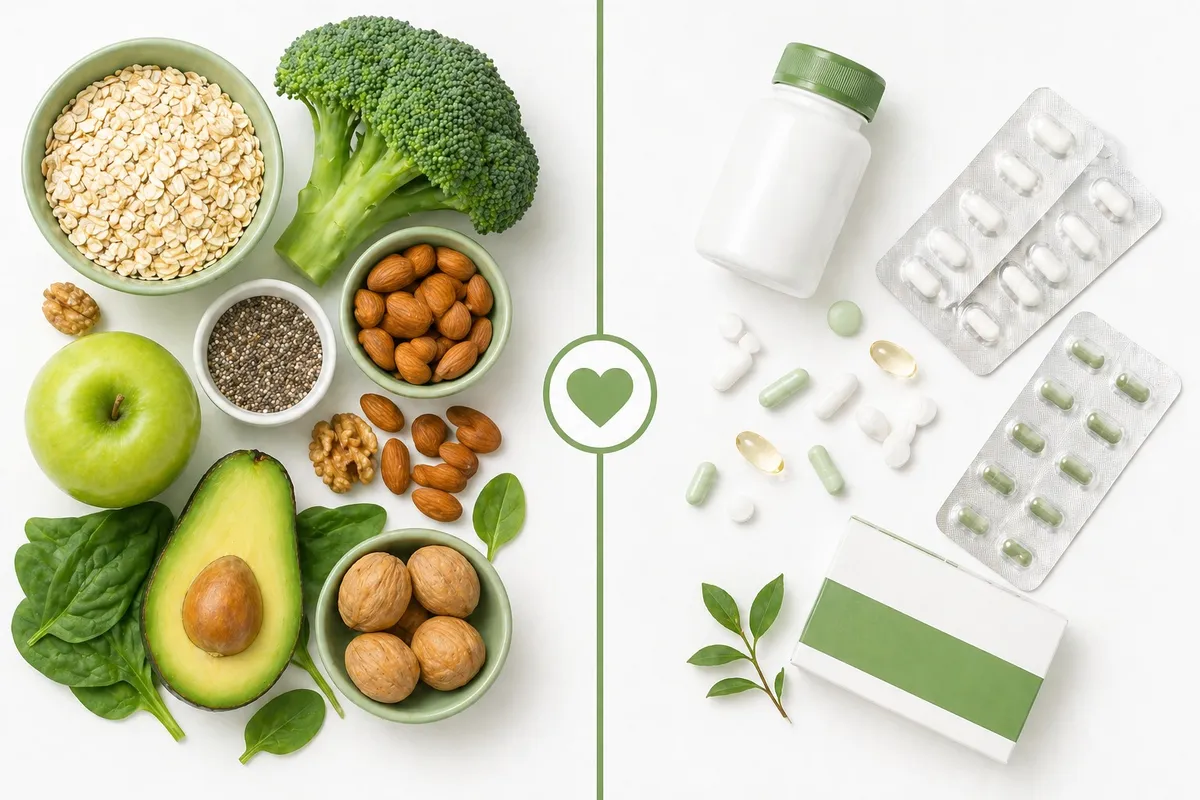
If you’ve been told your LDL is too high, you’ve probably already encountered two very different camps online. One says statins are the only answer. The other says statins are dangerous and you can fix everything with supplements and diet. Neither position reflects what the evidence actually shows.
This article walks through the full picture — what lifestyle changes accomplish, what supplements have real evidence behind them, and what the clinical guidelines say about when medication becomes the appropriate next step.
Start here: your LDL number doesn’t exist in isolation
The same LDL of 145 mg/dL can represent very different levels of risk depending on your age and sex, whether you have diabetes, hypertension, or chronic kidney disease, whether you smoke, your family history, and whether you already have established heart disease.
What lifestyle changes can actually accomplish
The Portfolio Diet — the most evidence-supported dietary approach
The Portfolio Diet combines four food categories that each have independent LDL-lowering evidence — and the effects are additive.
1. Soluble fiber (20–30g/day) — Soluble fiber binds bile acids in the gut, forcing the liver to pull LDL from the bloodstream. A 2014 meta-analysis found that increasing soluble fiber by 5–10g per day reduced LDL by approximately 5%.
2. Plant sterols and stanols (2g/day with meals) — Block cholesterol absorption in the small intestine. Must be taken with food. A 2014 Cochrane review found 2g/day reduces LDL by approximately 8–10%.
3. Soy protein (25g/day) — Tofu, edamame, soy milk. The FDA has an authorized health claim for soy protein and reduced coronary heart disease risk.
4. Nuts (30g/day) — Almonds and walnuts are the best studied. A 2015 Cochrane review found consistent LDL reductions across 61 trials.
Realistic expectations from lifestyle alone
| Intervention | Expected LDL reduction |
|---|---|
| Portfolio Diet (full adherence) | 15–30% |
| Reducing saturated fat meaningfully | 5–10% |
| Psyllium fiber 10g/day | 5–7% |
| Plant sterols 2g/day with meals | 8–10% |
| Weight loss (if overweight) | ~1% per kg lost |
Supplements: what has real evidence, what doesn’t
Plant sterols and stanols — the strongest evidence
2g/day with meals produces consistent 8–10% LDL reductions. FDA-authorized health claim. One of the few supplements that major cardiovascular guidelines specifically acknowledge as evidence-supported. Read our full plant sterols guide →
Psyllium fiber — consistent, modest effect
10g/day produces LDL reductions of approximately 5–7%. Inexpensive, safe, well-tolerated when taken with adequate water. Take 1–2 hours away from other medications. Read our full psyllium guide →
Red yeast rice — the complicated one
Berberine — promising but limited
Meta-analyses suggest modest LDL and triglyceride reduction. However, berberine inhibits multiple CYP enzymes (CYP2D6, CYP2C9, CYP3A4) — meaning it can significantly alter how your body processes other medications. Anyone taking other medications must discuss berberine with their pharmacist before starting. Read the full berberine guide →
Omega-3 fatty acids — it depends what you’re treating
Prescription icosapent ethyl (pure EPA at 4g/day) reduced cardiovascular events significantly in the REDUCE-IT trial. Standard OTC fish oil has not demonstrated cardiovascular event reduction in major trials. These are not equivalent products. Read the full EPA vs fish oil guide →
When medication becomes the appropriate next step
The four groups the 2026 guideline recommends for statin therapy
Group 1: Adults with established atherosclerotic cardiovascular disease (ASCVD) — prior heart attack, stroke, or confirmed cardiovascular events. High-intensity statin therapy is recommended.
Group 2: Adults aged 20–75 with LDL ≥190 mg/dL. High-intensity statin therapy is recommended without additional risk calculation.
Group 3: Adults aged 40–75 with diabetes and LDL 70–189 mg/dL. Moderate-intensity statin therapy is recommended.
Group 4: Adults aged 40–75 without diabetes, with LDL 70–189 mg/dL and estimated 10-year cardiovascular risk ≥7.5%. Statin therapy generally favored at ≥10% 10-year risk.
For people who can’t tolerate statins
Ezetimibe: Reduces LDL by blocking intestinal cholesterol absorption. The IMPROVE-IT trial showed meaningful cardiovascular event reduction. Can be used as monotherapy in statin-intolerant patients. Read the ezetimibe guide →
Bempedoic acid: The CLEAR Outcomes trial showed cardiovascular event reduction in statin-intolerant patients. Does not cause the muscle symptoms associated with statins. Read the bempedoic acid guide →
PCSK9 inhibitors: Injectable medications that dramatically reduce LDL. The FOURIER and ODYSSEY OUTCOMES trials both showed meaningful cardiovascular event reduction. Reserved for very high-risk patients. Read the PCSK9 guide →
A framework for deciding where you are
LDL ≥190 mg/dL: Clinical evaluation and statin therapy discussion should happen promptly. Lifestyle changes are still valuable but are unlikely to be sufficient at this level.
Established heart disease or prior stroke: Medication is part of your treatment regardless of lifestyle changes.
LDL 130–189 mg/dL with no major risk factors: Lifestyle-first is a reasonable approach with monitoring. 3–6 months of consistent dietary changes, then retest.
LDL 130–189 mg/dL with diabetes, hypertension, or family history: Risk is higher than the LDL number alone suggests. A 10-year risk calculation is essential before deciding.
Find out where you stand
Your LDL number is one input. Your risk profile — all of it — is what determines the right next step for you specifically.
Take the 2-minute quiz → Free · No account required · Based on 2026 clinical guidelinesSources
- Grundy SM, et al. 2018 AHA/ACC Guideline on the Management of Blood Cholesterol. JACC. 2019;73(24):e285-e350. PMID: 30423393
- Jenkins DJ, et al. Direct comparison of a dietary portfolio of cholesterol-lowering foods with a statin. JAMA. 2003;290(4):502-510. PMID: 12876093
- Ras RT, et al. LDL-cholesterol-lowering effect of plant sterols and stanols. Br J Nutr. 2014;112(2):214-219. PMID: 24780090
- Cannon CP, et al. Ezetimibe Added to Statin Therapy after Acute Coronary Syndromes (IMPROVE-IT). NEJM. 2015;372(25):2387-2397. PMID: 26039521
- Nissen SE, et al. Bempedoic Acid and Cardiovascular Outcomes (CLEAR Outcomes). NEJM. 2023;388(15):1353-1364. PMID: 36876740
- Sabatine MS, et al. Evolocumab and Clinical Outcomes (FOURIER). NEJM. 2017;376(18):1713-1722. PMID: 28304224
- Bhatt DL, et al. Cardiovascular Risk Reduction with Icosapent Ethyl (REDUCE-IT). NEJM. 2019;380(1):11-22. PMID: 30415628
- USPSTF. Statin Use for the Primary Prevention of Cardiovascular Events. JAMA. 2022;328(8):746-753. PMID: 35997723