Prescription EPA vs OTC Fish Oil: Why Formulation Determines Outcome

If you search “fish oil for cholesterol” online, you'll find confident recommendations to take omega-3 supplements for cardiovascular health. If you look at the clinical trial evidence, the picture is more complicated — and the distinction that matters is one that most supplement guides completely miss.
There is a meaningful difference between prescription icosapent ethyl (pure EPA) and over-the-counter fish oil. One has a large cardiovascular outcomes trial showing significant event reduction. The other does not. Understanding why requires looking at what each trial actually studied — and what that means for someone standing in a supplement aisle.
The two large omega-3 cardiovascular trials
REDUCE-IT — the positive trial
REDUCE-IT (Reduction of Cardiovascular Events with Icosapent Ethyl) enrolled 8,179 patients with elevated triglycerides (≥150 mg/dL) who were on statin therapy and had established cardiovascular disease or diabetes with additional cardiovascular risk factors.
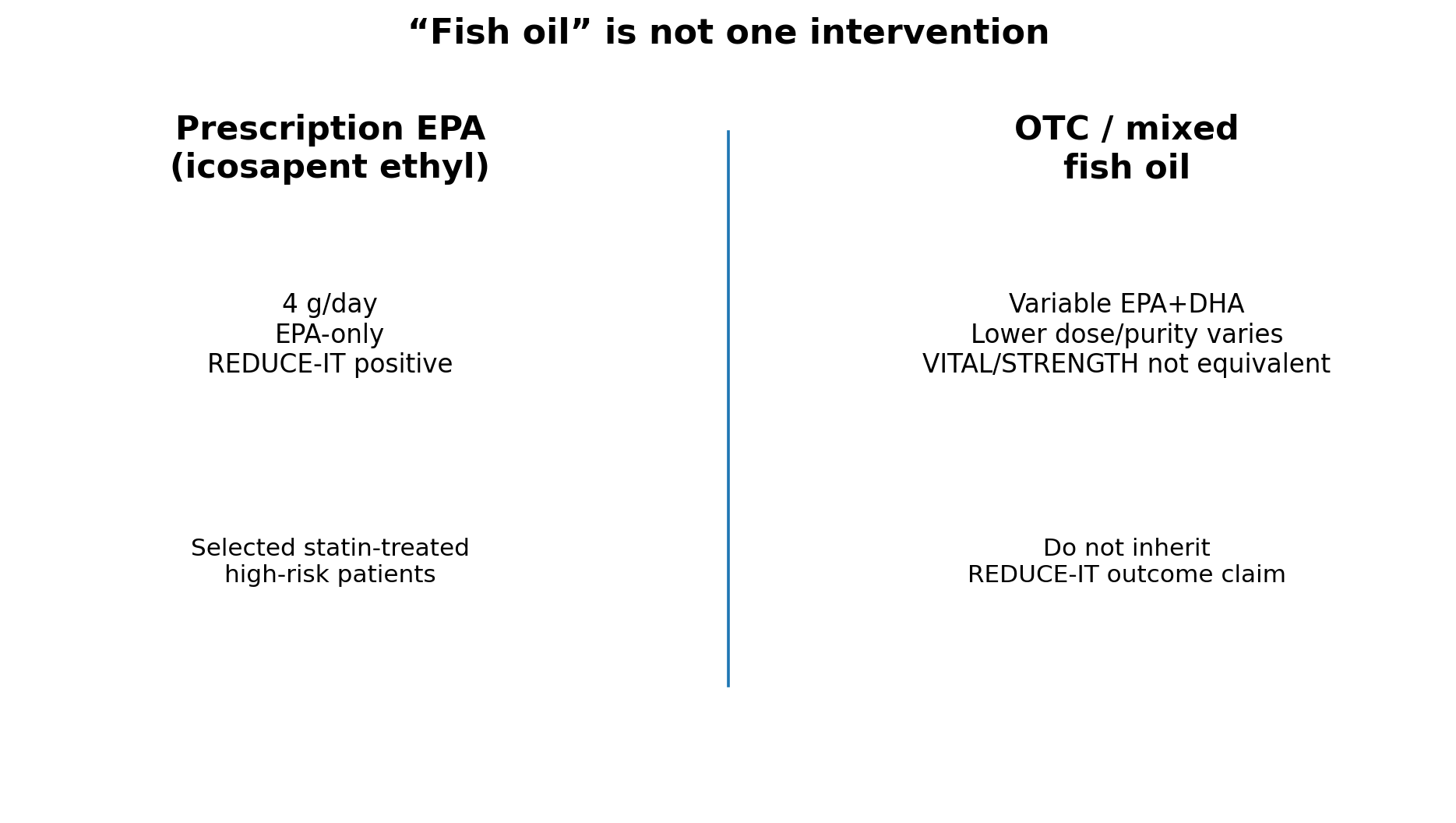
Patients were randomized to icosapent ethyl (Vascepa) 4g/day — a prescription medication containing pure EPA (eicosapentaenoic acid) — or to mineral oil placebo.
Results published in 2019:
- Major adverse cardiovascular events reduced by 25% relative to placebo
- Cardiovascular death reduced by 20%
- Triglycerides reduced by approximately 18% vs placebo
- Absolute risk reduction: 4.8 percentage points over a median 4.9 years
These are large, clinically meaningful reductions. REDUCE-IT was one of the most impactful cardiovascular trials of the past decade and prompted FDA approval of icosapent ethyl for the indication studied.
STRENGTH — the negative trial
STRENGTH (Statin Residual Risk Reduction with EpaNova in High Cardiovascular Risk Patients with Hypertriglyceridemia) enrolled 13,078 patients with elevated triglycerides on statin therapy with additional cardiovascular risk.
Patients were randomized to omega-3 carboxylic acids (Epanova) 4g/day — a prescription formulation containing both EPA and DHA at a free fatty acid form — or to corn oil placebo.
Results published in 2020: The trial was stopped early for futility. There was no significant reduction in major cardiovascular events compared to placebo.
Why the results differ — what the science says
Two trials, similar patient populations, similar doses, both prescription omega-3 formulations. Dramatically different results. This requires explanation.
The EPA vs EPA+DHA hypothesis
The most widely discussed explanation is that EPA and DHA have different cardiovascular effects:
- EPA (eicosapentaenoic acid): The active component in icosapent ethyl. Anti-inflammatory, anti-thrombotic, may stabilize atherosclerotic plaque. Does not raise LDL.
- DHA (docosahexaenoic acid): Present in most OTC fish oil alongside EPA. May raise LDL slightly in some patients. Some researchers hypothesize DHA may attenuate EPA’s cardiovascular benefits, though this is not definitively established.
REDUCE-IT used pure EPA. STRENGTH used EPA+DHA. The difference in outcomes could reflect genuine differences in the two fatty acids' cardiovascular effects.
The mineral oil placebo controversy
REDUCE-IT used mineral oil as placebo. Critics argued that mineral oil is not truly inert — that it may increase LDL and inflammation markers, thereby making icosapent ethyl look more beneficial by comparison. This remains a legitimate scientific debate. A subsequent analysis showed that patients on mineral oil had higher inflammatory markers than would be expected, lending some credence to the concern.
STRENGTH used corn oil as placebo — which also proved not entirely inert. Both trials have placebo-related limitations.
The dose question
Both trials used 4g/day of their respective formulations. Standard OTC fish oil doses are typically 1–3g of total omega-3s per day. The EPA content in a standard OTC supplement at typical doses is often 300–600mg — far below the 4g of pure EPA in REDUCE-IT. This is why REDUCE-IT results do not apply to OTC fish oil at typical doses.
What the ACC says
The 2021 ACC Expert Consensus on Hypertriglyceridemia addresses this directly:
- For patients with triglycerides ≥500 mg/dL: prescription omega-3 fatty acids are an option alongside dietary modification and treatment of secondary causes
- For high-risk patients on statins with triglycerides 135–499 mg/dL: icosapent ethyl 4g/day can be considered to reduce cardiovascular risk based on REDUCE-IT
- OTC fish oil is specifically noted as not having demonstrated cardiovascular event reduction in major trials
- Low-dose omega-3 mixtures (the typical OTC product) are not recommended as a substitute for prescription EPA
What OTC fish oil does and doesn’t do
What it does
OTC fish oil at standard doses does modestly reduce triglycerides. A dose-response relationship exists: higher doses produce greater triglyceride reduction. At 3–4g/day of total omega-3s, triglyceride reductions of 20–30% are achievable.
Dietary omega-3s from fatty fish (salmon, mackerel, sardines) have observational associations with cardiovascular health that are not replicated consistently in supplement trials — suggesting the food matrix may matter beyond the fatty acid content alone.
What it doesn’t do
OTC fish oil has not demonstrated cardiovascular event reduction in large randomized trials. The STRENGTH trial, ORIGIN trial, and several others have shown no significant reduction in major cardiovascular events with EPA+DHA supplements in high-risk patients on modern background therapy.
OTC fish oil is not a substitute for prescription icosapent ethyl. The formulation, dose, and patient population from REDUCE-IT do not generalize to typical OTC supplement use.
Who prescription icosapent ethyl is for
Based on REDUCE-IT and FDA approval, icosapent ethyl 4g/day is indicated for:
- Adults with triglycerides ≥150 mg/dL who are on maximally tolerated statin therapy
- Established cardiovascular disease, or diabetes plus two or more additional cardiovascular risk factors
This requires a clinician evaluation and prescription. It is not available OTC. The REDUCE-IT population is specific — the results should not be extrapolated to lower-risk patients or those not on statin therapy.
Practical guidance for common situations
| Situation | Evidence-based approach |
|---|---|
| High-risk, on statin, TG ≥150 mg/dL | Discuss prescription icosapent ethyl with your clinician |
| TG ≥500 mg/dL | Clinician evaluation urgently — dietary intervention + consider prescription omega-3 |
| Mildly elevated TG (150–499 mg/dL), not on statin | Dietary change first (reduce refined carbs, alcohol, sugar). Discuss risk profile with clinician. |
| Normal TG, taking OTC fish oil for general heart health | Dietary omega-3s from fish (2–3 servings/week) are a reasonable alternative with better observational data than supplements |
| Taking OTC fish oil instead of prescription EPA | They are not equivalent. Discuss with your clinician whether you meet criteria for prescription EPA. |
What to ask your doctor
- “Do my triglycerides and cardiovascular risk profile qualify me for prescription icosapent ethyl based on REDUCE-IT criteria?”
- “Is the OTC fish oil I’m taking providing any benefit for my specific situation, or should I stop?”
- “What dietary changes would most effectively address my elevated triglycerides?”
The bottom line
The omega-3 story is one of the clearest examples of why formulation and patient selection determine trial outcomes. REDUCE-IT showed that prescription-grade pure EPA at 4g/day in a specific high-risk population reduces cardiovascular events significantly. That result does not apply to mixed EPA+DHA supplements, lower doses, or different patient populations.
If you have elevated triglycerides and established cardiovascular disease or diabetes on statin therapy, prescription icosapent ethyl is worth discussing with your clinician. If you’re taking OTC fish oil because “omega-3s are good for the heart,” the evidence doesn’t support that expectation at typical supplement doses — but eating fish regularly does have observational support.
Find out what your triglyceride and cardiovascular risk profile calls for
Our quiz analyzes your triglyceride levels, cardiovascular risk, and current treatment.
Take the 2-minute quiz → Free · No account required · Based on 2026 clinical guidelinesSources
- Bhatt DL, et al. Cardiovascular Risk Reduction with Icosapent Ethyl (REDUCE-IT). NEJM. 2019;380(1):11-22. PMID: 30415628
- Nissen SE, et al. Cardiovascular Outcomes with Omega-3 Fatty Acids in High-Risk Patients (STRENGTH). JAMA. 2020;324(22):2268-2280. PMID: 33099847
- Skulas-Ray AC, et al. Omega-3 Fatty Acids for the Management of Hypertriglyceridemia (ACC Guidance). JACC. 2019;74(16):2015-2022. PMID: 31617347
- Yokoyama M, et al. Effects of eicosapentaenoic acid on major coronary events (JELIS). Lancet. 2007;369(9567):1090-1098. PMID: 17398308