Executive Summary
A polygenic risk score, or PRS, combines the effects of many common genetic variants into a single estimate of inherited susceptibility. It is fundamentally different from finding a pathogenic LDLR variant in familial hypercholesterolemia.
PRS can identify people with several-fold higher relative risk of coronary artery disease even when no single mutation explains the phenotype. Because DNA is present from birth, a PRS may be most conceptually useful before conventional risk factors have had decades to reveal themselves.
But prediction is not the same as clinical utility. A test earns a place in routine care only if it improves decisions, is calibrated in the population being tested, adds value beyond existing tools and leads to better outcomes or more efficient prevention.
A 2025 ESC clinical consensus statement explicitly noted that ESC guidelines did not yet advocate routine PRS use, while outlining scenarios in which PRS could become valuable and the infrastructure needed for responsible implementation.
In April 2026, a JACC study reported integrated PRS for eight cardiovascular traits in more than 53,000 validation participants. The top genetic-risk category had an odds ratio of 3.7 for CAD compared with average genetic risk, and the framework was deployed as a clinically orderable report.
That is an implementation milestone, not proof that ordering PRS for everyone prevents heart attacks. The authors themselves called for prospective studies and broader validation across diverse populations.
For most adults today, a PRS should complement, not replace, family history, standard lipids, ApoB, Lp(a), blood pressure, diabetes assessment and validated clinical risk tools. When treatment decisions remain uncertain, CAC often has more direct evidence for near-term reclassification.
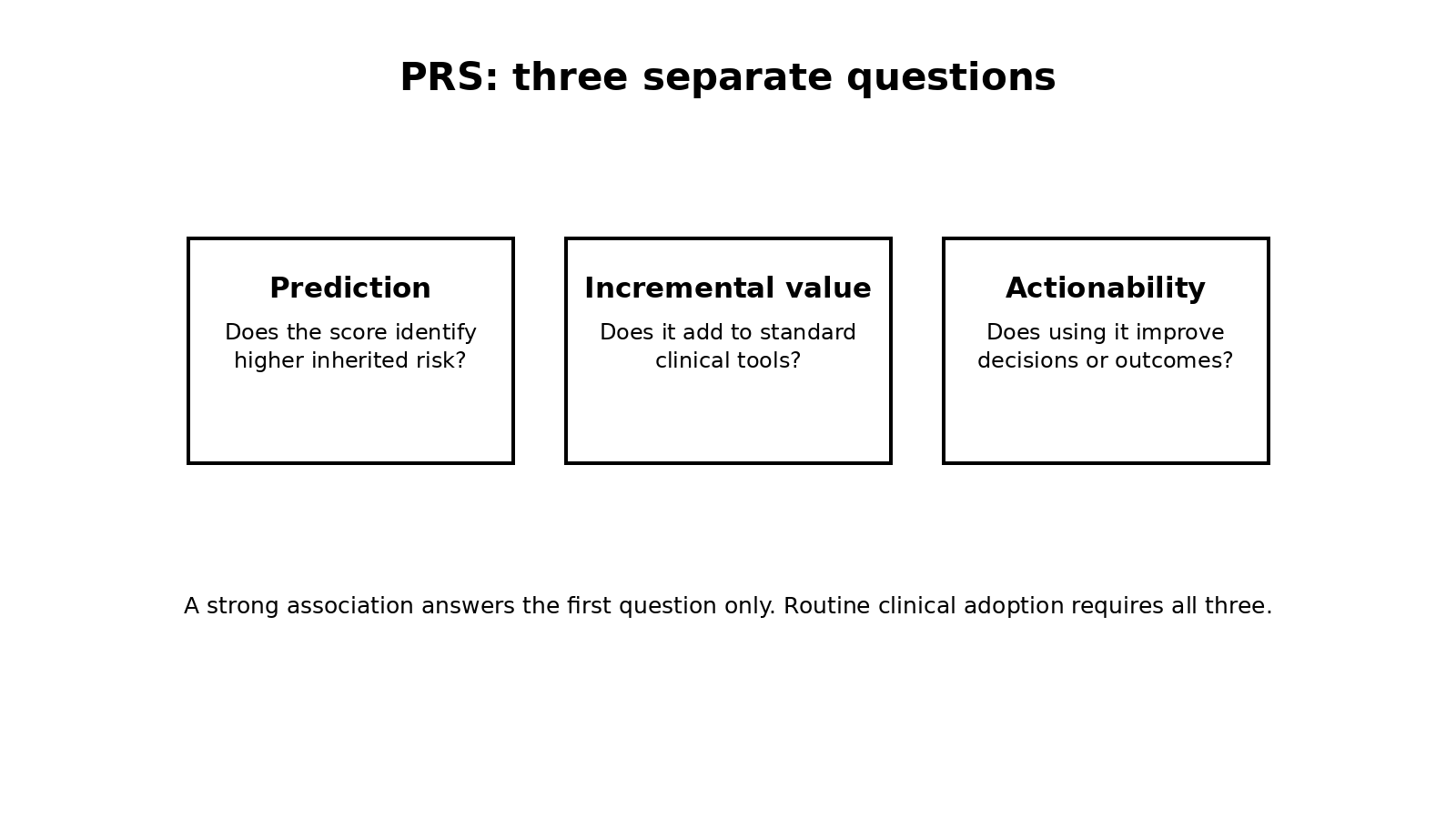
Figure 1. A PRS can sharpen inherited-risk estimation, but it must still pass the separate test of clinical actionability before becoming routine prevention.
1. What a PRS actually measures
Most cardiovascular disease is not caused by one decisive DNA variant. Thousands of common variants can each shift risk slightly, and a PRS aggregates those effects into a percentile or relative-risk estimate.
The score is probabilistic, not diagnostic. A person with a high CAD PRS is not destined to develop coronary disease, and a low PRS does not neutralize smoking, severe LDL elevation, diabetes or hypertension.
2. Prediction versus clinical utility
A new model can improve discrimination or reclassify some people without changing what clinicians should actually do. That distinction is central to the 2026 AHA framework for evaluating novel risk tools.
Useful implementation requires calibration, incremental value over established models, evidence that decisions change appropriately, acceptable cost, and equitable performance across relevant populations.
3. What changed in 2026
The JACC integrated-PRS report combined multiple published scores and externally validated eight cardiovascular traits. In the validation cohort, high genetic risk was strongly associated with CAD, severe hypercholesterolemia, atrial fibrillation, diabetes and other traits.
The report can be ordered clinically and is designed to integrate with electronic records. This moves PRS from an abstract research concept toward real-world deployment, but prospective outcome evidence remains the weak link.
4. Ancestry, calibration and portability
Genetic prediction can degrade when a score is applied to populations that differ from the cohorts used to develop it. Modern methods are improving multi-ancestry performance, but this is not a solved problem.
A percentile is only meaningful relative to the reference population and version of the score. Good reports should disclose ancestry considerations, calibration cohort, methodology and update policy.
5. Where PRS may be most useful today
The strongest use case may be an otherwise healthy younger person with uncertainty about inherited lifetime risk, especially when family history is incomplete or conventional short-term risk is low because of age.
Even there, the result should lead to evidence-based actions, not genetic anxiety. If LDL-C is 210 mg/dL, treatment does not need a PRS. If Lp(a) is very high, that result already provides direct inherited-risk information. If a 55-year-old remains borderline after standard assessment, CAC may answer the treatment question more directly.
| Question | Best current answer |
|---|---|
| Is PRS scientifically valid? | Yes, many scores predict CAD and other cardiovascular traits |
| Is it the same as FH genetic testing? | No, PRS aggregates many common variants; FH testing looks for high-impact pathogenic variants |
| Can a high PRS raise risk several-fold? | Yes, depending on score, trait and reference population |
| Do guidelines recommend it for everyone? | No, routine universal use is not established |
| Does it replace PREVENT or CAC? | No, it is complementary and often less directly actionable |
| Biggest remaining gap | Prospective evidence that PRS-guided care improves clinical outcomes |
Before buying a PRS, ask what decision the result would change. If the answer is “none,” the test is information rather than clinical leverage. Make sure standard inherited-risk data are already captured: family history, untreated LDL-C, ApoB when relevant and one-time Lp(a).
6. FAQ
Can a PRS diagnose familial hypercholesterolemia?
No. It may help explain polygenic severe hypercholesterolemia, but it does not replace clinical FH assessment or monogenic testing when FH is suspected.
If my PRS is low, can I ignore high LDL?
No. A low polygenic score does not cancel a major causal exposure such as severe LDL-C elevation.
Is a high PRS more useful than family history?
Sometimes it can add information, especially when family history is unavailable or uninformative, but family history also captures shared environment and rare inherited factors not represented by the PRS.
Should children get cardiovascular PRS testing?
Routine population testing in children is not established. Pediatric lipid screening and targeted evaluation for familial hypercholesterolemia have much clearer clinical pathways.
References
1. Schunkert H, Di Angelantonio E, Inouye M, et al. Clinical Utility and Implementation of Polygenic Risk Scores for Predicting Cardiovascular Disease. Eur Heart J. 2025.
2. Misra A, Jowell A, Haidermota S, et al. Development and Validation of a Clinical Polygenic Risk Report in U.S.-Based Health Systems for 8 Cardiovascular Conditions. J Am Coll Cardiol. 2026. doi:10.1016/j.jacc.2026.03.035.
3. Khan SS, Greenland P, Hayman LL, et al. Criteria to Assess the Predictive and Clinical Utility of Novel Models, Biomarkers, and Tools for Risk of Cardiovascular Disease. Circulation. 2026;153:e953-e970.
4. Klarin D, Natarajan P. Clinical Utility of Polygenic Risk Scores for Coronary Artery Disease. Nat Rev Cardiol. 2022;19:291-301.