Executive Summary
Each atherogenic particle—LDL, IDL, VLDL remnants and Lp(a)—contains one ApoB molecule. ApoB therefore approximates the number of circulating atherogenic particles rather than the cholesterol mass inside them.
Discordance matters. A patient with triglyceride-rich, cholesterol-depleted particles can have a reassuring LDL-C but an unexpectedly high ApoB. This is common in diabetes, obesity, CKM syndrome and hypertriglyceridemia.
The 2026 ACC/AHA guideline recommends ApoB measurement as reasonable in treated adults, especially those with ASCVD, CKM syndrome, type 2 diabetes or high triglycerides, when LDL-C and/or non-HDL-C goals have already been reached.
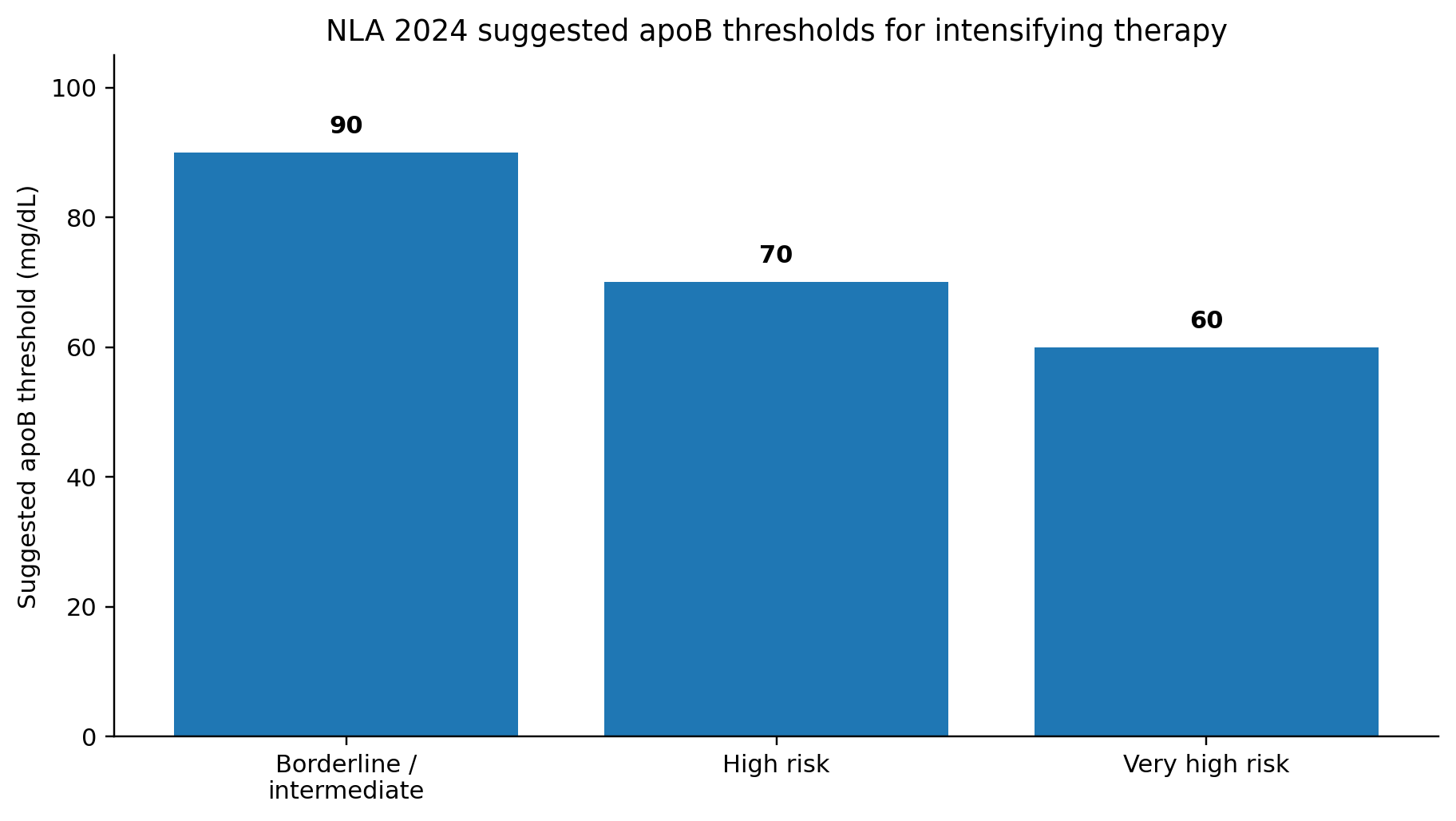
The National Lipid Association 2024 consensus suggested ApoB thresholds for intensification of approximately <90 mg/dL in borderline-to-intermediate risk, <70 mg/dL in high risk and <60 mg/dL in very-high-risk patients.
These values should be viewed alongside—not instead of—the formal LDL-C and non-HDL-C goals in the 2026 ACC/AHA guideline. For example, very-high-risk secondary prevention has an LDL-C goal <55 mg/dL and non-HDL-C <85 mg/dL.
Subclinical atherosclerosis changes the context. The 2026 guideline treats any CAC as evidence supporting LDL lowering; CAC ≥300 may justify LDL-C goals similar to established ASCVD. The guideline text also references ApoB <100 mg/dL alongside LDL-C <100 mg/dL for mild CAC.
1. Why ApoB can be more informative than LDL-C
LDL-C measures cholesterol mass; ApoB measures particle count. When particles carry less cholesterol each, LDL-C can underestimate how many particles are contacting the arterial wall.
This is why ApoB becomes especially useful in high triglycerides, diabetes and insulin resistance.
2. The NLA 2024 thresholds
The NLA expert consensus proposed 90, 70 and 60 mg/dL as pragmatic ApoB thresholds corresponding to borderline/intermediate, high and very-high-risk treatment intensification.
The authors explicitly noted that ApoB thresholds are less firmly established than LDL-C and non-HDL-C thresholds. They are evidence-informed clinical tools, not immutable biological cut points.
3. What the 2026 ACC/AHA guideline changed
The new guideline restored explicit LDL-C and non-HDL-C goals, lowered secondary-prevention targets, recommended universal once-in-a-lifetime Lp(a) testing and incorporated ApoB more directly into residual-risk assessment.
It does not simply replace LDL-C with ApoB. Instead, ApoB is used to resolve uncertainty and identify undertreated particle burden after conventional lipid goals appear achieved.
4. ApoB and CAC
CAC represents accumulated calcified plaque; ApoB represents current circulating particle burden. A patient with CAC 300 and ApoB 85 mg/dL is not “safe” because ApoB is below 90. The imaging evidence indicates much higher absolute risk, so treatment intensity should reflect that.
Conversely, a young person with ApoB 120 mg/dL and CAC 0 still has substantial lifetime exposure risk despite a favorable near-term imaging marker.
5. ApoB and Lp(a)
Lp(a) particles also carry ApoB, so total ApoB includes Lp(a)-particle number. In people with very high Lp(a), some measured ApoB is therefore “locked” into the inherited Lp(a) burden.
This does not make ApoB useless; it reinforces why ApoB and Lp(a) should be interpreted together rather than substituted for one another.
| Clinical context | Practical ApoB interpretation |
|---|---|
| Low-risk healthy adult | ApoB can add information but routine treatment is usually driven by global risk and LDL-C/non-HDL-C. |
| Borderline/intermediate risk | NLA suggested threshold ~90 mg/dL for intensification when clinically appropriate. |
| High-risk primary prevention | NLA suggested threshold ~70 mg/dL. ACC/AHA LDL-C goal is generally <70 mg/dL in high-risk primary prevention. |
| Very-high-risk ASCVD | NLA suggested threshold ~60 mg/dL; ACC/AHA LDL-C goal <55 mg/dL and non-HDL-C <85 mg/dL. |
| CAC ≥300 | 2026 guideline notes risk can approximate established ASCVD; lower LDL/ApoB burden is reasonable. |
| High TG / diabetes / CKM | ApoB is especially valuable because LDL-C discordance is more common. |
6. FAQ
Is ApoB \<60 mg/dL "optimal" for everyone?
No. That threshold is aimed at very-high-risk patients. Lower particle burden is generally favorable, but treatment intensity must match absolute risk, benefit, safety and patient preference.
Can ApoB be too low?
Large LDL-lowering trials have not identified a clear cardiovascular safety floor within the very low ranges achieved, but therapy should still be evidence-based rather than driven by a desire for the lowest possible laboratory number.
Should ApoB replace LDL-C?
Not universally. In 2026 ACC/AHA practice, LDL-C and non-HDL-C remain formal treatment goals; ApoB is an important additional tool when discordance or residual risk is likely.
How often should ApoB be checked?
When it is being used to guide therapy, rechecking after a treatment change on the same schedule as a lipid panel is reasonable.
References
1. Soffer DE, Marston NA, Maki KC, et al. Role of apolipoprotein B in the clinical management of cardiovascular risk in adults: An Expert Clinical Consensus from the National Lipid Association. J Clin Lipidol. 2024;18(5):e647-e663. doi:10.1016/j.jacl.2024.08.013.
2. Blumenthal RS, Morris PB, Gaudino M, et al. 2026 ACC/AHA/AACVPR/ABC/ACPM/ADA/AGS/APhA/ASPC/NLA/PCNA Guideline on the Management of Dyslipidemia. J Am Coll Cardiol. 2026;87(19):2624-2757. doi:10.1016/j.jacc.2025.11.016.
3. Wiggins BS, Barac A, Benziger CP, et al. 2026 Dyslipidemia Guideline-at-a-Glance. J Am Coll Cardiol. 2026;87(19):2617-2623. doi:10.1016/j.jacc.2026.02.4872.
4. Sniderman AD, Thanassoulis G, Glavinovic T, et al. Apolipoprotein B Particles and Cardiovascular Disease: A Narrative Review. JAMA Cardiol. 2019;4(12):1287-1295. doi:10.1001/jamacardio.2019.3780.
5. Ference BA, Ginsberg HN, Graham I, et al. Low-density lipoproteins cause atherosclerotic cardiovascular disease: evidence from genetic, epidemiologic, and clinical studies. Eur Heart J. 2017;38(32):2459-2472. doi:10.1093/eurheartj/ehx144.
6. Mach F, Koskinas KC, Roeters van Lennep JE, et al. 2025 Focused Update of the 2019 ESC/EAS Guidelines for the management of dyslipidaemias. Eur Heart J. 2025;46(42):4359-4378. doi:10.1093/eurheartj/ehaf190. Correction: Eur Heart J. 2026;47(6):697. doi:10.1093/eurheartj/ehaf1036.
7. Kronenberg F, Mora S, Stroes ESG, et al. Lipoprotein(a) in atherosclerotic cardiovascular disease and aortic stenosis: a European Atherosclerosis Society consensus statement. Eur Heart J. 2022;43(39):3925-3946. doi:10.1093/eurheartj/ehac361.