Executive Summary
LDL-C measures the amount of cholesterol carried inside LDL particles. ApoB approximates the number of major atherogenic particles because each LDL, IDL, VLDL remnant and Lp(a) particle carries one ApoB molecule.
When particles are cholesterol-depleted, many particles can circulate without a dramatically high LDL-C. ApoB therefore becomes “discordantly high.”
This phenotype is common in hypertriglyceridemia and insulin resistance, where VLDL/remnant traffic rises and LDL particles become smaller and cholesterol-poorer.
The 2026 ACC/AHA guideline states that ApoB can be useful after LDL-C/non-HDL-C goals are reached, particularly in CKM syndrome, type 2 diabetes, high triglycerides or established CVD, and notes that ApoB and non-HDL-C can be more accurate than LDL-C when discordance is present in hypertriglyceridemia.
Large observational datasets support the concept: in statin-treated patients, high ApoB with lower LDL-C was associated with higher MI risk; a 2024 Copenhagen analysis found “excess ApoB” above what LDL-C predicted was associated with MI and ASCVD across the LDL-C spectrum.
The practical response is not to ignore LDL-C, but to recognize that the treatment target is the burden of ApoB-containing particles. ApoB should be interpreted alongside non-HDL-C, triglycerides, diabetes/insulin resistance and absolute risk.
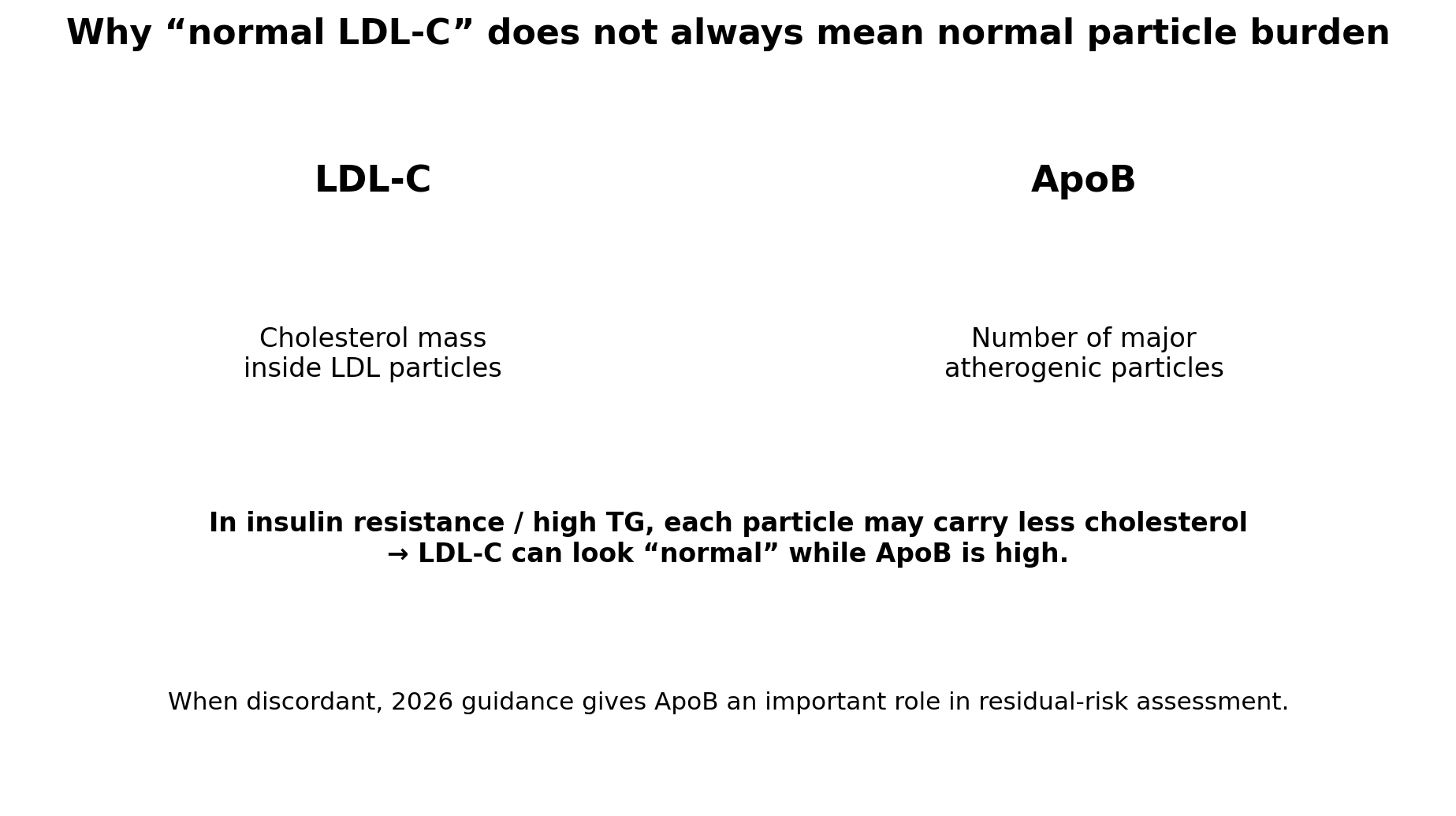
Figure 1. LDL-C is cholesterol mass; ApoB is a particle-number marker. Discordance occurs when the cholesterol carried per particle changes.
1. What "normal LDL-C" actually means
“Normal” is context dependent. An LDL-C of 95 mg/dL may be acceptable for one low-risk person but well above goal for someone with coronary disease, high CAC or very high risk.
The more important question is whether LDL-C and ApoB are concordant for that individual’s metabolic phenotype.
2. Why ApoB rises disproportionately
In insulin resistance, the liver exports more triglyceride-rich VLDL particles. Lipid exchange and remodeling create cholesterol-depleted LDL and remnant particles. The total number of ApoB particles can rise even when LDL-C does not.
High triglycerides, metabolic syndrome, diabetes, obesity and some genetic phenotypes are classic settings for this pattern.
3. Does high ApoB mean LDL-C is "wrong"?
No. Both tests are correct—they are measuring different things. LDL-C measures cargo; ApoB measures particle count.
When the two disagree, cohort data and causal biology generally support giving substantial weight to ApoB because atherosclerosis is driven by the number of ApoB-containing particles entering the arterial wall over time. This page is the deep dive for the high-ApoB/normal-LDL-C phenotype; for both directions of discordance and the broader adjudication framework, see “Discordant LDL-C and ApoB.”
4. How should treatment be adjusted?
First make sure LDL-C/non-HDL-C are at the risk-based goal. If ApoB remains high, confirm the metabolic context and consider whether more intensive LDL-lowering therapy is warranted.
Lifestyle that improves insulin resistance—weight loss where appropriate, physical activity, dietary quality and diabetes control—can improve triglycerides and particle composition, but medication may still be needed for high absolute risk.
| Pattern | Likely interpretation | Common context |
|---|---|---|
| LDL-C normal, ApoB high | Too many cholesterol-poor atherogenic particles | High TG, diabetes, insulin resistance |
| LDL-C high, ApoB high | Concordant high particle burden | Primary hypercholesterolemia, FH, mixed dyslipidemia |
| LDL-C high, ApoB lower | Fewer but cholesterol-rich particles | Some lean/low-TG phenotypes |
| LDL-C low, ApoB low | Concordant lower atherogenic burden | Often favorable if total risk also low |
If LDL-C and ApoB disagree, add triglycerides and non-HDL-C to the same page, note whether you have diabetes/insulin resistance, and compare ApoB with a risk-based target rather than with the laboratory “normal” flag alone.
5. FAQ
Is ApoB always better than LDL-C?
LDL-C remains a primary treatment target and is excellent in most people. ApoB adds most value when discordance or residual risk is likely.
Can ApoB be high with triglycerides that are normal?
Yes. Triglycerides make discordance more likely, but they are not required.
Should I order LDL particle number too?
Usually ApoB provides the actionable particle count at lower cost and with better standardization. LDL-P can be useful in selected lipid-clinic cases.
Can lifestyle lower ApoB?
Yes to varying degrees, especially when insulin resistance and excess adiposity are drivers, but large reductions often require lipid-lowering therapy.
References
1. Blumenthal RS, Morris PB, Gaudino M, et al. 2026 ACC/AHA Multisociety Guideline on the Management of Dyslipidemia. Circulation. 2026.
2. Johannesen CDL, Mortensen MB, Langsted A, Nordestgaard BG. Apolipoprotein B and Non-HDL Cholesterol Better Reflect Residual Risk Than LDL Cholesterol in Statin-Treated Patients. J Am Coll Cardiol. 2021;77:1439-1450.
3. Benn M, Nordestgaard BG, et al. Excess Apolipoprotein B and Cardiovascular Risk in Women and Men. J Am Coll Cardiol. 2024.
4. Du Y. Impact of LDL-C and ApoB Discordance on Cardiovascular Outcomes in a Large Primary Prevention Population. J Am Coll Cardiol. 2026;87(13 Suppl):A185-A186.