Executive Summary
LDL-C measures cholesterol mass. ApoB estimates particle number. Because cholesterol content per particle varies, the two markers can be discordant.
The most clinically important pattern is high ApoB relative to LDL-C, often seen with high triglycerides, insulin resistance, type 2 diabetes and obesity. In this setting, LDL-C can underestimate risk.
In statin-treated Danish data, discordantly high ApoB with lower LDL-C was associated with higher all-cause mortality and MI risk, whereas discordantly high LDL-C with lower ApoB was not associated with the same excess risk.
A 2024 Copenhagen General Population Study analysis introduced “excess ApoB” and found a dose-dependent association with MI and ASCVD across the LDL-C spectrum.
A large 2026 UK Biobank analysis reported higher MACE risk with discordantly high ApoB and lower risk with discordantly low ApoB, with VLDL-related particles explaining a meaningful part of the high-ApoB phenotype.
The 2026 guideline still uses LDL-C and non-HDL-C as formal treatment goals, but supports ApoB when residual risk or discordance is suspected, especially with hypertriglyceridemia and CKM conditions.
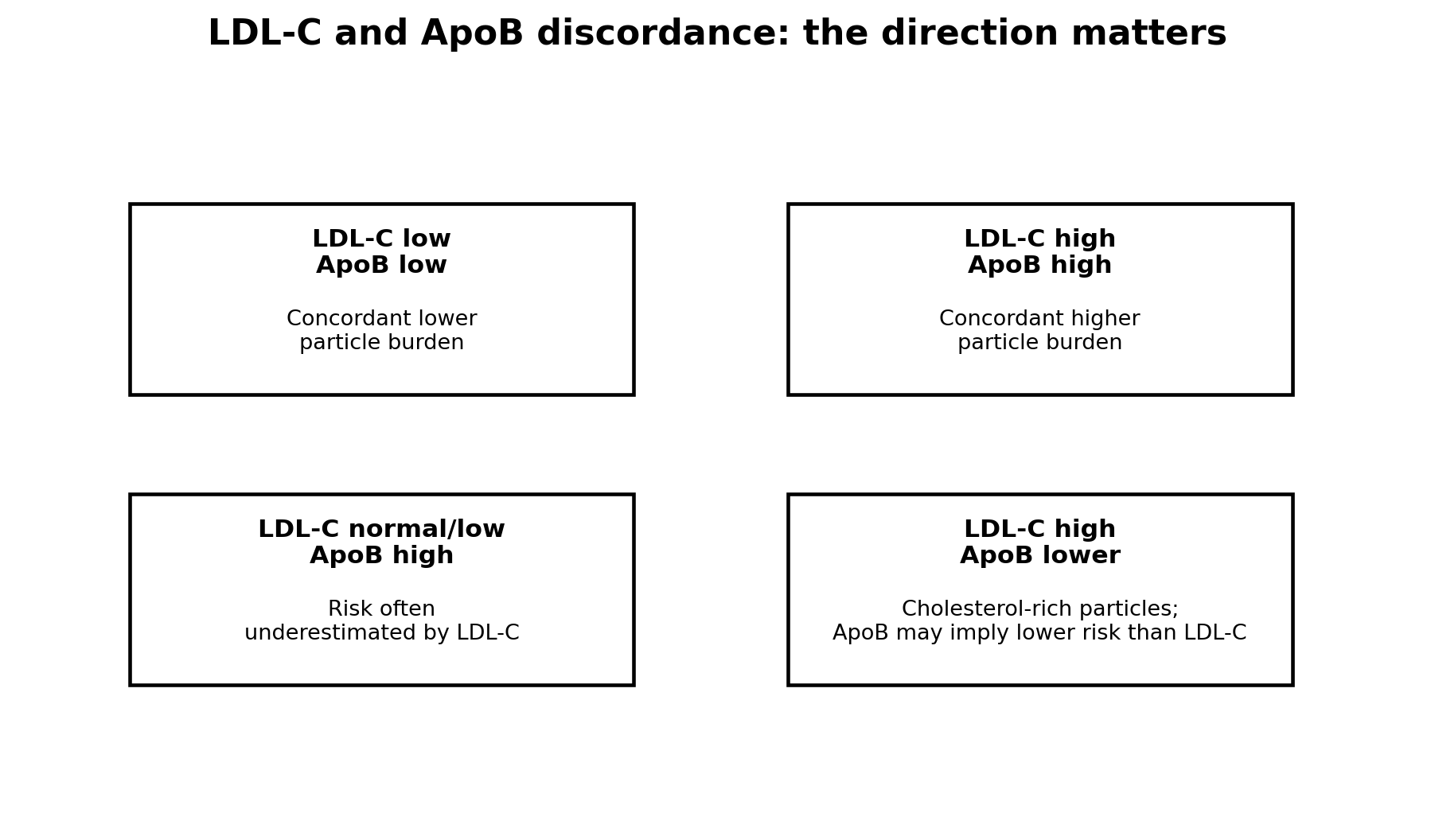
Figure 1. Four common LDL-C/ApoB patterns. Discordantly high ApoB is usually the more concerning direction.
1. Why discordance happens
LDL particles are not identical. Some carry more cholesterol, others less. Triglyceride-rich lipoprotein metabolism also changes the mix of VLDL remnants and LDL particles.
Anything that changes particle cholesterol content can move LDL-C and ApoB apart.
2. High ApoB, lower LDL-C
High ApoB with lower or apparently normal LDL-C is the more clinically concerning direction of discordance. It is common in insulin resistance, hypertriglyceridemia, type 2 diabetes and obesity, where a larger number of cholesterol-depleted ApoB-containing particles can circulate than LDL-C alone suggests.
This article only summarizes that phenotype because it has its own owner page. For the metabolic drivers, interpretation and treatment implications of this specific pattern, see “High ApoB With Normal LDL-C.”
3. Higher LDL-C, lower ApoB
This pattern can occur when LDL particles are relatively cholesterol-rich. Particle burden may be lower than LDL-C implies.
This does not make high LDL-C irrelevant—formal LDL-C goals still apply—but ApoB can refine how aggressively residual risk is interpreted.
4. How to adjudicate a discordant panel
Confirm the values were obtained in a stable clinical state, inspect triglycerides and non-HDL-C, and look for diabetes, visceral adiposity, hypothyroidism, kidney disease or major diet changes.
For treatment, combine formal LDL/non-HDL goals with ApoB as a particle-burden check. Avoid inventing a single conversion formula between LDL-C and ApoB; percentiles and metabolic context matter.
5. Do not overinterpret small numerical differences
ApoB 82 vs LDL-C 78 is not necessarily clinically meaningful discordance. Large percentile separation or persistent mismatch is more important than a few mg/dL.
The laboratory reference range is not the same as a prevention target.
| Pattern | What LDL-C suggests | What ApoB adds | Typical implication |
|---|---|---|---|
| Both low | Low cholesterol mass | Low particle number | Concordant favorable pattern |
| Both high | High cholesterol mass | High particle number | Concordant high risk |
| LDL-C lower / ApoB higher | Appears better than it is | Reveals excess particles | Underestimated residual risk |
| LDL-C higher / ApoB lower | Appears worse by LDL alone | Shows fewer particles | Potentially lower particle burden, but LDL goal still matters |
Put LDL-C, non-HDL-C, triglycerides and ApoB from the same blood draw side by side. If ApoB looks unexpectedly high, ask whether insulin resistance, diabetes, obesity or high triglycerides explain the mismatch—and whether your LDL-lowering plan should be intensified.
6. FAQ
Which number is causal---LDL-C or ApoB?
The causal exposure is ApoB-containing particles and the cholesterol they deliver to the arterial wall. LDL-C is an excellent proxy in most people; ApoB becomes especially useful when the proxy breaks down.
Should I ignore LDL-C if ApoB is low?
No. LDL-C remains a formal guideline treatment target. ApoB refines, rather than replaces, the complete clinical picture.
Does fasting matter?
Usually not for LDL-C/ApoB, but fasting can help when triglycerides are markedly elevated or inherited dyslipidemia is being assessed.
Is non-HDL-C useful in discordance?
Yes. It captures cholesterol in all ApoB-containing particles and is a valuable bridge between LDL-C and ApoB.
References
1. Blumenthal RS, Morris PB, Gaudino M, et al. 2026 ACC/AHA Multisociety Guideline on the Management of Dyslipidemia. Circulation. 2026.
2. Johannesen CDL, Mortensen MB, Langsted A, Nordestgaard BG. Apolipoprotein B and Non-HDL Cholesterol Better Reflect Residual Risk Than LDL Cholesterol in Statin-Treated Patients. J Am Coll Cardiol. 2021;77:1439-1450.
3. Benn M, et al. Excess Apolipoprotein B and Cardiovascular Risk in Women and Men. J Am Coll Cardiol. 2024.
4. Wilkins JT, Li RC, Sniderman A, et al. Discordance Between ApoB and LDL-C in Young Adults Predicts Coronary Artery Calcification: CARDIA. J Am Coll Cardiol. 2016;67:193-201.
5. Du Y. LDL-C/ApoB Discordance and Cardiovascular Outcomes in a Large Primary Prevention Population. J Am Coll Cardiol. 2026;87(13 Suppl):A185-A186.