Executive Summary
The 2021 AHA/ACC Chest Pain Guideline recommends CCTA as a useful test for intermediate-high-risk patients with stable chest pain and no known CAD, while very-low-risk patients often need no testing.
The 2024 ESC chronic coronary syndrome guideline similarly gives CCTA a prominent first-line role, particularly for symptomatic patients with low-to-moderate likelihood of obstructive CAD, because CCTA has high negative predictive value and directly shows nonobstructive plaque.
CCTA answers a different question from CAC. CAC is a noncontrast risk-stratification test for calcified plaque burden; CCTA uses iodinated contrast to show the coronary lumen, stenosis and both calcified and noncalcified plaque.
In asymptomatic primary prevention, CAC is usually the simpler evidence-based decision tool. Selected asymptomatic high-risk patients may be considered for CCTA in specialist practice, but routine screening CCTA is not a universal guideline strategy.
CCTA can be less reliable when coronary calcium is very heavy, heart rate is irregular or fast, kidney function limits contrast, or contrast allergy is significant. Functional imaging may be preferable in some of these settings.
If CCTA shows an intermediate stenosis, functional assessment such as FFR-CT, stress imaging or invasive physiology may be needed before deciding on revascularization.
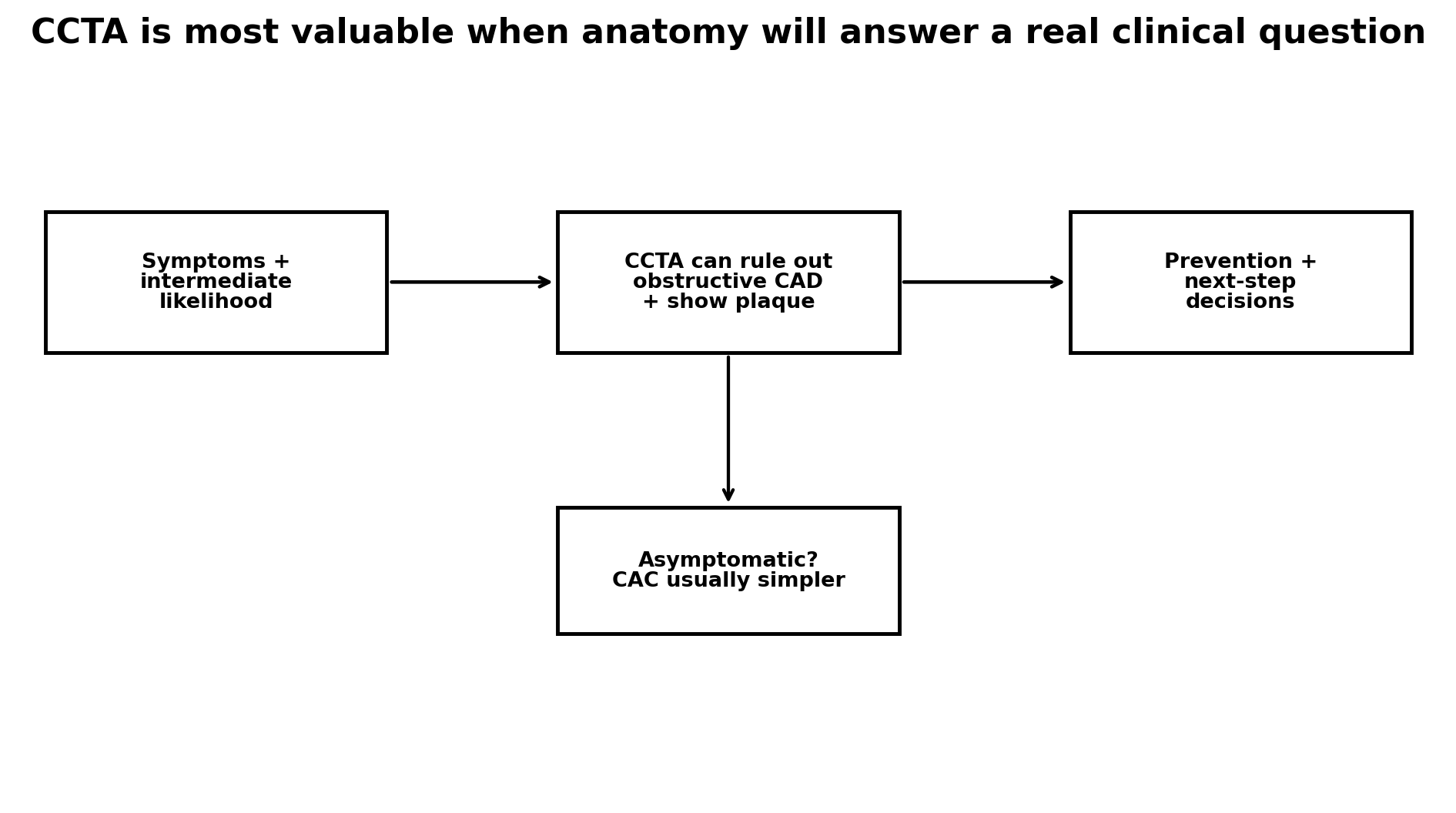
Figure 1. The value of CCTA depends on whether coronary anatomy will change diagnosis, prevention or the next test.
1. Best use case: stable symptoms with no known CAD
For exertional chest pressure, dyspnea or other plausible anginal equivalents in an intermediate-risk patient, CCTA can rule out obstructive disease and simultaneously identify nonobstructive plaque that would intensify prevention.
In younger symptomatic patients, CCTA is often particularly attractive because heavy calcification is less common and image quality is typically good.
2. When CAC is the better test
If you are asymptomatic and the real question is “Should I start or intensify prevention?”, CAC usually provides the key information with no contrast and less radiation.
A high CAC score tells you plaque burden is already important; a CCTA is not automatically needed just to confirm what CAC already established.
3. When CCTA can add value after another test
CCTA can be reasonable after an inconclusive or discordant stress test when suspicion remains. Conversely, functional testing can follow CCTA when a stenosis needs ischemic significance clarified.
The 2021 chest pain guideline explicitly discourages indiscriminate layered testing; choose the test most likely to answer the clinical question.
4. What about asymptomatic high-risk people?
SCCT consensus considers CCTA potentially appropriate in selected asymptomatic high-risk individuals, especially younger people in whom noncalcified plaque may dominate. Examples include strong premature family history, diabetes, smoking, HIV or inflammatory disease.
This is a selective specialist strategy, not a population-screening mandate. The evidence base for improving outcomes in asymptomatic screening is much weaker than for symptomatic diagnosis.
5. Why not repeat CCTA every year?
Serial CCTA exposes the patient to repeated contrast and radiation, and small changes can reflect acquisition/reconstruction variability. There is no guideline-supported annual plaque-monitoring schedule.
Treatment response is better judged by achieved LDL/ApoB, blood pressure, symptoms and clinical outcomes. Repeat imaging should answer a new question.
| Clinical question | Best first approach in many patients | Why |
|---|---|---|
| Asymptomatic, uncertain statin decision | CAC | Simple, noncontrast risk reclassification |
| Stable chest pain, intermediate likelihood, no known CAD | CCTA or appropriate functional imaging | Rules out CAD; shows anatomy/plaque |
| Very low-risk noncardiac symptoms | Often no cardiac imaging | Avoid low-value testing |
| Known obstructive CAD with persistent symptoms | Functional imaging often favored | Need ischemia assessment |
| Heavy CAC / poor CT image conditions | Consider functional imaging | Blooming/artifact can overestimate stenosis |
Write the one question you want the scan to answer. If the question is “Do I have calcified plaque and should prevention intensify?”, CAC may be enough. If the question is “Do these symptoms come from coronary anatomy?“, CCTA becomes much more valuable.
6. FAQ
Does CCTA detect soft plaque?
Yes. Unlike CAC, CCTA can visualize noncalcified and mixed plaque as well as stenosis.
Can a normal CCTA rule out a heart attack forever?
No. It provides a strong snapshot and prognosis, but atherosclerosis can develop later.
Should I get CCTA if CAC is 300 but I have no symptoms?
Not routinely just because CAC is high. High CAC already establishes substantial plaque burden and treatment intensity; anatomy testing should answer a separate clinical question.
Is CCTA better than a stress test?
Neither is universally better. CCTA is excellent for anatomy/rule-out; stress imaging is excellent for ischemia and functional significance. Age, calcium burden, rhythm, kidney function and local expertise matter.
References
1. Gulati M, Levy PD, Mukherjee D, et al. 2021 AHA/ACC Guideline for the Evaluation and Diagnosis of Chest Pain. Circulation. 2021;144:e368-e454.
2. Vrints C, Andreotti F, Koskinas KC, et al. 2024 ESC Guidelines for the Management of Chronic Coronary Syndromes. Eur Heart J. 2024;45:3415-3537.
3. Narula J, Chandrashekhar Y, Ahmadi A, et al. SCCT 2021 Expert Consensus Document on Coronary Computed Tomographic Angiography. J Cardiovasc Comput Tomogr. 2021.
4. Newby DE, Adamson PD, Berry C, et al. Coronary CT Angiography and 5-Year Risk of Myocardial Infarction. N Engl J Med. 2018;379:924-933.
5. Douglas PS, Hoffmann U, Patel MR, et al. Outcomes of Anatomical versus Functional Testing for Coronary Artery Disease. N Engl J Med. 2015;372:1291-1300.