Executive Summary
The 2026 ACC/AHA dyslipidemia guideline recommends LDL-C <55 mg/dL and non-HDL-C <85 mg/dL for very-high-risk secondary prevention. Reaching that level is a major success, not a signal that treatment has “failed” because some risk remains.
Residual risk exists because atherosclerotic events are generated by multiple interacting pathways: cumulative prior plaque burden, Lp(a), residual ApoB-containing particles/remnants, inflammation, thrombosis, blood pressure, smoking, diabetes, kidney disease, obesity and aging.
ApoB can remain informative even after LDL-C/non-HDL-C goals are reached, especially with type 2 diabetes, CKM syndrome or high triglycerides. LDL-C describes cholesterol mass; ApoB estimates particle number.
Lp(a) is a genetically determined independent risk factor and should be measured at least once in adulthood. High Lp(a) supports more intensive control of all modifiable risk factors even when LDL-C is already low.
Persistent hsCRP can identify an inflammatory phenotype, but hsCRP is nonspecific. Colchicine has event-reduction evidence in selected secondary-prevention populations; it is not simply prescribed from a CRP threshold.
Triglyceride-rich remnants matter when metabolic disease persists. In selected statin-treated high-risk patients with TG 150-499 mg/dL, the 2026 guideline says icosapent ethyl may be reasonable.
Blood pressure, smoking, diabetes and CKD often contribute more to the remaining absolute risk than trying to lower LDL-C from “very low” to “even lower” without a clear indication.
Imaging burden matters too: a person with extensive multivessel plaque remains at higher absolute risk than someone with minimal disease at the same current LDL-C because treatment cannot erase decades of prior exposure overnight.
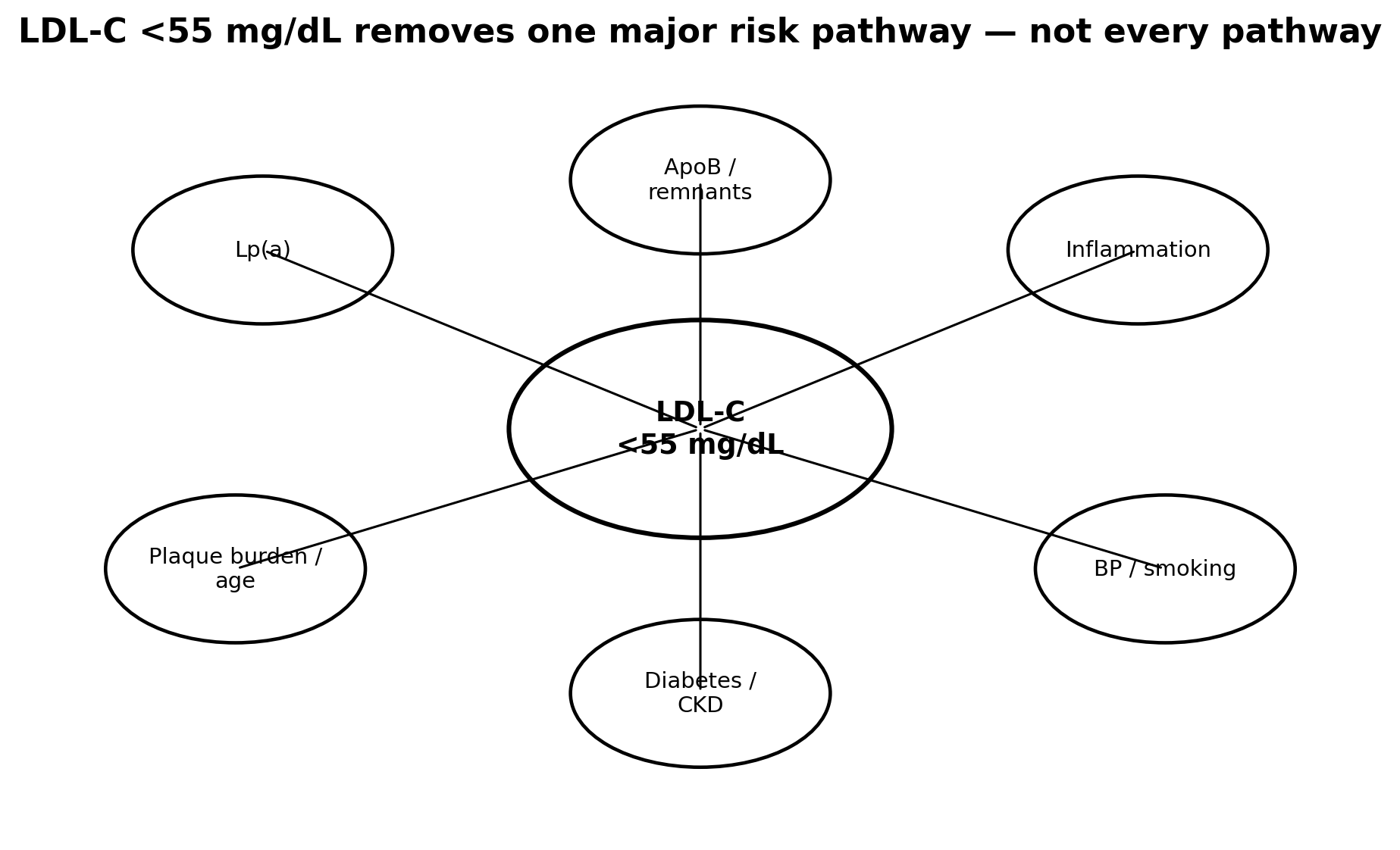
Figure 1. Very-low LDL-C treats one major causal pathway; residual risk can arise from several other biological and clinical domains.
1. First question: is LDL exposure actually controlled?
Verify adherence, achieved LDL-C and non-HDL-C, and consider ApoB when discordance is plausible. An LDL-C of 54 mg/dL with ApoB still unexpectedly high is not the same state as concordantly low LDL-C and ApoB.
In hypertriglyceridemia, cholesterol-depleted particles can make LDL-C underestimate particle burden.
2. Lp(a): genetically fixed residual lipoprotein risk
Lp(a) contributes cholesterol, ApoB, oxidized phospholipid and calcific/inflammatory biology. Because lifestyle has little effect on its concentration, the current response is aggressive management of everything modifiable while dedicated Lp(a) outcome trials mature.
PCSK9-based therapy can lower Lp(a) modestly, but current drugs are chosen mainly for LDL/ApoB and proven overall event benefit.
3. Residual inflammation
Inflammation is not merely a side effect of cholesterol. CANTOS established proof of concept for selective anti-inflammatory prevention, and COLCOT/LoDoCo2 made colchicine clinically practical in coronary disease.
The key is to distinguish stable vascular inflammation from transient hsCRP elevation due to infection or another inflammatory condition.
4. Cardiometabolic and renal risk
Diabetes, visceral adiposity, hypertension and CKD create independent myocardial, vascular and heart-failure risk even at low LDL-C.
Modern prevention therefore includes SGLT2 inhibitors, GLP-1 receptor agonists, RAAS/BP therapy and albuminuria-directed care when indicated—not just more lipid medicine.
5. Plaque burden and time
Achieved LDL-C describes today’s environment; CAC/CCTA reflects, in part, cumulative exposure and existing disease burden.
Someone with prior MI, diffuse CCTA plaque or high CAC remains high risk because plaque burden and prior events are powerful predictors. The benefit of low LDL is preventing future progression and stabilizing disease, not resetting the arteries to age 20.
| Residual-risk domain | Useful question | Possible measurement / action |
|---|---|---|
| ApoB particles | Is particle number still high despite low LDL-C? | ApoB, non-HDL-C; optimize LDL-lowering regimen |
| Lp(a) | Is inherited risk substantial? | Measure at least once; intensify modifiable risk control |
| Remnants / TG | Is metabolic lipoprotein traffic still high? | TG, ApoB, non-HDL-C; lifestyle, diabetes therapy, selected IPE |
| Inflammation | Is stable inflammatory risk present? | Repeat hsCRP when well; consider evidence-based anti-inflammatory strategy in appropriate CAD |
| Blood pressure / smoking | Are major nonlipid drivers controlled? | Home BP; complete tobacco/nicotine cessation |
| Diabetes / CKD | Is CKM risk untreated? | A1c, eGFR, UACR; cardiorenal therapies when indicated |
| Plaque burden | How much disease already exists? | Use prior CAC/CCTA/clinical ASCVD context; do not image serially without a reason |
6. FAQ
If LDL is 45, can I still have a heart attack?
Yes. Risk is much lower than it would be with high LDL, but it is not zero because plaque and non-LDL pathways remain.
Should LDL always go below 30?
Not automatically. Intensification depends on absolute risk, therapy, tolerability and guideline indication; \<55 mg/dL is the 2026 very-high-risk goal.
What is the next lab after LDL is controlled?
Often ApoB, Lp(a) if never measured, triglycerides/non-HDL-C, hsCRP in selected contexts, and CKM labs such as UACR/eGFR.
Should I repeat CAC to see if treatment worked?
Usually no. CAC commonly increases or densifies during successful statin therapy and is not a routine treatment-response score.
References
1. Blumenthal RS, Morris PB, Gaudino M, et al. 2026 ACC/AHA Multisociety Guideline on the Management of Dyslipidemia.
2. 2026 AHA/ACC/ADA/ASN Guideline for the Prevention, Detection, Evaluation, and Management of Cardiovascular-Kidney-Metabolic Syndrome.
3. Tardif JC, et al. COLCOT. N Engl J Med. 2019.
4. Nidorf SM, et al. LoDoCo2. N Engl J Med. 2020.
5. Bhatt DL, et al. REDUCE-IT. N Engl J Med. 2019.
6. Contemporary evidence on ApoB discordance, Lp(a), CAC/CCTA plaque burden and residual cardiovascular risk.