Executive Summary
VO2max is the maximum rate at which the body can take up, transport and use oxygen during intense exercise. It reflects the integrated performance of the lungs, heart, blood vessels, blood and skeletal muscle.
The AHA scientific statement on cardiorespiratory fitness notes that CRF is an independent predictor of cardiovascular and all-cause mortality and can outperform many traditional single risk factors.
In a 2022 JACC study of 750,302 U.S. veterans, mortality risk fell in a graded fashion across increasing fitness levels and there was no signal of harm at extremely high cardiorespiratory fitness. The least-fit group had roughly four-fold the mortality risk of the extremely fit group.
Meta-analytic data suggest that each 1-MET higher fitness level is associated with roughly 10-15% lower mortality or cardiovascular-event risk. This is observational and should not be interpreted as an exact causal discount per MET for an individual.
Direct cardiopulmonary exercise testing (CPET) is the reference method for VO2peak/VO2max. Treadmill METs, submaximal tests and wearables provide estimates with varying accuracy.
Training can improve VO2max, but genetics, age, medications and prior training status strongly affect the magnitude of change. The goal is better functional capacity and lower risk, not winning a smartwatch leaderboard.
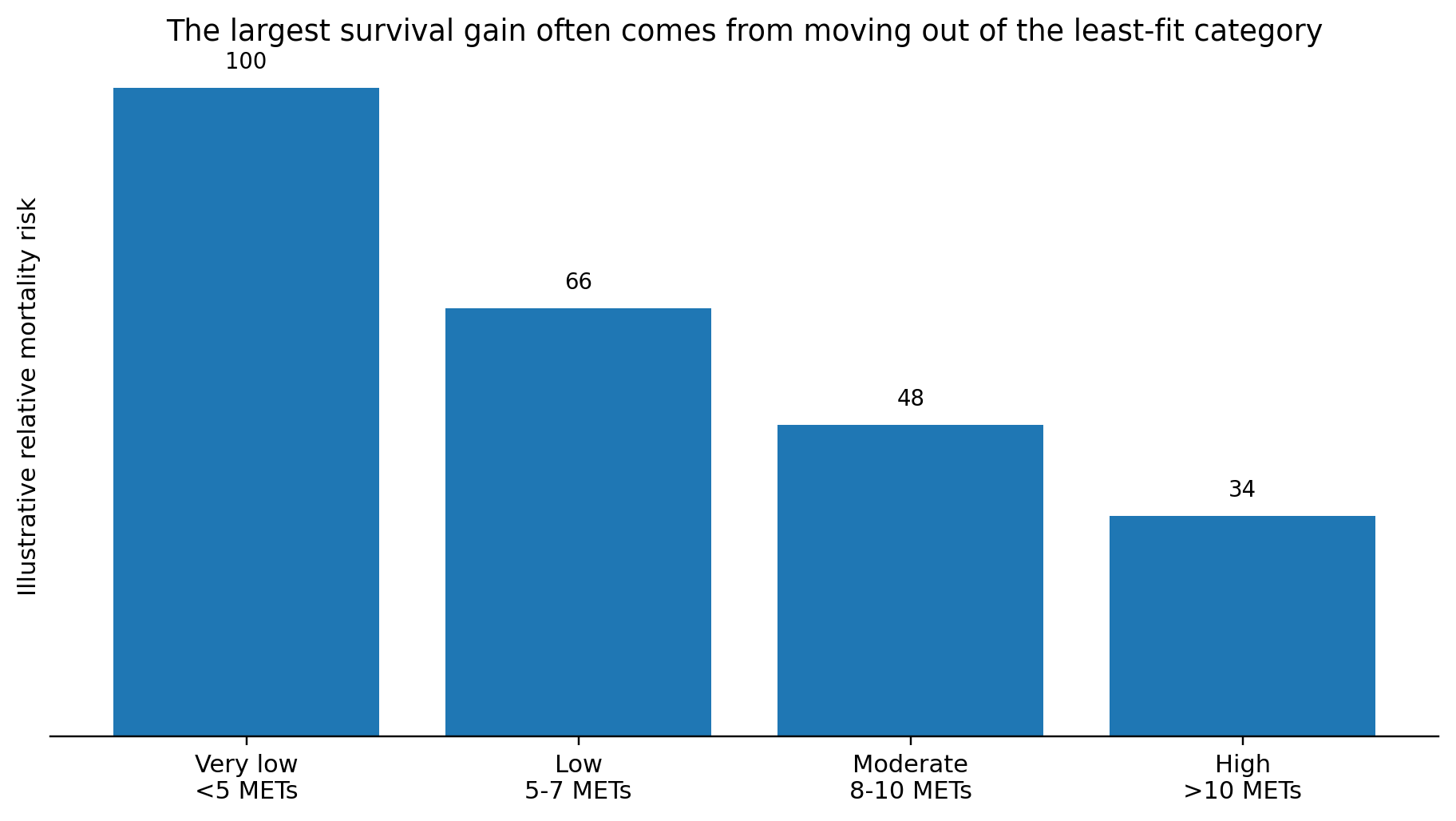
Figure 1. The absolute values are illustrative, but the evidence consistently shows a steep risk gradient between very low and moderate fitness.
1. VO2max vs METs
One MET is approximately 3.5 mL of oxygen per kilogram per minute. Exercise capacity on a treadmill can therefore be expressed in METs even when respiratory gas analysis is not performed.
Direct VO2 measurement is more precise; estimated METs are more accessible and still strongly prognostic.
2. Why fitness predicts so much
CRF integrates cardiac output, pulmonary function, hemoglobin oxygen transport, vascular function, mitochondrial capacity and skeletal-muscle health.
It also indirectly reflects physical activity, frailty and chronic disease burden.
3. How much is enough?
AHA guidance notes that <5 METs in adults is associated with high risk, while levels above roughly 8-10 METs are associated with better survival. Age and sex must be considered.
The largest relative gain often occurs when someone moves from very low to merely moderate fitness.
4. How to improve VO2max
Both moderate continuous training and higher-intensity intervals can improve cardiorespiratory fitness. A common practical model is frequent moderate aerobic work plus one or two appropriately scaled higher-intensity sessions per week.
People with known coronary disease, symptoms or marked deconditioning may need supervised cardiac rehabilitation or clinical assessment before vigorous intervals.
5. Wearable VO2max estimates
Watches estimate fitness from heart rate, pace/power and personal data rather than directly measuring gas exchange. They are best used for within-person trends under similar conditions.
A sudden unexplained fall can be worth investigating, but small day-to-day changes may reflect temperature, fatigue, device algorithms or medication.
6. FAQ
What is a good VO2max?
It depends on age and sex. Percentile relative to peers is more useful than one universal cutoff.
Can VO2max be too high?
Large contemporary cohorts have not shown increased mortality at very high fitness, although extreme endurance exercise has other nuanced considerations.
How quickly can it improve?
Meaningful changes can occur over weeks to months; the response varies widely by baseline fitness and training.
Is VO2max more important than LDL-C?
They measure different risk dimensions. High fitness does not neutralize severe ApoB or Lp(a) exposure.
References
1. Ross R, Blair SN, Arena R, et al. Importance of Assessing Cardiorespiratory Fitness in Clinical Practice: A Case for Fitness as a Clinical Vital Sign. Circulation. 2016;134:e653-e699.
2. Kokkinos P, Faselis C, Samuel IBH, et al. Cardiorespiratory Fitness and Mortality Risk Across the Spectra of Age, Race, and Sex. J Am Coll Cardiol. 2022;80:598-609.
3. Fit Is It for Longevity Across Populations. J Am Coll Cardiol editorial. 2022.
4. American Heart Association physical activity guidance and Life's Essential 8.