Executive Summary
The SPORT randomized trial directly compared rosuvastatin 5 mg with placebo and six widely marketed supplements—fish oil, cinnamon, garlic, turmeric, plant sterols and red yeast rice. Rosuvastatin lowered LDL-C by about 38%; none of the supplements significantly lowered LDL-C versus placebo over 28 days.
Generic omega-3 supplementation should not be conflated with prescription icosapent ethyl. STRENGTH found no event reduction with high-dose EPA+DHA, whereas REDUCE-IT found a 25% relative reduction with prescription EPA-only icosapent ethyl in selected high-risk statin-treated patients.
Psyllium has reproducible modest LDL-C lowering. A recent meta-analysis found about an 8-9 mg/dL average LDL-C reduction. That is useful as an adjunct but is not a plaque-regression therapy.
Plant sterols/stanols can reduce intestinal cholesterol absorption and modestly lower LDL-C when used consistently, though hard cardiovascular-outcome trials are lacking.
Berberine and garlic show modest improvements in some meta-analyses, but study quality and heterogeneity are substantial and cardiovascular outcomes evidence is inadequate. Red yeast rice can contain monacolin K, chemically identical to lovastatin, which creates statin-like efficacy and risks plus supplement-quality uncertainty.
Vitamin K2 became more interesting after the 2026 VitaK-CAC randomized trial showed slower CAC progression with MK-7, but no heart-attack, stroke or mortality benefit has been demonstrated.
Nattokinase, serrapeptase, pycnogenol and many 'arterial cleansing' products do not have high-quality randomized cardiovascular outcome evidence. Positive small or uncontrolled studies should not be presented as proof of plaque reversal.
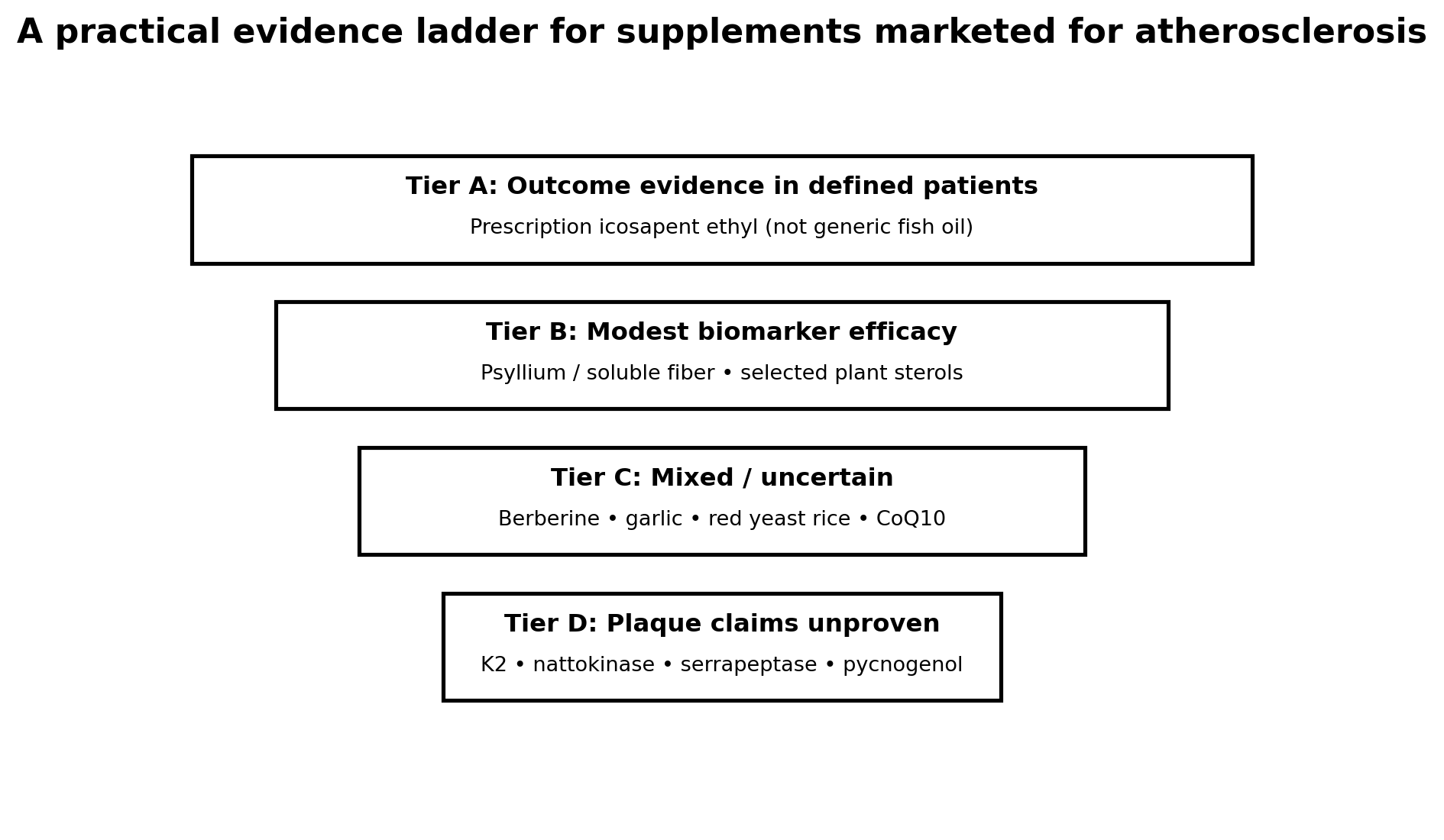
Figure 1. The evidence ladder separates outcome-proven therapy from modest biomarker effects and unproven plaque claims.
1. The Evidence Matrix
| Product | Best-supported effect | Hard CVD outcomes? | Editorial verdict |
|---|---|---|---|
| Prescription icosapent ethyl | Lowers TG; REDUCE-IT event reduction in selected high-risk patients | Yes, in defined population | Evidence-based drug, not equivalent to OTC fish oil |
| OTC EPA+DHA fish oil | Lowers TG modestly at adequate dose | Generally no consistent benefit in large primary/high-risk trials | Do not market as plaque therapy |
| Psyllium | Modest LDL-C reduction | No direct ASCVD outcomes trial | Useful food-like adjunct |
| Plant sterols/stanols | Modest LDL-C reduction | No definitive hard-outcome trial | Reasonable adjunct, not substitute |
| Red yeast rice | Can lower LDL if monacolin K is present | Some older event data; product consistency/regulation problematic | Essentially unregulated lovastatin exposure |
| Berberine | Modest LDL/TG/glucose effects in heterogeneous RCTs | No robust modern ASCVD outcomes evidence | Promising metabolic adjunct, not statin replacement |
| Garlic | Mixed/modest lipid/BP effects | No convincing ASCVD event evidence | Food is fine; supplement evidence weaker than marketing |
| Vitamin K2 (MK-7) | 2026 RCT: slower CAC progression | No | Promising imaging signal, not proven event prevention |
| Nattokinase | Small/nonstandard studies; fibrinolytic effects | No high-quality outcomes evidence | Do not claim plaque reversal |
| Serrapeptase | Very limited cardiovascular evidence | No | Insufficient evidence |
| CoQ10 | May help selected statin-associated muscle symptoms; not an LDL drug | No proven ASCVD prevention benefit | Symptom adjunct, not plaque therapy |
| Pycnogenol | Small studies on BP/endothelial markers | No robust outcomes evidence | Interesting but low priority |
2. Why SPORT matters
SPORT randomized 190 higher-risk adults to low-dose rosuvastatin, placebo or one of six popular supplements. Rosuvastatin reduced LDL-C by about 37.9%, while none of the supplements significantly reduced LDL-C versus placebo.
The trial was short and not designed for heart attacks, but it directly challenged common marketing claims that supplements are 'natural statins' with comparable biochemical efficacy.
3. Fish oil vs prescription EPA
STRENGTH randomized more than 13,000 high-risk patients to 4 g/day EPA+DHA or corn-oil placebo and found no reduction in major cardiovascular events.
REDUCE-IT, using prescription icosapent ethyl 4 g/day in statin-treated patients with elevated triglycerides, reported a 25% relative reduction in the primary composite endpoint. The two trials differ in formulation, comparator and achieved biology, and the discrepancy remains debated.
The safe editorial rule is simple: do not transfer REDUCE-IT's outcome claim to generic fish-oil capsules.
4. Products that can lower LDL modestly
Psyllium and other viscous soluble fibers lower LDL by increasing bile-acid excretion. A 2025 meta-analysis of 41 trials estimated an average LDL reduction of roughly 8.6 mg/dL.
Plant sterols/stanols can lower LDL by reducing intestinal cholesterol absorption. Their effect is usually modest and depends on dose and regular intake.
These strategies are additive to a heart-healthy dietary pattern but usually insufficient alone for people with high absolute ASCVD risk.
5. Red yeast rice: the \'natural statin\' problem
Monacolin K is chemically identical to lovastatin. If a red yeast rice product contains enough active monacolin K to lower LDL substantially, it can also cause statin-class adverse effects and interactions.
Content varies across products and regulatory environments. This produces a paradox: the more pharmacologically effective the supplement is, the more it resembles an inconsistently dosed prescription statin.
6. K2, nattokinase and plaque claims
MK-7 deserves a more nuanced position after VitaK-CAC: a randomized 2026 trial found slower CAC progression. But CAC increased in both groups and clinical events were not tested.
Nattokinase has small and nonstandard studies, including an uncontrolled 1,062-person study reporting carotid changes at high dose. Lack of randomization and hard cardiovascular outcomes prevents strong conclusions.
Serrapeptase has even less relevant evidence. Neither should be marketed as an alternative antiplatelet or plaque-regression therapy.
7. Safety and quality
Supplements can interact with anticoagulants, antiplatelets, blood-pressure drugs and glucose-lowering medicines.
Red yeast rice may produce statin-like muscle/liver effects and can contain variable monacolin content.
Garlic, nattokinase and several herbal products may increase bleeding tendency in susceptible patients.
Product purity, dose accuracy and contamination standards vary by jurisdiction and manufacturer.
Using many supplements simultaneously makes adverse-effect attribution and interaction assessment difficult.
8. FAQ
What supplement has the best evidence for lowering LDL?
Viscous soluble fiber such as psyllium has reproducible modest efficacy. For large LDL reductions and event prevention, evidence-based medicines are far stronger.
Is prescription EPA a supplement?
Regulatorily and clinically it is a prescription drug. It should not be grouped with standard OTC fish oil.
Does K2 remove calcium from arteries?
No. VitaK-CAC showed slower progression, not removal or regression of calcium.
Is nattokinase a natural aspirin?
No. There is no equivalent randomized cardiovascular-outcomes evidence, and bleeding interactions are possible.
Can supplements replace a statin if I have high CAC?
There is no evidence-based supplement strategy with comparable event-reduction evidence.
References
1. Laffin LJ, Bruemmer D, Garcia M, et al. Comparative Effects of Low-Dose Rosuvastatin, Placebo, and Dietary Supplements on Lipids and Inflammatory Biomarkers: SPORT. J Am Coll Cardiol. 2023;81:1-12.
2. Bhatt DL, Steg PG, Miller M, et al. REDUCE-IT. N Engl J Med. 2019;380:11-22.
3. Nicholls SJ, Lincoff AM, Garcia M, et al. STRENGTH. JAMA. 2020;324:2268-2280.
4. Psyllium supplementation and lipid profiles: systematic review and dose-response meta-analysis of randomized controlled trials. 2025.
5. Effects of garlic supplementation on cardiovascular risk factors in adults: updated systematic review and meta-analysis. Nutrition Reviews. 2025/2026.
6. Berberine supplementation and cardiovascular risk factors: systematic reviews/meta-analyses of randomized trials.
7. Vossen LM, et al. Two Years of Menaquinone-7 Supplementation and Coronary Artery Calcification. JAMA Cardiol. 2026.
8. Effective management of atherosclerosis progress and hyperlipidemia with nattokinase: clinical study with 1,062 participants. Front Cardiovasc Med. 2022. Interpret with caution because of study design.
9. Lichtenstein AH, Khera A, et al. 2026 AHA Dietary Guidance to Improve Cardiovascular Health.