Executive Summary
Older adults have the highest absolute cardiovascular event rates, which can make effective prevention valuable. At the same time, they also have more competing illness, polypharmacy, frailty and variation in life expectancy, so the decision cannot be reduced to age.
The 2026 ACC/AHA guideline uses PREVENT-ASCVD for primary-prevention risk assessment through age 79. For adults 65–79 with intermediate or high PREVENT risk, lipid-lowering therapy should be considered after clinician-patient discussion.
For adults aged 75 years and older with estimated life expectancy of at least 2.5 years, initiating moderate-intensity statin therapy may be reasonable to reduce ASCVD risk after discussing potential benefits and harms.
When the primary-prevention decision is uncertain in someone older than 75 with at least 2.5 years of life expectancy, the guideline allows selective CAC testing. CAC 0 or 1–10 may support reclassification to lower risk and avoidance of lipid-lowering therapy.
Deprescribing is also addressed explicitly. In a patient with life expectancy below one year, stopping lipid-lowering therapy may be reasonable to reduce unnecessary medication burden and adverse effects.
Secondary prevention is different. Most older adults with previous clinical ASCVD are at high or very high recurrent-event risk; the 2026 guideline recommends LDL-C below 55 mg/dL for very-high-risk ASCVD. Simply turning 75 is not a reason to abandon proven secondary-prevention therapy.
Randomized trial meta-analysis supports statin efficacy across older age groups, although primary-prevention evidence becomes less direct beyond age 75. That uncertainty is exactly why absolute risk, health status and treatment horizon matter.
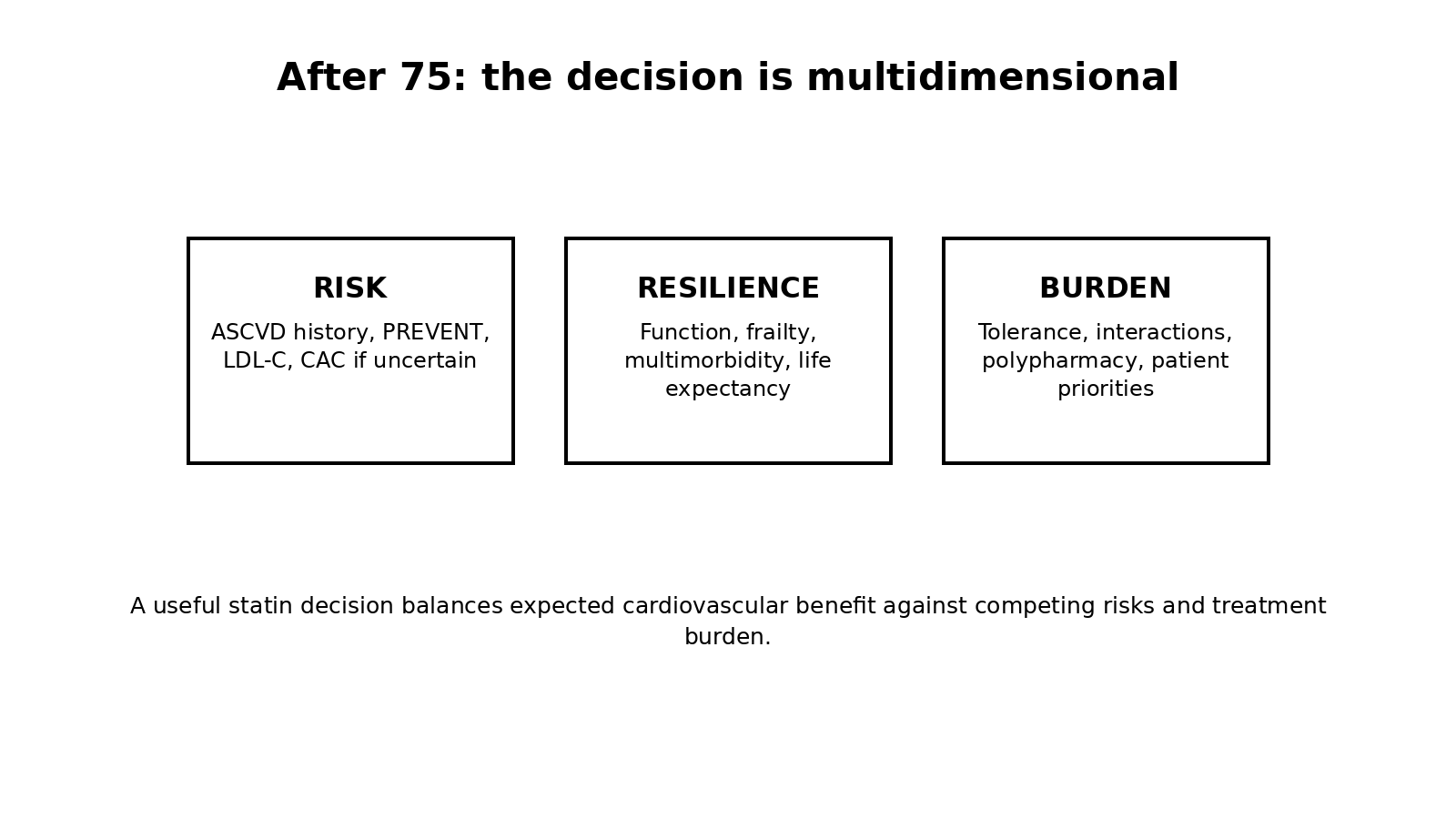
Figure 1. After 75, the treatment decision is a balance of cardiovascular risk, time to benefit, biological resilience and medication burden, not a birthday cutoff.
1. Why "too old for a statin" is the wrong question
The useful question is whether the person is likely to live long enough and remain healthy enough to benefit from fewer cardiovascular events. Two 78-year-olds can have radically different treatment horizons: one active and independent with decades of expected life, another with advanced frailty and limited prognosis.
The 2026 geriatric guidance explicitly says discontinuation decisions should include patient priorities, functional status, multimorbidity, frailty, polypharmacy and life expectancy. Chronological age alone is inadequate.
2. Primary prevention from 65 to 79
PREVENT-ASCVD remains available through age 79. In adults aged 65–79 with intermediate 10-year risk of 5% to below 10% or high risk at least 10%, lipid-lowering therapy should be considered after a clinician-patient discussion.
Absolute risk is often high in this age group, so even a similar relative risk reduction can translate into more prevented events. But competing noncardiovascular mortality and treatment burden also rise, which is why the absolute benefit must be individualized.
3. Starting a statin after 75
For adults at least 75 years old with estimated life expectancy of at least 2.5 years, the guideline says moderate-intensity statin initiation may be reasonable after discussion. This is deliberately more nuanced than a universal treatment mandate.
A key distinction is whether the patient is starting therapy for primary prevention versus continuing a well-tolerated drug that has already achieved good LDL reduction. Stopping an effective medication solely because of age can remove benefit without solving a real problem.
4. Where CAC can actually help
If an older adult has no clinical ASCVD and the treatment decision is genuinely uncertain, CAC can provide evidence about whether coronary atherosclerosis is already present. The 2026 geriatric summary notes that CAC 0 or 1–10 may support lower-risk reclassification in selected adults older than 75.
CAC should not be ordered reflexively. It makes sense when the result could change the decision. A person with prior MI does not need CAC to prove they have atherosclerosis, and a person with very limited life expectancy is unlikely to benefit from another screening test.
5. Risks, interactions and deprescribing
Statin-associated severe muscle injury is rare, but older adults are more vulnerable to drug interactions, renal or hepatic changes, and symptoms that can impair function. Medication lists should be reviewed for interacting agents and the dose should fit the treatment goal and tolerance.
The guideline also legitimizes deprescribing when the prevention horizon disappears. With life expectancy below one year, discontinuation may be reasonable. That is not “giving up”; it is aligning medication burden with goals of care and realistic time to benefit.
| Clinical situation | 2026 approach |
|---|---|
| Age 65–79, PREVENT 5–<10% | Consider lipid-lowering therapy after discussion |
| Age 65–79, PREVENT ≥10% | Strongly favors lipid-lowering therapy |
| Age ≥75, life expectancy ≥2.5 years | Moderate-intensity statin initiation may be reasonable |
| Age >75, uncertain primary prevention | Selective CAC can help; CAC 0–10 may reclassify lower |
| Established ASCVD | Secondary-prevention pathway; age alone is not a stop rule |
| Life expectancy <1 year | Deprescribing lipid-lowering therapy may be reasonable |
Do not ask only “How old am I?” Ask: Do I already have ASCVD? What is my functional status? What is my likely treatment horizon? Am I tolerating the statin? What medications could interact? If primary prevention remains uncertain after those answers, ask whether CAC would genuinely change the decision.
6. FAQ
Should everyone over 75 start a statin?
No. The 2026 guideline says initiation may be reasonable in adults 75 or older with at least 2.5 years of estimated life expectancy after individualized discussion. That is not a universal rule.
Should I stop a statin when I turn 75?
No age cutoff requires automatic discontinuation. The guideline specifically warns against basing discontinuation on chronological age alone.
Does CAC zero matter after 75?
In selected older adults without known ASCVD and with an uncertain primary-prevention decision, CAC 0 or 1–10 may support reclassification to lower risk. It is a decision aid, not a universal test.
What if I already had a heart attack?
That is secondary prevention, where the evidence and expected absolute benefit of LDL lowering are much stronger. Most patients with clinical ASCVD qualify for aggressive LDL goals, often below 55 mg/dL when very high risk.
References
1. Blumenthal RS, Morris PB, Gaudino M, et al. 2026 ACC/AHA Multisociety Guideline on the Management of Dyslipidemia. Circulation. 2026;153:e1154-e1276.
2. American Heart Association. Top Take-Home Messages for Geriatric Clinicians: 2026 Guideline on the Management of Dyslipidemia. 2026.
3. Cholesterol Treatment Trialists’ Collaboration. Efficacy and safety of statin therapy in older people: meta-analysis of individual participant data from 28 randomized trials. Lancet. 2019;393:407-415. doi:10.1016/S0140-6736(18)31942-1.
4. Orkaby AR, Driver JA, Ho YL, et al. Association of Statin Use With All-Cause and Cardiovascular Mortality in US Veterans 75 Years and Older. JAMA. 2020;324:68-78.