Executive Summary
The 2026 ACC/AHA guideline treats coronary artery calcium (CAC) as evidence of subclinical coronary atherosclerosis rather than merely a statistical risk marker.
For CAC 1-99 and below the 75th percentile, moderate-intensity statin therapy is reasonable, with a goal of at least a 30-49% LDL-C reduction and LDL-C <100 mg/dL.
For CAC 100-299 or CAC at/above the 75th percentile, lipid-lowering therapy is recommended, with consideration of a statin as first-line and an LDL-C goal <70 mg/dL.
For CAC 300-999, the guideline recommends at least 50% LDL-C reduction and LDL-C <70 mg/dL; intensification toward <55 mg/dL is reasonable. CAC ≥1000 carries a Class 1 goal of LDL-C <55 mg/dL.
The strongest reason to treat is not that a statin makes the calcium score fall. Statins can increase calcium density while reducing lipid-rich plaque, inflammation and cardiovascular events. Serial CAC is therefore not a treatment-response score.
Exceptions include pregnancy/planning pregnancy, true severe statin intolerance, specific drug interactions or unusual medical circumstances. In those cases, the question is usually “which LDL-lowering strategy?” rather than “should atherosclerosis be untreated?”
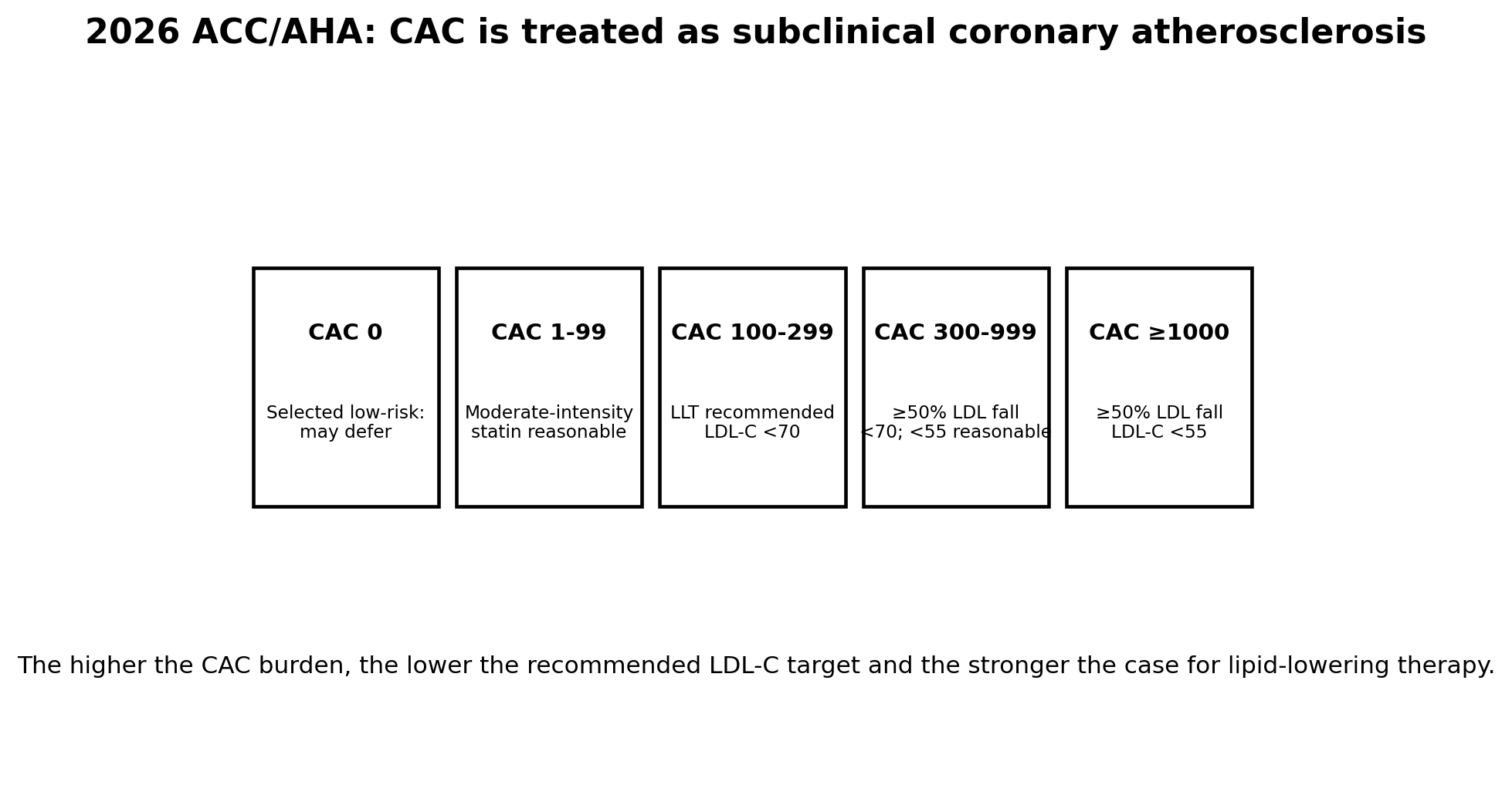
Figure 1. 2026 ACC/AHA management framework for subclinical coronary atherosclerosis detected by CAC.
1. CAC means plaque is already present
A CAC score above zero proves that calcified coronary atherosclerotic plaque exists. The absolute score estimates the total calcified burden; it does not directly measure stenosis or the amount of noncalcified plaque.
This changes the prevention discussion because the patient is no longer being treated solely on the basis of probability. Imaging has demonstrated disease.
2. What the 2026 thresholds mean
The 2026 guideline moves beyond the older “CAC ≥100 means statin” shorthand and links CAC burden to explicit LDL-C goals. CAC 1-99 generally supports moderate-intensity therapy; CAC ≥100 supports LDL-C <70 mg/dL; CAC ≥300 moves the patient toward secondary-prevention-like risk; CAC ≥1000 supports LDL-C <55 mg/dL.
Importantly, treatment may still be appropriate even when baseline LDL-C is already below the numerical goal, because the guideline also emphasizes a percentage reduction from untreated baseline.
3. Why a statin may make the calcium score rise
Statins can shift plaque composition toward greater calcification density while reducing lipid-rich components and stabilizing plaque. This is one reason repeat CAC after treatment is not recommended as a measure of whether the drug “worked.”
The outcome that matters is fewer cardiovascular events, not a lower Agatston score.
4. What if a statin is not tolerated?
First verify the intolerance rather than assuming any muscle symptom is pharmacologic. Lower dose, a different statin or intermittent dosing may be workable.
If statin exposure remains limited, ezetimibe, bempedoic acid and PCSK9-targeting therapy can be used according to the LDL reduction needed and the patient’s risk. A high CAC score strengthens the reason to find a tolerable LDL-lowering strategy.
5. VESALIUS-CV strengthens the "lower LDL in high-risk primary prevention" concept
VESALIUS-CV randomized 12,257 high-risk patients without previous MI or stroke and showed that adding evolocumab reduced first major cardiovascular events. Many participants qualified because of documented atherosclerosis, including CAC ≥100.
The trial was published after the guideline evidence review and has been cited by guideline leaders as strengthening the rationale for intensive LDL lowering in high-risk subclinical disease.
| CAC | 2026 treatment framing | LDL-C goal |
|---|---|---|
| 0 | Selected borderline/intermediate-risk adults may defer LLT if no higher-risk condition is present | Risk-based; lifestyle + reassessment |
| 1-99, <75th percentile | Moderate-intensity statin reasonable | <100 mg/dL + ≥30-49% reduction |
| 100-299 or ≥75th percentile | LLT recommended; statin first-line | <70 mg/dL |
| 300-999 | ≥50% LDL reduction; high-intensity strategy | <70 mg/dL; <55 reasonable with intensification |
| ≥1000 | Very high subclinical burden | <55 mg/dL + ≥50% reduction |
Write down your CAC score, percentile, untreated LDL-C, ApoB, Lp(a), blood pressure, diabetes/smoking status and current medications. The treatment conversation should be about your total atherosclerotic burden and the LDL reduction needed—not the CAC number in isolation.
6. FAQ
Can diet alone be reasonable with CAC 100?
In the 2026 guideline, CAC ≥100 is a Class 1 indication for lipid-lowering therapy. Lifestyle remains essential but is not the only evidence-based treatment.
Does high CAC mean I need aspirin?
No. Aspirin depends on ischemic benefit versus bleeding risk and is not automatically indicated just because CAC is high.
Should I repeat CAC after starting a statin?
Usually no. The 2026 guideline specifically states repeat CAC is not indicated once lipid-lowering therapy is initiated.
If my LDL-C is already 65 with CAC 300, do I still need treatment?
Often yes, because baseline exposure and percent reduction matter. The exact regimen depends on whether 65 mg/dL is untreated or treatment-achieved and on the rest of the risk profile.
References
1. Blumenthal RS, Morris PB, Gaudino M, et al. 2026 ACC/AHA/AACVPR/ABC/ACPM/ADA/AGS/APhA/ASPC/NLA/PCNA Guideline on the Management of Dyslipidemia. Circulation. 2026;153:e1153-e1276. doi:10.1161/CIR.0000000000001423.
2. Watson KE, Fonarow GC. The 2026 ACC/AHA Multisociety Guideline on the Management of Dyslipidemia: A More Precise Framework. Circulation. 2026;153:1265-1267.
3. Bohula EA, Marston NA, Bhatia AK, et al. Evolocumab in Patients without a Previous Myocardial Infarction or Stroke. N Engl J Med. 2026;394:117-127.
4. Blumenthal RS, et al. Clinical Guidelines as a Continuous Work in Progress: Moving at the Speed of Science. Circulation. 2026;153:e1277-e1278.