Executive Summary
Non-HDL-C includes LDL cholesterol plus cholesterol in VLDL/remnants, IDL and Lp(a)-containing particles. It is therefore especially useful when triglycerides are elevated.
It requires no extra laboratory test: non-HDL-C = total cholesterol − HDL-C. It is valid in fasting and nonfasting samples.
LDL-C remains the principal treatment target in the 2026 ACC/AHA guideline, but non-HDL-C has returned as a formal co-target because it better reflects total atherogenic cholesterol.
Non-HDL-C and ApoB are related but answer different questions. Non-HDL-C measures cholesterol mass across atherogenic particles; ApoB estimates particle number.
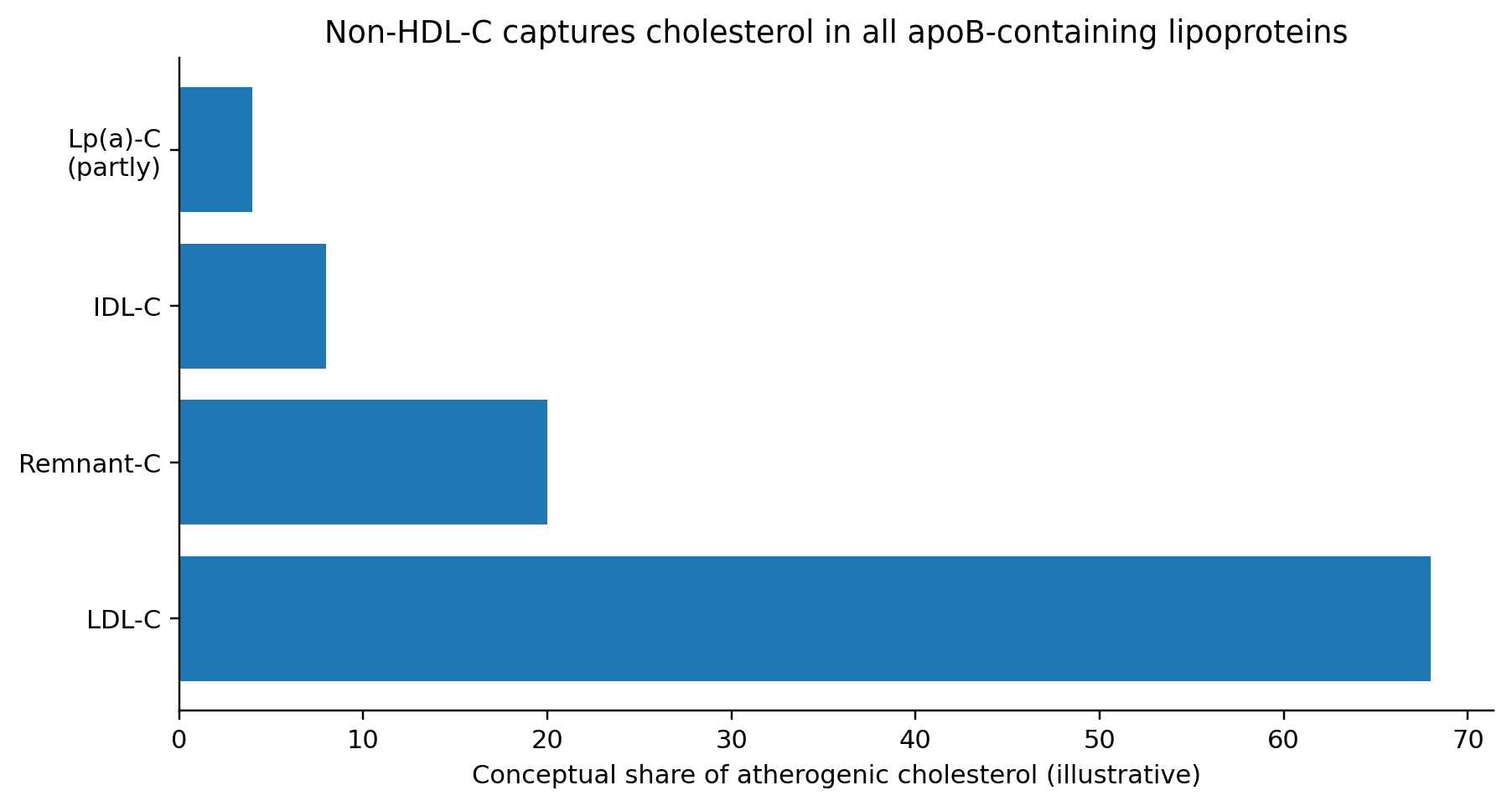
Figure 1. Non-HDL-C conceptually includes cholesterol in LDL plus triglyceride-rich remnants, IDL and Lp(a)-containing particles. The proportions shown are illustrative.
1. How to Calculate It
Non-HDL-C = Total cholesterol − HDL-C. Example: TC 210 mg/dL − HDL-C 45 mg/dL = non-HDL-C 165 mg/dL.
2. 2026 ACC/AHA Goals
| Risk category | LDL-C goal | Non-HDL-C goal |
|---|---|---|
| Borderline / intermediate primary prevention | <100 mg/dL | <130 mg/dL |
| High-risk primary prevention | <70 mg/dL | <100 mg/dL |
| ASCVD, not very high risk | <70 mg/dL | <100 mg/dL |
| Very-high-risk ASCVD | <55 mg/dL | <85 mg/dL |
3. When Non-HDL-C Is Particularly Useful
Triglycerides are elevated.
Diabetes, obesity or insulin resistance is present.
LDL-C appears controlled but VLDL/remnant cholesterol remains elevated.
A nonfasting lipid panel is being interpreted.
An inexpensive secondary atherogenic target is needed without ordering ApoB.
4. Non-HDL-C vs ApoB
Non-HDL-C is a cholesterol-mass measure; ApoB is a particle-number measure. Discordance is clinically meaningful. In high-triglyceride and insulin-resistant states, ApoB often reveals more particles than LDL-C alone would suggest.
5. FAQ
Is non-HDL-C better than LDL-C?
It is often more informative when triglyceride-rich particles are abundant, but 2026 guidelines use both rather than declaring one universally superior.
Do I need to fast?
No. Non-HDL-C is robust in nonfasting samples.
Does non-HDL-C include Lp(a)?
Yes, the cholesterol carried inside Lp(a) contributes to total non-HDL-C.
Why is the non-HDL goal usually 30 mg/dL above the LDL goal?
That convention allows for cholesterol in other atherogenic particles, particularly remnants.
References
1. Blumenthal RS, Morris PB, Gaudino M, et al. 2026 ACC/AHA Multisociety Guideline on the Management of Dyslipidemia. 2026.
2. American College of Cardiology. Lower Sooner: How the 2026 Dyslipidemia Guideline Changes Practice. July 2026.
3. Sniderman AD, et al. Apolipoprotein B and non-HDL cholesterol in cardiovascular risk assessment. Consensus literature.
4. Björnson E, et al. Quantifying triglyceride-rich lipoprotein atherogenicity and implications for non-HDL cholesterol. J Am Coll Cardiol. 2024.