Executive Summary
Menopause coincides with adverse shifts in LDL-C, ApoB, body-fat distribution, insulin sensitivity and blood pressure, although aging and lifestyle also contribute.
Lp(a) may rise modestly after menopause because estrogen can lower Lp(a), but MHT is not recommended as an Lp(a)-lowering strategy for cardiovascular prevention.
The Women’s Health Initiative transformed practice because initiating oral hormone therapy in older postmenopausal women did not prevent cardiovascular disease and increased some harms.
Later analyses support a “timing hypothesis”: absolute risks are lower when symptomatic women start MHT before age 60 or within about 10 years of menopause and have no major contraindication. This supports symptom treatment—not prescribing MHT as a cardiovascular drug.
ACOG states that combined hormone therapy should not be used solely to protect against heart disease. Transdermal estrogen may carry less venous-thromboembolism risk than oral estrogen because it avoids first-pass hepatic effects.
In February 2026, the FDA approved labeling changes for six menopausal hormone therapy products removing cardiovascular disease, breast cancer and probable dementia language from boxed warnings. The labeling change does not turn MHT into a proven primary-prevention therapy.
Women with premature ovarian insufficiency or early menopause are a special population: in the absence of contraindications, hormone replacement is often recommended until the usual age of natural menopause because prolonged estrogen deficiency has bone and other health consequences.
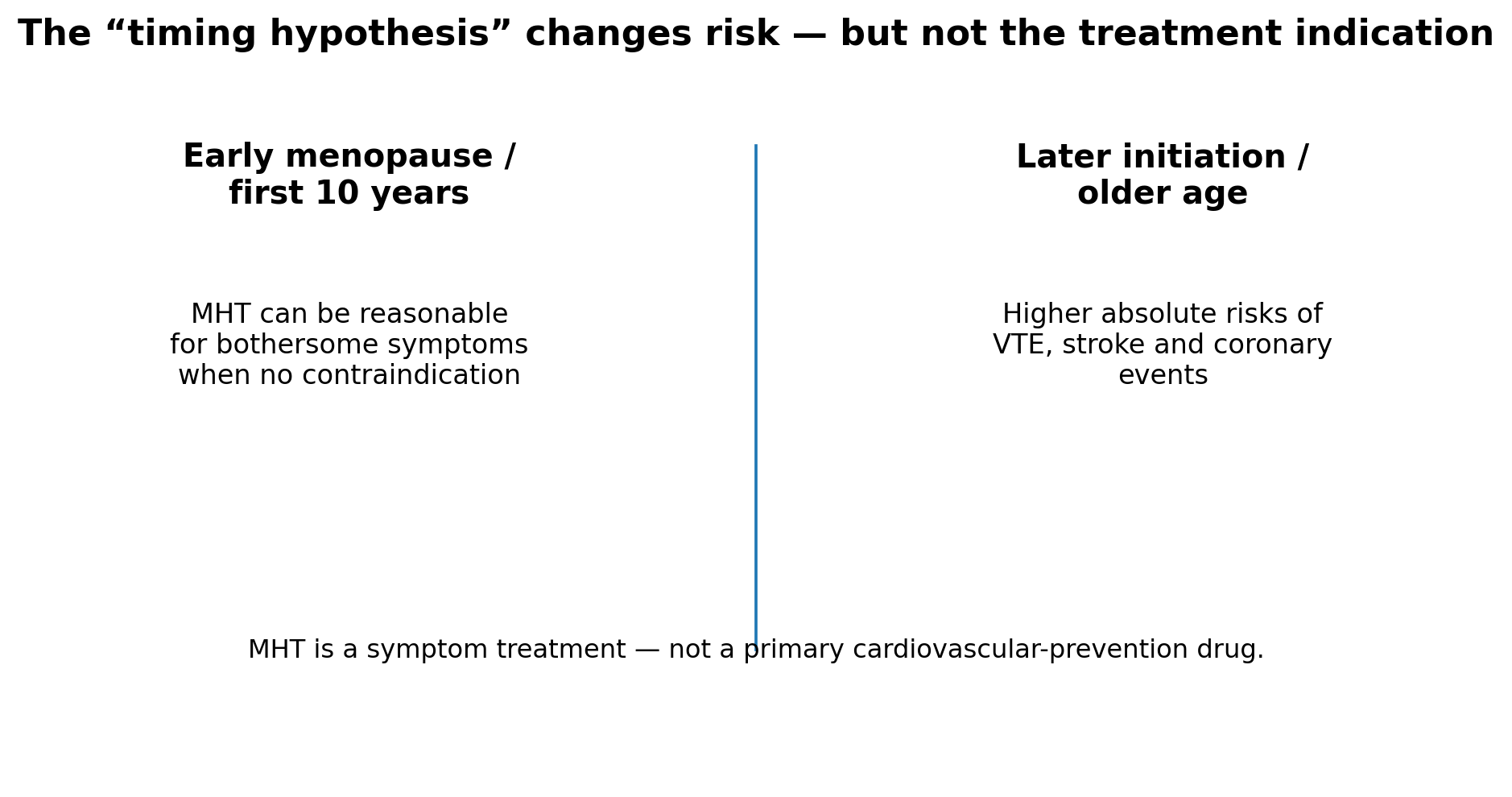
Figure 1. Earlier initiation in appropriate symptomatic women generally carries a more favorable risk profile, but MHT remains a symptom treatment rather than a heart-prevention prescription.
1. What changes around menopause
LDL-C and ApoB commonly rise, visceral fat tends to increase, and blood-pressure and glucose regulation often worsen. These changes increase cumulative cardiovascular risk during midlife.
Menopause should therefore trigger a broader prevention review rather than a reflex prescription for hormones.
2. What MHT is good at
Systemic estrogen—with progestogen when the uterus is present—is the most effective treatment for bothersome hot flashes and night sweats. Local vaginal estrogen is highly effective for genitourinary symptoms.
Systemic MHT also reduces bone loss and fractures while taken.
3. Cardiovascular prevention: what it does not prove
MHT should not be started solely to prevent myocardial infarction, stroke or dementia. The evidence does not support that indication.
For a symptomatic woman early after menopause, cardiovascular risk is part of the safety assessment rather than the treatment goal.
4. Route and formulation matter
Oral estrogen increases hepatic production of clotting factors and triglycerides more than transdermal estrogen. Observational and mechanistic data suggest transdermal routes may have lower VTE risk.
Women with a uterus generally need endometrial protection with a progestogen when using systemic estrogen.
5. The 2026 FDA labeling change
The FDA removed several long-standing boxed-warning risk statements from selected menopausal hormone products after re-reviewing evidence and emphasizing that risk varies strongly by age, timing, route and formulation.
This was a labeling/safety communication change, not a randomized trial showing that MHT should be prescribed to prevent cardiovascular disease.
| Situation | Evidence-based framing |
|---|---|
| Bothersome vasomotor symptoms, <60 or <10 y since menopause | MHT can be reasonable if no contraindication and benefits outweigh risks. |
| Known prior MI or stroke | Systemic MHT usually not first-line; specialist individualized review. |
| Prior VTE / high clot risk | Systemic therapy requires caution; transdermal route may be safer but is not automatically appropriate. |
| Early menopause / POI | Hormone replacement is often recommended until usual menopause age if no contraindication. |
| Starting MHT solely to prevent CVD | Not recommended. |
6. FAQ
Does estrogen lower LDL-C?
Often yes, particularly oral estrogen, but lipid changes do not make MHT a cardiovascular-prevention therapy.
Does MHT lower Lp(a)?
It can modestly lower Lp(a), but it is not used solely for that purpose.
Is transdermal estrogen safer for the heart?
It generally has less hepatic clotting/triglyceride effect and may lower VTE risk, but individual cardiovascular history still matters.
Did the FDA say HRT prevents heart disease in 2026?
No. It changed boxed-warning labeling. ACOG still advises against using combined hormone therapy solely to protect against heart disease.
References
1. American College of Obstetricians and Gynecologists. Hormone Therapy for Menopause. Current guidance.
2. U.S. Food and Drug Administration. FDA Approves Labeling Changes to Menopausal Hormone Therapy Products. February 12, 2026.
3. The Menopause Society. Hormone Therapy Position Statement and subsequent clinical guidance.
4. Women’s Health Initiative randomized hormone-therapy trial literature and long-term follow-up.
5. ACOG. Hormone therapy and early menopause. 2025.