Executive Summary
LDL-C tells you how much cholesterol is inside LDL particles. LDL-P tells you how many LDL particles are present. ApoB estimates the total number of circulating atherogenic particles.
Discordance occurs because cholesterol content per particle varies. Two people with identical LDL-C can have very different LDL particle counts and ApoB concentrations.
ApoB has practical advantages: standardized assays, broad availability, lower cost in many systems, and direct incorporation into current guidelines and expert-consensus thresholds.
LDL-P can be useful in specialized lipid practice, particularly when historical NMR data are already available, but it generally adds little when a high-quality ApoB result is already known.
Small dense LDL is best understood as a marker of an insulin-resistant, particle-rich phenotype. Once ApoB/particle number is accounted for, particle size usually adds less independent information than marketing around Pattern B implies.
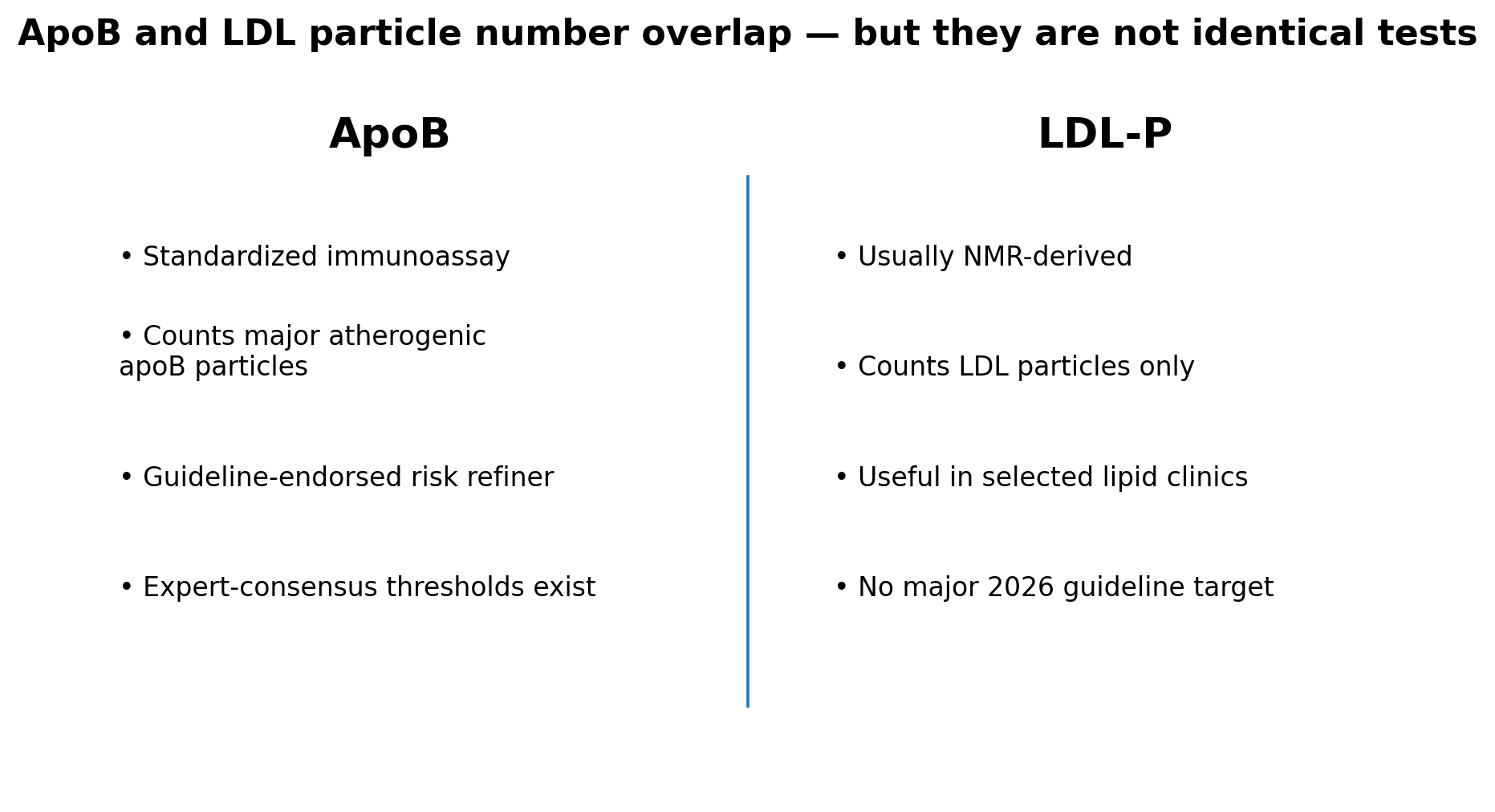
Figure 1. ApoB and LDL-P overlap conceptually, but ApoB captures a broader atherogenic particle pool and is more directly represented in 2026 guidelines.
1. What LDL-P Measures
LDL-P is most commonly measured by nuclear magnetic resonance spectroscopy. It estimates the concentration of LDL particles, often reported in nmol/L. The assay may also report particle sizes and VLDL/HDL subclass information.
2. What ApoB Measures
Each LDL, IDL, VLDL-remnant and Lp(a) particle contains one apoB-100 molecule. Measuring ApoB therefore provides a practical estimate of the number of circulating atherogenic particles across multiple lipoprotein classes.
3. When LDL-C and Particle Number Disagree
| Pattern | LDL-C | ApoB / LDL-P | Interpretation |
|---|---|---|---|
| Cholesterol-rich LDL | High | Moderate | LDL-C may look worse than particle count. |
| Insulin-resistant phenotype | Normal/mildly high | High | Particle number may reveal hidden risk. |
| Low TG / large LDL | Moderately high | Lower | Fewer, cholesterol-rich particles. |
| High TG / remnants | Can be modest | ApoB often high | ApoB is especially useful because non-LDL particles contribute. |
4. Why 2026 Guidelines Prefer ApoB
The 2026 ACC/AHA guideline states that ApoB measurement is reasonable in treated adults—particularly those with ASCVD, CKM syndrome, type 2 diabetes and/or high triglycerides—when LDL-C or non-HDL-C goals have been reached but residual risk may remain.
No parallel major-guideline recommendation or treatment target is provided for LDL-P. That does not make LDL-P invalid; it makes ApoB the more standardized clinical language for particle burden.
5. FAQ
If my ApoB is known, do I also need LDL-P?
Usually not. The tests are highly correlated and ApoB is more actionable in current guidelines.
Is small dense LDL dangerous?
It tracks with particle-rich insulin-resistant states. Particle number, ApoB, triglycerides and metabolic risk are usually more actionable than size alone.
Can LDL-P be high while ApoB is normal?
Some assay discordance occurs, but large differences should prompt review of methods, triglycerides and laboratory variability.
Which has better treatment targets?
ApoB. Expert consensus provides ApoB thresholds, whereas LDL-P has no widely adopted 2026 treatment goal.
References
1. Blumenthal RS, Morris PB, Gaudino M, et al. 2026 ACC/AHA Guideline on the Management of Dyslipidemia.
2. National Lipid Association. Role of apolipoprotein B in the clinical management of cardiovascular risk in adults. J Clin Lipidol. 2024.
3. Sniderman AD, et al. Discordance analysis and particle-number metrics in cardiovascular risk. Lipidology literature.
4. Hassan S, Triffon DW. Discordance among LDL-C, non-HDL-C, LDL-P and ApoB. J Am Coll Cardiol. 2024;83(Suppl):1849.