Executive Summary
Interleukin-6, or IL-6, sits in the inflammatory cascade between IL-1β signaling and hepatic production of C-reactive protein. That makes it biologically attractive, but hsCRP remains the practical biomarker used to identify residual inflammatory risk.
CANTOS proved that cardiovascular events can be reduced by targeted anti-inflammatory therapy without lowering LDL-C. Canakinumab, which blocks IL-1β, reduced recurrent events in prior-MI patients with hsCRP at least 2 mg/L, but also increased fatal infection and never became a routine cardiovascular drug.
Ziltivekimab directly binds the IL-6 ligand. In the phase 2 RESCUE trial, monthly treatment lowered hsCRP by roughly 77%, 88% and 92% across the three tested doses at 12 weeks, without materially changing the total-cholesterol-to-HDL ratio.
Those biomarker effects are much larger than the question clinicians actually care about. A drug can suppress hsCRP beautifully and still fail to improve hard outcomes, or produce harms that erase the benefit.
ZEUS enrolled patients with established ASCVD, chronic kidney disease and systemic inflammation. ARTEMIS studies patients after acute MI, while HERMES and ATHENA extend the IL-6 program into inflammatory heart failure phenotypes.
As of the August 2026 evidence cutoff, there is no guideline-supported role for measuring IL-6 itself to decide on cardiovascular treatment, and no approved IL-6 inhibitor for routine ASCVD prevention.
The practical strategy remains to control proven risk drivers first: LDL/ApoB, blood pressure, smoking, diabetes, kidney disease, exercise and weight, then use hsCRP as a residual-risk signal in the right clinical context.
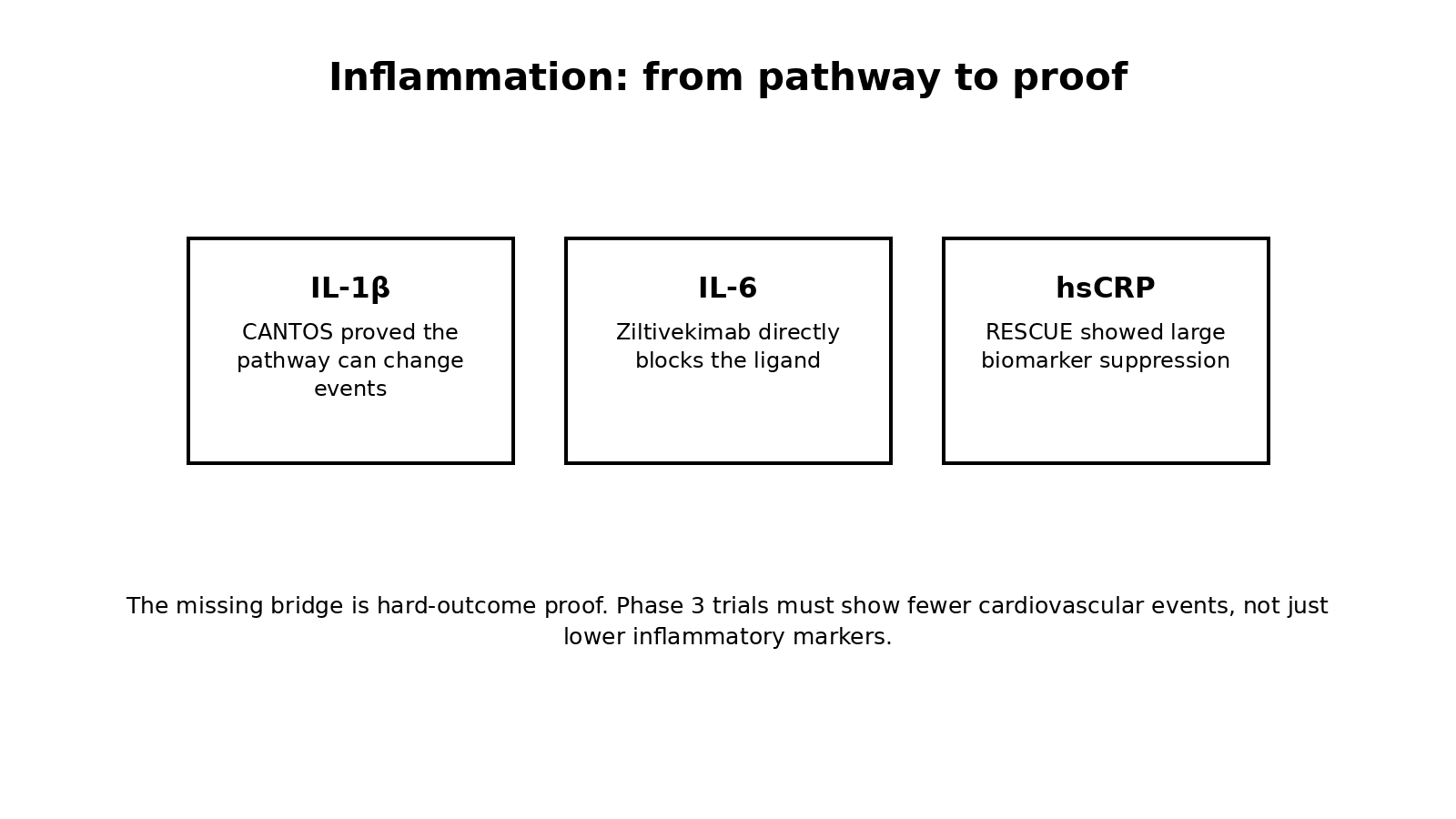
Figure 1. The inflammatory pathway is biologically coherent, but cardiovascular practice changes only when biomarker suppression translates into fewer clinical events.
1. Why IL-6 is an attractive target
The NLRP3 inflammasome and IL-1β sit upstream of IL-6, which in turn drives hepatic acute-phase proteins including CRP. Genetic, epidemiologic and trial data all support this pathway as relevant to atherothrombosis.
That does not make an isolated IL-6 blood level a treatment target. Current preventive practice still uses hsCRP because it is standardized, inexpensive and better connected to the clinical trial evidence base.
2. What CANTOS already proved, and what it did not
CANTOS randomized more than 10,000 patients with previous MI and hsCRP at least 2 mg/L. The 150 mg canakinumab dose reduced the primary cardiovascular endpoint by about 15% without lowering lipids.
The trade-off mattered: fatal infection was more frequent, all-cause mortality was not reduced, and the drug was not adopted as standard ASCVD prevention. The lesson was proof of biology, not a blanket endorsement of immune suppression.
3. Ziltivekimab and the RESCUE signal
RESCUE studied 264 high-risk patients with chronic kidney disease and hsCRP at least 2 mg/L. Ziltivekimab produced dose-dependent reductions in hsCRP and several inflammatory or thrombotic biomarkers.
This made IL-6 blockade one of the strongest biomarker signals in cardiovascular inflammation. It still remained a phase 2 surrogate-endpoint result, not evidence that patients lived longer or had fewer myocardial infarctions.
4. ZEUS, ARTEMIS and HERMES: outcomes are the gatekeeper
ZEUS was designed around major cardiovascular events in patients with established ASCVD, CKD and inflammation. ARTEMIS tests the concept after acute MI, while HERMES and ATHENA address heart failure with systemic inflammation.
A registry completion date is not an outcome. Until peer-reviewed event data are available, it is premature to present ziltivekimab as proven cardiovascular prevention.
5. Where this fits in prevention today
If LDL-C and ApoB remain high, fix those first. If blood pressure, smoking or diabetes are uncontrolled, those interventions have established outcome benefits and should not be displaced by fascination with inflammatory biomarkers.
In patients with established ASCVD and persistent hsCRP elevation despite strong conventional prevention, residual inflammatory risk is clinically meaningful. Today, low-dose colchicine has outcome evidence in selected coronary disease patients; IL-6 blockade remains an emerging strategy under outcome testing.
| Evidence layer | What it tells us |
|---|---|
| hsCRP | Practical downstream marker of systemic inflammation and residual risk |
| CANTOS | Targeted anti-inflammatory therapy can reduce recurrent CV events without LDL lowering |
| RESCUE | Direct IL-6 blockade can produce very large hsCRP reductions |
| ZEUS | Tests whether ziltivekimab reduces MACE in ASCVD + CKD + inflammation |
| ARTEMIS | Tests IL-6 blockade after acute myocardial infarction |
| Clinical use in 2026 | No routine IL-6 inhibitor is approved specifically for ASCVD prevention |
If you are evaluating residual inflammatory risk, do not order exotic cytokine panels first. Start with a standard risk review, confirm LDL-C/ApoB control and, when clinically appropriate, use hsCRP as the practical inflammatory marker. Treating IL-6 itself remains a trial-era strategy, not a self-directed prevention plan.
6. FAQ
Should I ask for an IL-6 blood test?
Usually not for routine ASCVD prevention. hsCRP is the better standardized clinical marker and is the biomarker used in the major residual-inflammation trial framework.
Is ziltivekimab available for heart-disease prevention?
Not as a routine approved ASCVD-prevention therapy as of the August 2026 evidence cutoff. Outcome trials are the key next step.
Does a high hsCRP mean I need an anti-inflammatory drug?
No. hsCRP is nonspecific and can rise with infection, obesity and many inflammatory conditions. Persistent elevation should be interpreted in clinical context.
Is IL-6 more important than LDL?
They represent different causal pathways. LDL/ApoB lowering remains the primary proven lipoprotein target; inflammation can contribute residual risk after standard prevention is optimized.
References
1. Fahed J, Zahid S, Blumenthal RS. IL-6 as a Predictor of CV Risk Assessment: Role of Canakinumab and Ziltivekimab in Preventive Cardiology. American College of Cardiology. July 2026.
2. Ridker PM, Devalaraja M, Baeres FMM, et al. IL-6 Inhibition With Ziltivekimab in Patients at High Atherosclerotic Risk (RESCUE). Lancet. 2021;397:2060-2069.
3. Ridker PM, Everett BM, Thuren T, et al. Antiinflammatory Therapy With Canakinumab for Atherosclerotic Disease. N Engl J Med. 2017;377:1119-1131.
4. ClinicalTrials.gov. NCT05021835. ZEUS: Effects of Ziltivekimab Versus Placebo on Cardiovascular Outcomes in Participants With ASCVD, CKD and Systemic Inflammation.