Executive Summary
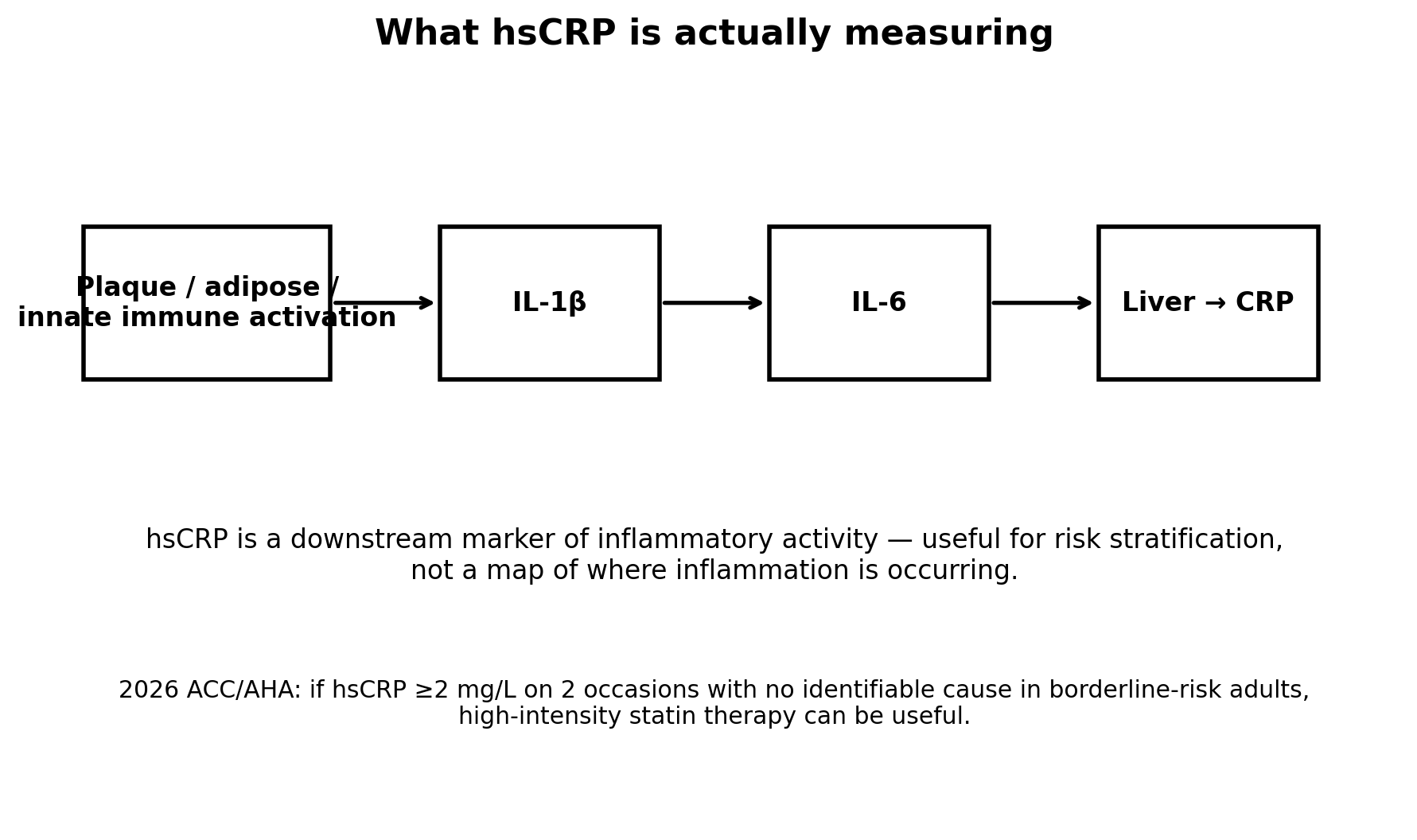
High-sensitivity CRP measures low levels of C-reactive protein with sufficient precision for cardiovascular risk assessment. It is produced by the liver largely in response to interleukin-6 signaling.
The conventional risk-enhancer threshold is hsCRP ≥2 mg/L. The 2026 ACC/AHA dyslipidemia guideline adds an important nuance: in borderline-risk adults, if hsCRP is ≥2 mg/L on two successive measurements with no identifiable alternative cause, high-intensity statin therapy can be useful.
JUPITER randomized 17,802 apparently healthy adults with LDL-C <130 mg/dL but hsCRP ≥2 mg/L. Rosuvastatin lowered LDL-C by about 50%, hsCRP by 37%, and the primary cardiovascular endpoint by 44%.
CANTOS provided proof of principle that selectively reducing inflammation can lower recurrent cardiovascular events without lowering lipids. Canakinumab 150 mg reduced events but increased fatal infection and never became routine ASCVD therapy.
hsCRP is nonspecific. Obesity, smoking, sleep disorders, infections, autoimmune disease, periodontal disease and many other states can raise it. Interpretation is strongest when the patient is clinically stable.
1. CRP vs hsCRP
CRP and hsCRP measure the same protein. “High sensitivity” refers to an assay capable of measuring the low concentrations relevant to chronic cardiovascular risk.
Routine CRP assays are designed more for larger inflammatory elevations; hsCRP is designed to distinguish values such as 0.7, 1.8 and 3.2 mg/L.
2. Practical interpretation
Historically, values below 1 mg/L were considered lower inflammatory risk, 1-3 mg/L average, and above 3 mg/L higher. Modern guidelines focus less on these bins and more on persistent hsCRP ≥2 mg/L as a risk enhancer.
Values above about 10 mg/L are more likely to reflect an acute or substantial inflammatory process and should generally be repeated after recovery.
3. JUPITER: why hsCRP entered preventive cardiology
JUPITER enrolled patients who would not have looked particularly high risk from LDL-C alone. Rosuvastatin 20 mg reduced the primary endpoint with a hazard ratio of 0.56 and lowered both LDL-C and hsCRP.
The study does not prove that treating CRP itself is the mechanism, because statins changed both lipids and inflammation.
4. CANTOS: proof that inflammation is causal
CANTOS enrolled patients with prior MI and persistent hsCRP ≥2 mg/L. Canakinumab targeted IL-1β and reduced recurrent events without lowering LDL-C, proving that an inflammatory pathway can be therapeutically causal.
The price was higher fatal infection risk and cost, and canakinumab did not become standard cardiovascular therapy.
5. What does persistent hsCRP mean after LDL-C is controlled?
This pattern is often called residual inflammatory risk. It is particularly relevant in established ASCVD, diabetes, obesity and CKM syndrome.
It should trigger a broad review of lifestyle, adiposity, smoking, sleep, periodontal health and inflammatory conditions—not an automatic search for exotic anti-inflammatory drugs.
6. hsCRP and imaging
hsCRP is systemic, while CCTA and perivascular fat-attenuation methods can provide local information about coronary plaque and vascular inflammation. The tools are complementary rather than interchangeable.
| hsCRP result | Practical interpretation |
|---|---|
| <1 mg/L | Low inflammatory signal in a stable patient |
| 1 to <2 mg/L | Low-to-moderate; usually not a standalone risk enhancer |
| ≥2 mg/L | Recognized ASCVD risk enhancer if persistent and unexplained |
| >10 mg/L | Consider acute infection/inflammation; repeat when clinically stable |
7. FAQ
Should I fast for hsCRP?
No. Fasting is not required.
How often should I repeat it?
If elevated unexpectedly, repeat after the patient is well and free of an obvious inflammatory trigger. The 2026 guideline specifically references two successive elevations for the borderline-risk statin recommendation.
Can exercise raise CRP?
A hard acute workout can transiently raise inflammatory markers; chronic regular exercise generally lowers inflammatory risk.
Does low hsCRP mean no plaque?
No. A person can have extensive atherosclerosis with a low hsCRP. Lipid risk and inflammatory risk are separate dimensions.
References
1. Blumenthal RS, Morris PB, Gaudino M, et al. 2026 ACC/AHA Multisociety Guideline on the Management of Dyslipidemia. J Am Coll Cardiol. 2026.
2. Ridker PM, Danielson E, Fonseca FAH, et al. Rosuvastatin to Prevent Vascular Events in Men and Women with Elevated C-Reactive Protein. N Engl J Med. 2008;359:2195-2207.
3. Ridker PM, Everett BM, Thuren T, et al. Antiinflammatory Therapy with Canakinumab for Atherosclerotic Disease. N Engl J Med. 2017;377:1119-1131.
4. Ridker PM, MacFadyen JG, Thuren T, et al. Relationship of C-reactive protein reduction to cardiovascular event reduction following treatment with canakinumab. Lancet.
5. Ridker PM, Everett BM, Pradhan A, et al. Low-dose methotrexate for prevention of atherosclerotic events. N Engl J Med. 2019.
6. Libby P. Inflammation in atherosclerosis. Nature. Review.
7. 2021 ESC Guidelines on cardiovascular disease prevention. Eur Heart J. 2021.