Executive Summary
MESA followed 3,116 adults with baseline CAC = 0 and estimated a “warranty period” to new CAC of roughly 3-7 years depending on age, sex and baseline risk.
A practical MESA framework suggested 5-7 years for low-risk adults, 3-5 years for borderline/intermediate risk, and about 3 years for high-risk adults or diabetes.
The 2026 ACC/AHA guideline incorporates this evidence: when CAC = 0 leads to deferral of lipid-lowering therapy and no higher-risk condition is present, repeat CAC in 3-7 years is reasonable.
Higher-risk conditions that make CAC = 0 less suitable for deferring treatment include FH/severe hypercholesterolemia, diabetes after age 40, current smoking and strong family history of premature ASCVD.
If CAC is already positive and lipid-lowering therapy is started, the guideline states repeat CAC is not indicated because statins can increase calcium density while improving plaque stability and outcomes.
Repeat testing is worthwhile only if the result can change management. A scan that cannot alter treatment is usually low-value radiation and cost.
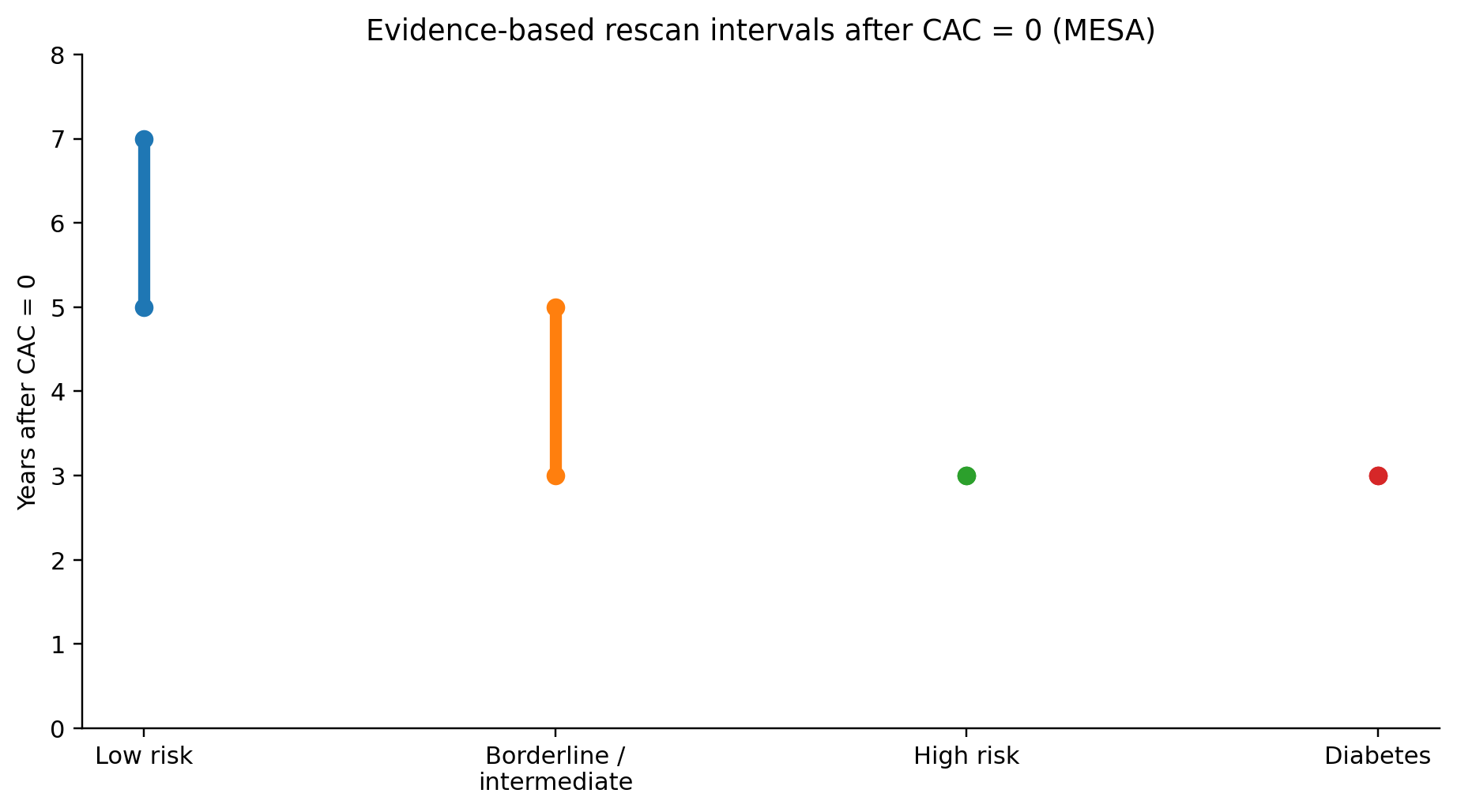
Figure 1. MESA-derived approximate CAC = 0 rescan intervals. Individual age, risk, treatment and the purpose of testing matter.
1. Why the interval is not one-size-fits-all
CAC conversion accelerates with age and baseline cardiovascular risk. Diabetes shortened the zero-score warranty most clearly in MESA.
Family history and smoking had smaller effects on conversion timing in MESA, but clinically they matter because they can be reasons not to use CAC = 0 to defer treatment in the first place.
2. The 3-7 year rule
The 2026 guideline gives a broad 3-7 year window after CAC = 0 when pharmacotherapy has been deferred. This intentionally allows tailoring.
A healthy low-risk person may reasonably be near the longer end; a higher-risk or diabetic patient is closer to the shorter end if rescanning is still the chosen strategy.
3. When not to repeat CAC
If CAC >0 has already triggered statin therapy and the treatment plan would not change, rescanning usually adds little.
If someone has established clinical ASCVD, CAC no longer answers the central treatment question; management follows secondary prevention.
4. Why CAC progression is a poor treatment score
Agatston score can rise because plaque volume increases, because plaque becomes denser/calcified, or both. Statin therapy can increase calcific density while reducing the vulnerable lipid component.
Comparing two CAC scores from different scanners or protocols can also introduce measurement variability.
5. What if symptoms appear before the rescan date?
Do not wait for the scheduled calcium scan. New exertional chest pressure, dyspnea or other concerning symptoms are a diagnostic question, not a screening question, and require clinical evaluation using an appropriate chest-pain pathway.
| Baseline situation | Typical repeat approach | Why |
|---|---|---|
| CAC = 0, low risk, therapy deferred | ~5-7 years | Slow conversion; low event rate |
| CAC = 0, borderline/intermediate risk | ~3-5 years | Higher conversion yield |
| CAC = 0, high risk or diabetes | ~3 years if rescanning is used | Shorter warranty |
| CAC >0 and LLT started | Usually no routine repeat CAC | Does not measure statin response |
| Clinical ASCVD | CAC follow-up generally unnecessary | Treatment already determined by disease status |
Ask one question before booking a repeat scan: “What treatment decision would change if the score is still zero—or becomes positive?” If the answer is “nothing,” the repeat scan may not be useful.
6. FAQ
Should I repeat CAC every year?
No. That is usually much too frequent and is not guideline-supported.
My CAC was 0 five years ago. Am I still protected?
Risk remains lower than if CAC had been positive, but conversion becomes more common with time. Whether to rescan depends on current risk and whether the result will change management.
Can I compare scores from different CT centers?
Broadly, but scanner/protocol differences add noise. Small changes should not be overinterpreted.
If CAC rose after a statin, did treatment fail?
Not necessarily. Statins can increase plaque calcification density while lowering events; serial CAC is not a response biomarker.
References
1. Dzaye O, Dardari ZA, Cainzos-Achirica M, et al. Warranty Period of a Calcium Score of Zero: Comprehensive Analysis From MESA. JACC Cardiovasc Imaging. 2021;14:990-1002.
2. Dzaye O, et al. Incidence of New Coronary Calcification: Time to Conversion From CAC=0. J Am Coll Cardiol. 2020;75:1610-1613.
3. Blumenthal RS, Morris PB, Gaudino M, et al. 2026 ACC/AHA Multisociety Guideline on the Management of Dyslipidemia. Circulation. 2026.
4. Blaha MJ, et al. Multi-Ethnic Study of Atherosclerosis (MESA): JACC Focus Seminar. J Am Coll Cardiol. 2021.