Executive Summary
For adults with LDL-C 70-189 mg/dL and uncertain borderline/intermediate risk, CAC can help decide whether lipid-lowering therapy can be deferred. CAC = 0 is most useful in this decision zone.
For LDL-C ≥190 mg/dL, the 2026 guideline takes a different approach: severe hypercholesterolemia is high lifetime risk, and statin therapy is recommended even without ASCVD, FH, other risk factors or subclinical atherosclerosis.
CAC = 0 is still prognostically informative in severe hypercholesterolemia. Cohorts show that many people with LDL-C ≥190 have no detectable calcium and have lower short-term event rates than peers with positive CAC.
But “lower short-term risk” is not the same as “no treatment benefit over decades.” LDL exposure is cumulative, and calcium may appear only after years of noncalcified plaque biology.
If LDL-C is 160-189 rather than ≥190, CAC = 0 can carry more weight in shared decision-making, especially if there is no diabetes, smoking, strong family history or very high Lp(a).
If familial hypercholesterolemia is suspected or genetically confirmed, general-population risk calculators and CAC should not be used to talk the patient out of statin therapy; the guideline states CAC is not indicated to withhold treatment in FH.
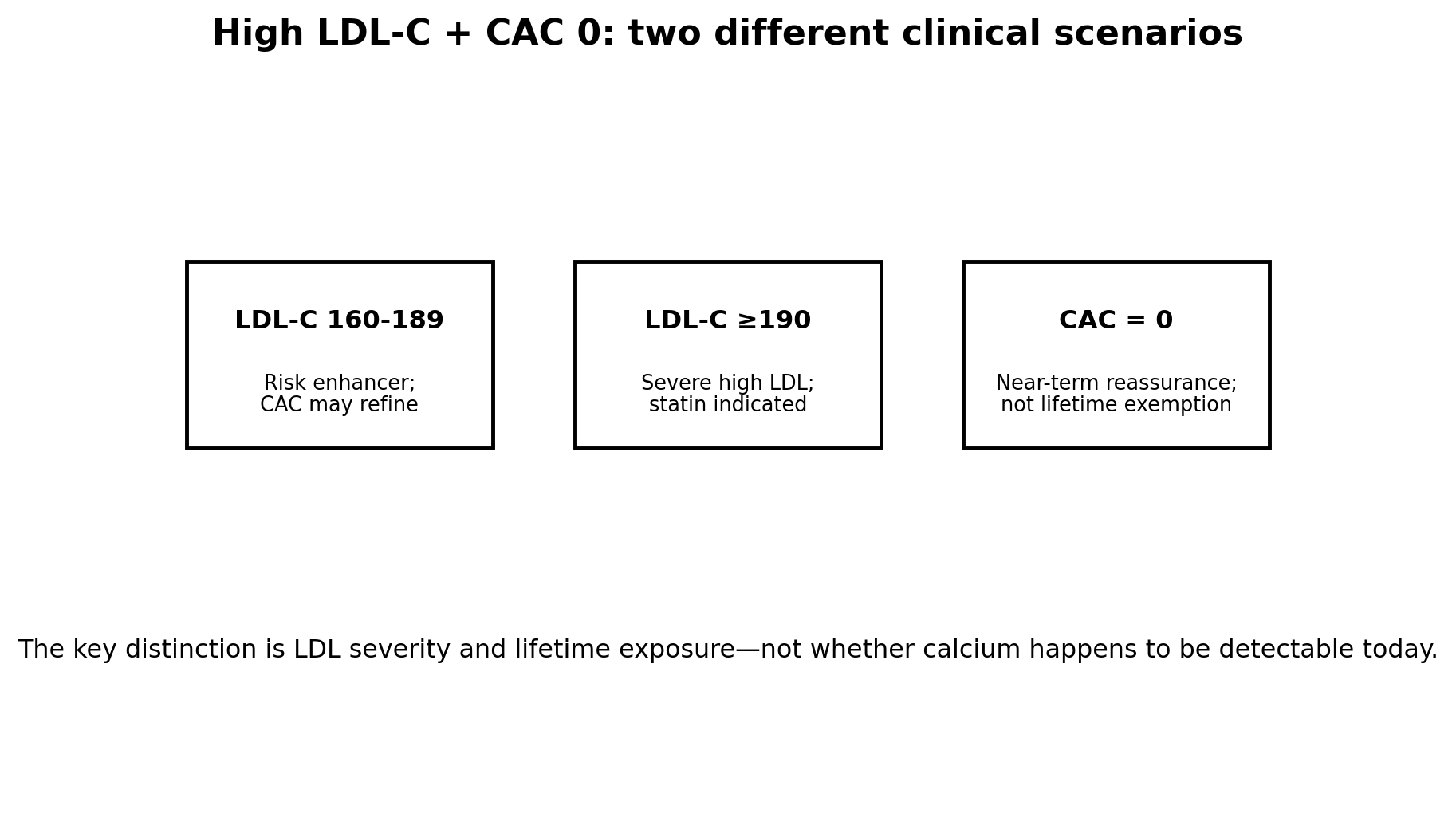
Figure 1. CAC = 0 means something different at LDL-C 165 mg/dL than at LDL-C 220 mg/dL. Severe hypercholesterolemia is treated as a lifetime-exposure condition.
1. LDL-C 160-189 mg/dL: a risk enhancer, not automatically severe hypercholesterolemia
In younger adults and primary prevention, LDL-C ≥160 mg/dL is an important risk enhancer. A strong family history makes earlier pharmacotherapy more compelling.
If treatment remains uncertain and the patient is old enough for CAC to be informative, CAC = 0 can help support a more conservative near-term approach in selected people.
2. LDL-C ≥190 mg/dL: the rules change
The 2026 guideline classifies severe hypercholesterolemia with LDL-C ≥190 mg/dL and/or ApoB ≥140 mg/dL as high lifetime ASCVD risk. Maximally tolerated statin therapy is the first step.
The minimum goal in otherwise uncomplicated severe hypercholesterolemia is LDL-C <100 mg/dL and non-HDL-C <130 mg/dL; lower goals apply when FH, additional risk factors or coronary calcification are present.
3. Why can CAC still be zero?
Atherosclerosis is heterogeneous. Genetics, age, duration of exposure, blood pressure, smoking and other factors determine how rapidly calcified plaque appears.
In FH cohorts, roughly half of some middle-aged samples have had CAC = 0 despite markedly elevated LDL-C, with very low short-term event rates. That is useful for prognosis and treatment intensity, but not a reason to ignore lifelong exposure.
4. What should CAC change if treatment is already indicated?
CAC can help communicate absolute near-term risk, motivate adherence and determine how aggressively to add nonstatin drugs. A CAC ≥300 in severe hypercholesterolemia would support a much lower LDL target than CAC = 0.
But a zero score should generally not turn a Class 1 severe-hypercholesterolemia treatment recommendation into “no therapy.”
| Scenario | Role of CAC = 0 | Treatment implication |
|---|---|---|
| LDL-C 160-189; borderline/intermediate risk | Can meaningfully reclassify near-term risk | May support deferral in selected people after full risk review |
| LDL-C ≥190 | Prognostic but not a treatment veto | Maximally tolerated statin recommended |
| Confirmed HeFH | Short-term risk stratifier only | Do not use CAC to withhold statin therapy |
| LDL-C ≥190 + CAC positive | Confirms even higher burden | Lower LDL goals; add-on therapy more compelling |
Find the highest reliable untreated LDL-C you have ever had. A treated LDL of 170 is not the same as an untreated LDL of 170. Then ask whether severe hypercholesterolemia, FH, ApoB ≥140, family history or high Lp(a) changes the meaning of your CAC = 0.
5. FAQ
If CAC is zero, can I stop my statin?
Not automatically. In severe hypercholesterolemia or FH, CAC = 0 is not a guideline-supported reason to stop indicated therapy.
Can LDL 220 be harmless if I have no calcium?
It can coexist with low short-term observed risk, but decades of high LDL/ApoB exposure remain causally linked to ASCVD.
Should I get CCTA to look for soft plaque?
Usually not solely to justify a treatment decision that is already clear from LDL severity. CCTA is better reserved for a clinical anatomy question.
Does CAC 0 mean my genetics are good?
No. CAC is a phenotype snapshot; it does not exclude FH or other inherited risk.
References
1. Blumenthal RS, Morris PB, Gaudino M, et al. 2026 ACC/AHA Multisociety Guideline on the Management of Dyslipidemia. Circulation. 2026.
2. Miname MH, Bittencourt MS, Moraes SR, et al. Coronary Artery Calcium and Cardiovascular Events in Patients With Familial Hypercholesterolemia Receiving Standard Lipid-Lowering Therapy. JACC Cardiovasc Imaging. 2019;12:1797-1804.
3. Shapiro MD, Blankstein R. Reclassifying Risk in Familial Hypercholesterolemia: The Power of a CAC Score of Zero. JACC Cardiovasc Imaging. 2019;12:1805-1807.
4. Shepherd J, Cobbe SM, Ford I, et al. Prevention of Coronary Heart Disease With Pravastatin in Men With Hypercholesterolemia. N Engl J Med. 1995;333:1301-1307.