Executive Summary
Atherosclerosis is a cumulative exposure disease. The arterial wall responds to the number of atherogenic particles circulating over time, which means both the height of LDL-C and the duration of exposure matter.
This creates a predictable trap in people in their 20s and 30s: 10-year event risk is usually low because age is low, even when LDL-C has been high for years. Waiting until short-term risk becomes impressive can mean waiting until substantial lifetime exposure has already accumulated.
The 2026 ACC/AHA dyslipidemia guideline therefore emphasizes earlier intervention and specifically calls for early consideration of pharmacotherapy in young adults with LDL-C at least 160 mg/dL or a strong family history of premature ASCVD.
For adults aged 30–59 who otherwise have low 10-year PREVENT-ASCVD risk below 3%, a moderate-intensity statin is reasonable when LDL-C is 160–189 mg/dL or 30-year PREVENT-ASCVD risk is at least 10%.
LDL-C at least 190 mg/dL is severe hypercholesterolemia. Maximally tolerated statin therapy is recommended regardless of calculated risk because lifetime exposure and the probability of an inherited disorder are high enough that a low short-term score is not reassuring.
Family history changes the threshold for concern. Premature ASCVD in first-degree relatives, especially together with markedly elevated LDL-C, should prompt evaluation for familial hypercholesterolemia and cascade screening rather than another decade of “watchful waiting.”
Early treatment does not mean automatic medication for every mildly abnormal lipid panel. It means recognizing when the cost of delay is decades of preventable exposure, then making a proportionate decision based on LDL-C, ApoB, family history, Lp(a), blood pressure, smoking, metabolic health and long-term risk.
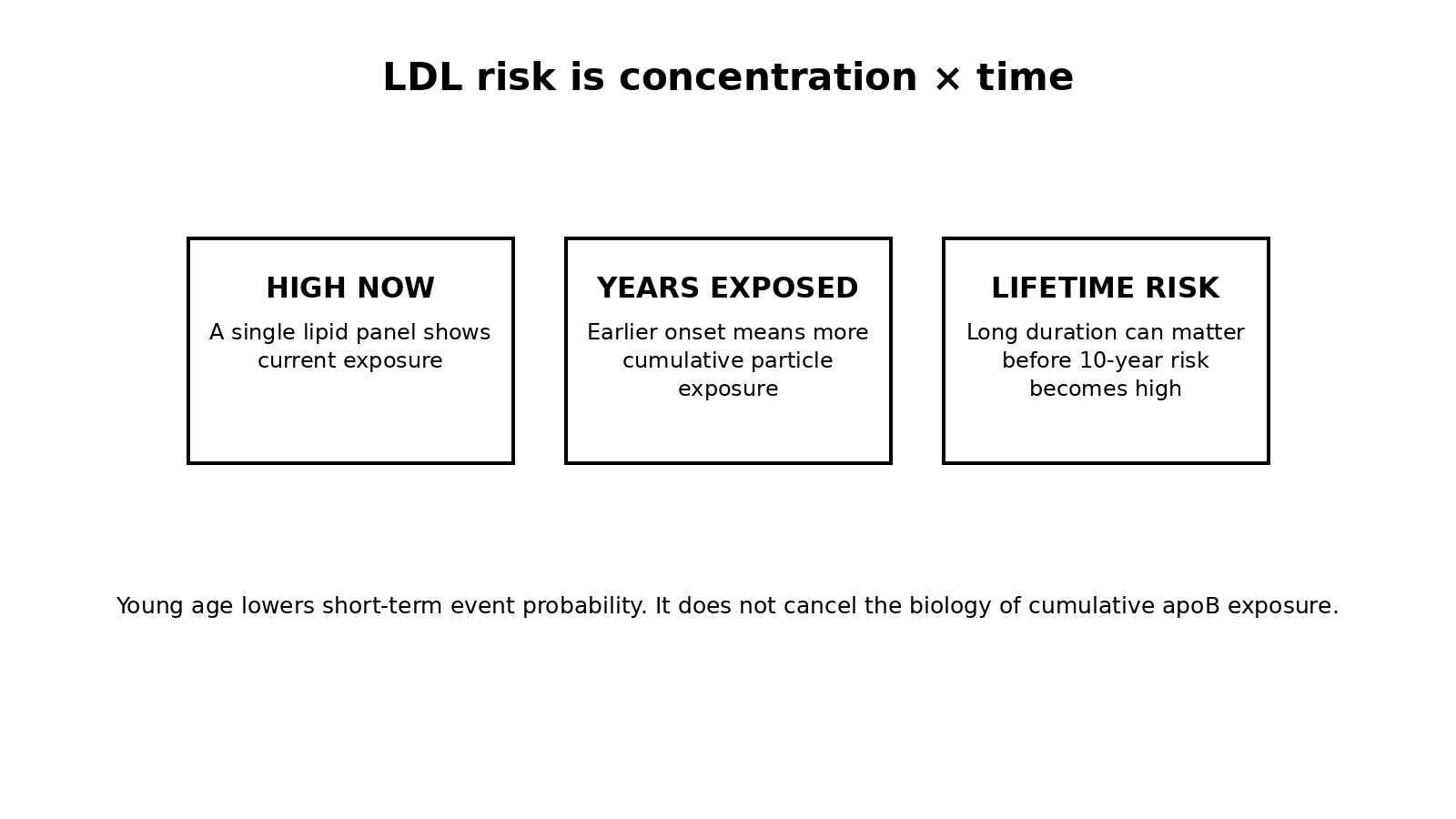
Figure 1. Two people can have the same LDL-C today but very different cumulative exposure depending on how long the elevation has been present.
1. Why age can hide risk
A 32-year-old with LDL-C 175 mg/dL may calculate a very low 10-year event probability simply because heart attacks and strokes are uncommon at that age. The calculator is answering the question it was built to answer: near-term absolute event risk.
It is not saying that 30 more years of LDL exposure are biologically neutral. Cohort data show that cumulative LDL-C exposure from young adulthood through middle age predicts later coronary heart disease independently of the LDL-C measured in middle age.
2. The 2026 treatment triggers that matter
The guideline’s headline is “treat dyslipidemia earlier.” In young adulthood, LDL-C at least 160 mg/dL or a strong family history of premature ASCVD should trigger early consideration of pharmacotherapy rather than relying only on a low 10-year risk estimate.
At LDL-C at least 190 mg/dL, the conversation changes again. This is severe hypercholesterolemia, for which maximally tolerated statin therapy is recommended regardless of PREVENT risk. Evaluation for familial hypercholesterolemia becomes particularly important.
3. How 30-year PREVENT changes the 30s
PREVENT can estimate 30-year ASCVD risk in adults aged 30–59. The 2026 guideline uses that horizon to identify people whose short-term risk is low but whose long-term trajectory is not.
If 10-year risk is below 3% but LDL-C is 160–189 mg/dL or 30-year PREVENT-ASCVD risk is at least 10%, a moderate-intensity statin is reasonable. This is not “treating a calculator.” It is reducing cumulative exposure while there is still time to prevent plaque from becoming advanced.
4. What to investigate before calling it "genetic"
Repeat a clearly abnormal lipid profile when appropriate and look for secondary causes such as hypothyroidism, nephrotic-range kidney disease, cholestatic liver disease, major dietary changes, medications and uncontrolled diabetes. ApoB can help characterize particle burden in selected cases.
Then ask about family history with actual ages: myocardial infarction, stroke, bypass surgery or sudden cardiac death in first-degree relatives at unusually young ages. Measure Lp(a) at least once in adulthood. A pattern of severe LDL elevation plus premature family disease should raise suspicion for FH.
5. What "early" does not mean
Early prevention starts with diet quality, physical activity, nicotine avoidance, healthy weight, blood-pressure control and sleep. Medication is added when the expected reduction in cumulative atherogenic exposure justifies it; it does not replace those behaviors.
A mildly elevated LDL-C in a metabolically healthy young adult with no family history is not the same problem as LDL-C 180 mg/dL with a father who had an MI at 44. Good prevention distinguishes those scenarios instead of applying one age-based rule to both.
| Scenario | 2026 implication |
|---|---|
| LDL-C <160 mg/dL, low long-term risk | Lifestyle and periodic reassessment usually dominate |
| LDL-C 160–189 mg/dL in young adult | Early pharmacotherapy should be considered |
| Age 30–59, 10-year risk <3%, 30-year risk ≥10% | Moderate-intensity statin is reasonable |
| LDL-C ≥190 mg/dL | Treat as severe hypercholesterolemia regardless of calculated risk |
| Strong premature family history | Raises concern and may favor earlier treatment / FH evaluation |
| Lp(a) | Measure at least once; elevation strengthens lifetime-risk management |
Find your earliest available lipid panel, not just the latest one. Write down your LDL-C trajectory, age at each test and the age at which any first-degree relative developed coronary disease or stroke. If you are 30–59, calculate both 10-year and 30-year PREVENT risk. That timeline is more informative than a single “normal for my age” reassurance.
6. FAQ
Is LDL 160 high enough for a statin at age 30?
The 2026 guideline says pharmacotherapy should be considered in young adulthood at LDL-C at least 160 mg/dL, especially when family history or long-term risk strengthens the case. It is a shared decision, not an automatic prescription for every person.
What if my 10-year risk is only 1%?
That is common in young adults. At ages 30–59, the 30-year PREVENT estimate can reveal long-term risk that the 10-year number misses. LDL-C 160–189 mg/dL itself is also a guideline-relevant signal.
Does a CAC score of zero mean I can ignore high LDL in my 30s?
No. CAC detects calcified plaque and can be absent early in the disease process. In severe hypercholesterolemia or strong inherited risk, a zero score does not erase decades of future exposure.
Should I get genetic testing?
Not for every elevated LDL result. It becomes more useful when the phenotype suggests familial hypercholesterolemia, particularly severe LDL elevation and premature disease in close relatives, because a diagnosis can also guide cascade screening.
References
1. Blumenthal RS, Morris PB, Gaudino M, et al. 2026 ACC/AHA Multisociety Guideline on the Management of Dyslipidemia. Circulation. 2026;153:e1154-e1276.
2. Zhang Y, Pletcher MJ, Vittinghoff E, et al. Association Between Cumulative LDL-C Exposure During Young Adulthood and Middle Age and Risk of Cardiovascular Events. JAMA Cardiol. 2021;6:1406-1413. doi:10.1001/jamacardio.2021.3508.
3. Ference BA, Braunwald E, Catapano AL. The LDL cumulative exposure hypothesis: evidence and practical applications. Nat Rev Cardiol. 2024.
4. American College of Cardiology. Prioritizing Health: Lower Sooner - How the 2026 Dyslipidemia Guideline Changes Practice. July 2026.