Executive Summary
ANGPTL3 is a liver-derived inhibitor of lipoprotein lipase and endothelial lipase. Human loss-of-function variants produce low triglycerides, low LDL-C and lower lifetime coronary risk, making the pathway genetically validated.
Evinacumab (EVKEEZA) is a fully human monoclonal antibody against ANGPTL3. In ELIPSE HoFH, it produced a placebo-corrected LDL-C reduction of about 49% despite maximal background treatment.
This is especially important in HoFH because statins and PCSK9 inhibitors rely substantially on functioning LDL receptors; evinacumab can work even in patients with LDLR null-null variants.
The U.S. indication was expanded in September 2025 to adults and children age 1 year and older with HoFH, as an adjunct to diet/exercise and other LDL-lowering therapy.
Zodasiran is an RNAi therapy that silences hepatic ANGPTL3. A Phase 2b mixed-hyperlipidemia trial showed dose-dependent triglyceride reductions of roughly 51-63% versus placebo. In July 2026, enrollment was completed in the Phase 3 YOSEMITE HoFH trial, with completion anticipated in mid-2027.
CTX310 takes the concept much further: a one-time CRISPR-Cas9 infusion permanently edits hepatic ANGPTL3. Phase 1 data published in 2025 showed substantial lipid lowering, but irreversible gene editing carries a much higher long-term safety and ethical evidence burden.
Vupanorsen is a useful cautionary tale: despite lowering ANGPTL3 and triglycerides, development was discontinued in 2022 because dose-related liver fat and enzyme changes weakened the risk-benefit profile.
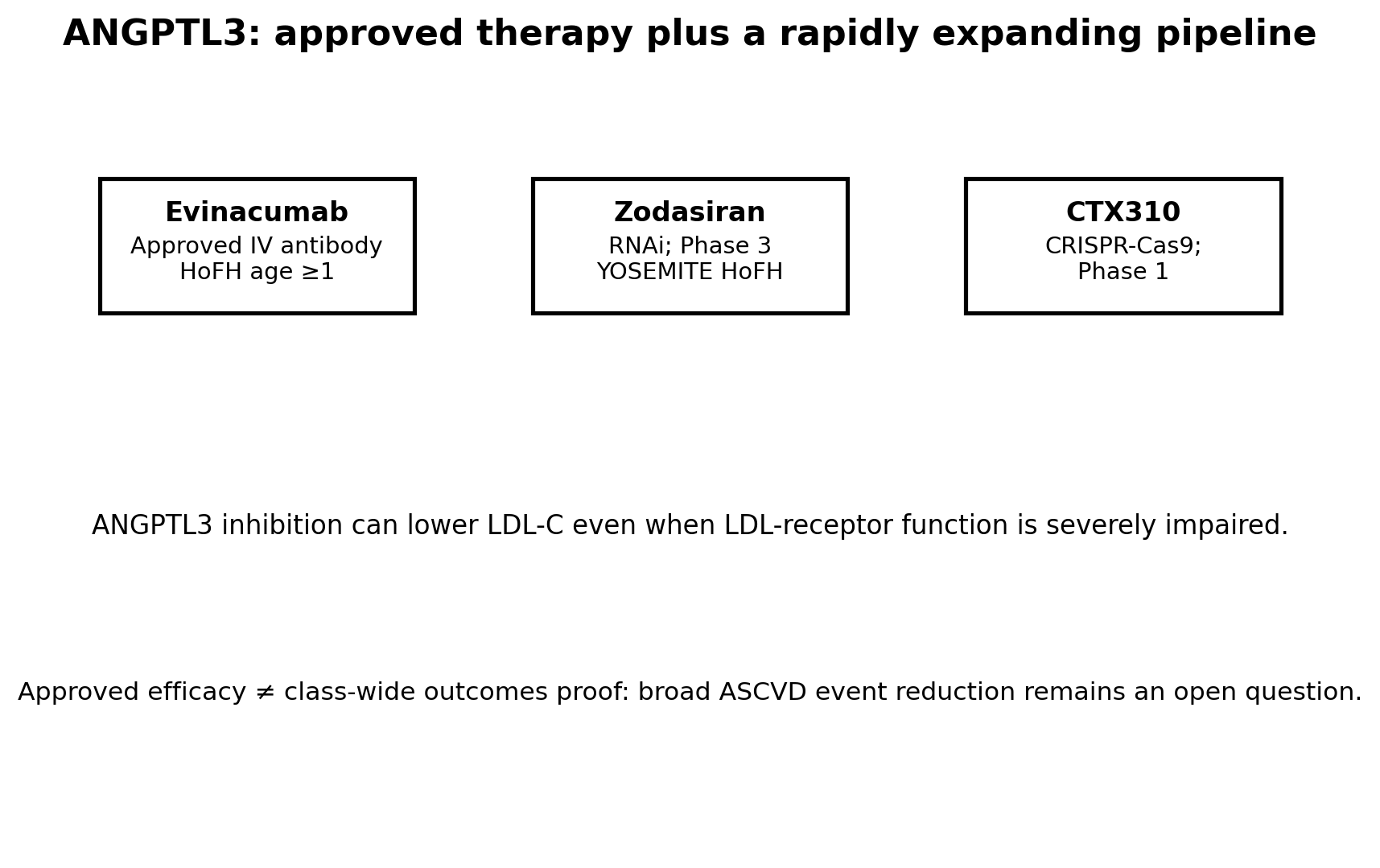
Figure 1. ANGPTL3 ranges from an approved antibody to investigational RNA silencing and irreversible gene editing.
1. Why ANGPTL3 is different from PCSK9
PCSK9 therapies preserve LDL receptors. ANGPTL3 inhibition changes lipoprotein metabolism through a pathway that can reduce LDL-C even when LDL-receptor function is severely impaired.
That makes the mechanism uniquely valuable in HoFH.
2. Evinacumab: the proven therapy
ELIPSE HoFH randomized 65 patients receiving intensive background therapy. At 24 weeks, the between-group difference in LDL-C change was about 49 percentage points.
The effect was present in both null-null and non-null LDLR genotypes, confirming practical LDLR independence.
3. What zodasiran could change
RNAi offers long-duration hepatic silencing rather than monthly IV antibody infusion. Phase 2b data in mixed hyperlipidemia produced large reductions in ANGPTL3 and triglycerides.
The Phase 3 YOSEMITE program is testing zodasiran in HoFH; until results and regulatory review are complete, it remains investigational.
4. Gene editing: exciting and fundamentally different
CTX310 is designed as a one-time permanent intervention. Early Phase 1 results make the biological concept credible, but short-term lipid efficacy is not enough to establish long-term safety.
For common chronic diseases, an irreversible edit must meet a much higher bar than a drug that can simply be stopped.
| Approach | Status Aug 2026 | Main attraction | Main limitation |
|---|---|---|---|
| Evinacumab | FDA approved for HoFH age ≥1 | ~50% LDL lowering independent of LDLR | IV infusion; rare-disease indication; no dedicated broad ASCVD outcomes trial |
| Zodasiran | Phase 3 HoFH | Long-acting RNAi | Investigational; outcomes/approval pending |
| CTX310 | Early Phase 1 | Potential one-time therapy | Irreversible editing; long-term safety unknown |
| Vupanorsen | Discontinued | Validated biology | Liver fat/enzyme safety concerns ended program |
5. FAQ
Does evinacumab replace PCSK9 inhibitors?
No. It serves a different niche, particularly HoFH and very refractory LDL elevation.
Why does it lower HDL too?
ANGPTL3 affects several lipase pathways, so lowering HDL-C is an expected biochemical effect and does not imply that therapy is harmful.
Can anyone with high LDL get EVKEEZA?
The U.S. labeled indication is HoFH, not routine polygenic high cholesterol.
Is ANGPTL3 gene editing ready for prevention?
No. Early human data are promising, but durable safety and outcomes evidence are far from established.
References
1. Raal FJ, Rosenson RS, Reeskamp LF, et al. Evinacumab for Homozygous Familial Hypercholesterolemia. N Engl J Med. 2020;383:711-720.
2. U.S. EVKEEZA (evinacumab-dgnb) Prescribing Information. 2025; indication includes adults and pediatric patients age 1 year and older with HoFH.
3. Arrowhead Pharmaceuticals. Zodasiran Phase 3 YOSEMITE enrollment completed. July 27, 2026.
4. Rosenson RS, et al. Zodasiran, an RNAi Therapeutic Targeting ANGPTL3, for Mixed Hyperlipidemia. N Engl J Med. 2024.
5. Laffin LJ, Nicholls SJ, et al. Phase 1 Trial of CRISPR-Cas9 Gene Editing Targeting ANGPTL3. N Engl J Med. 2025.
6. Pfizer and Ionis. Discontinuation of the vupanorsen clinical development program. January 31, 2022.