Executive Summary
Lipfendra contains enlicitide, a macrocyclic peptide that binds PCSK9 and prevents PCSK9 from degrading LDL receptors. More LDL receptors return to the hepatocyte surface and clear circulating LDL particles.
The FDA indication is broad: adjunct to diet and exercise to reduce LDL-C in adults with hypercholesterolemia, including heterozygous familial hypercholesterolemia (HeFH).
In CORALreef Lipids, placebo-adjusted LDL-C reduction at week 24 was about 56%; in CORALreef HeFH, about 59%. ApoB fell by roughly half in the pivotal program. These are cross-trial data, not a head-to-head comparison with evolocumab, alirocumab or inclisiran.
The recommended dose is one 20 mg tablet each morning on an empty stomach with water, black coffee or plain tea, followed by at least 30 minutes before food or other beverages.
Approval is based on LDL-C lowering. CORALreef Outcomes is a 14,550-participant Phase 3 MACE trial that was active but not recruiting in April 2026; estimated primary completion is November 2029 and no results were posted as of August 6, 2026.
This distinction matters editorially: LDL/ApoB causality makes event reduction biologically plausible, but “expected to reduce risk” is not the same as “this specific drug has already proved MACE reduction.”
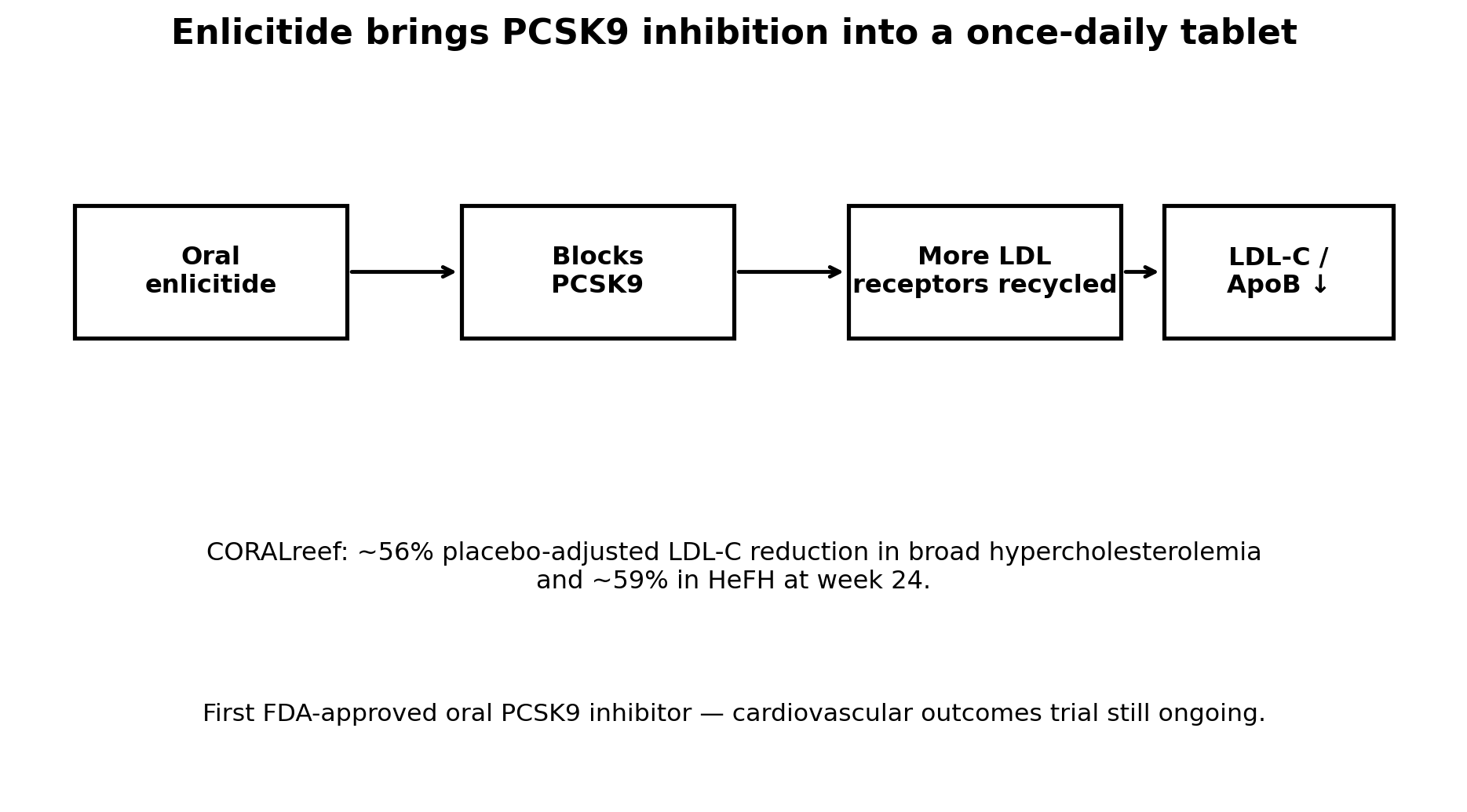
Figure 1. Oral enlicitide inhibits PCSK9 and preserves hepatic LDL receptors, producing large LDL-C and ApoB reductions.
1. Why an oral PCSK9 inhibitor is a big deal
PCSK9 inhibition has been one of the most potent ways to lower LDL-C, but until 2026 every approved therapy in this pathway required an injection. A daily pill may change acceptability, adherence and payer pathways for patients who dislike injections.
It also creates a new practical choice rather than a new biological target: the target is still PCSK9.
2. How much does it lower LDL-C?
In the Phase 3 CORALreef program, LDL-C fell approximately 56% versus placebo in a broad hypercholesterolemia population and approximately 59% in HeFH at 24 weeks.
Those values place enlicitide in the same general efficacy neighborhood as injectable PCSK9 therapies, but there is no appropriate basis for ranking them from separate trials.
3. The dosing trade-off
The convenience of a pill comes with a specific administration routine. The 20 mg tablet is taken in the morning on an empty stomach and swallowed whole; patients wait at least 30 minutes before food or beverages other than water, black coffee or plain tea.
For some patients, twice-monthly or twice-yearly injections may actually be easier than a daily fasting routine. Convenience is personal.
4. Outcomes evidence: the missing piece
Statins and PCSK9 monoclonal antibodies have dedicated randomized outcomes trials. Enlicitide does not yet.
CORALreef Outcomes is designed to test first MACE events including coronary death, ischemic stroke, MI, acute limb ischemia/major amputation or urgent arterial revascularization. Until it reports, the most defensible claim is “proven LDL-C lowering, outcomes pending.”
5. Who might consider it?
Potential candidates include adults who remain above LDL-C/non-HDL-C goals despite tolerated statin and ezetimibe, people with HeFH, and some statin-intolerant patients who need a large oral LDL reduction.
Exact sequencing will depend on risk, LDL target, insurance access, adherence preferences, drug interactions and whether a clinician prioritizes already-proven outcomes for a specific agent.
| Therapy | Typical LDL-C effect | Route / frequency | Dedicated CV outcomes? |
|---|---|---|---|
| Enlicitide | ~56-59% vs placebo in CORALreef | 20 mg oral daily | Pending: CORALreef Outcomes |
| Evolocumab / alirocumab | ~50-65% | Injection every 2-4 weeks | Yes |
| Inclisiran | ~50% | Injection day 1, day 90, then every 6 months | Outcomes pending as of Aug 2026 |
| Ezetimibe | ~18% alone | Oral daily | Yes when added to statin |
6. FAQ
Is Lipfendra a statin?
No. It inhibits PCSK9 through a completely different mechanism.
Does it lower Lp(a)?
The clinical program showed a modest reduction, but enlicitide is not an Lp(a)-specific treatment.
Is it better than Repatha?
There is no head-to-head outcomes trial establishing superiority. Route, adherence, access and outcomes maturity differ.
Can I take it with breakfast?
The label specifies morning administration on an empty stomach, then waiting at least 30 minutes before food or most beverages.
References
1. U.S. Food and Drug Administration. FDA Approves First Oral PCSK9 Inhibitor to Lower LDL Cholesterol in Adults with High Cholesterol. July 17, 2026.
2. Merck. LIPFENDRA (enlicitide) Prescribing Information. Revised July 2026.
3. Merck. CORALreef Lipids and CORALreef HeFH Phase 3 results / FDA approval announcement. July 2026.
4. ClinicalTrials.gov NCT06008756. CORALreef Outcomes. Updated April 23, 2026; active, not recruiting; no results posted.
5. Blumenthal RS, Morris PB, Gaudino M, et al. 2026 ACC/AHA Multisociety Guideline on the Management of Dyslipidemia.