Executive Summary
CKD is defined by abnormalities of kidney structure or function present for at least three months. The most common risk dimensions are estimated glomerular filtration rate (eGFR) and urine albumin-to-creatinine ratio (UACR).
KDIGO classifies albuminuria as A1 <30 mg/g, A2 30-300 mg/g and A3 >300 mg/g. Cardiovascular and kidney risk rise sharply as patients move toward lower eGFR and higher albuminuria categories.
The 2026 AHA/ACC/ADA/ASN CKM guideline places CKD inside a broader cardiovascular-kidney-metabolic continuum rather than treating it as a separate specialty problem.
DAPA-CKD showed a 39% relative reduction in the primary kidney/CV composite with dapagliflozin. EMPA-KIDNEY showed a 28% relative reduction in kidney disease progression or cardiovascular death with empagliflozin, including in patients without diabetes.
In type 2 diabetes and CKD, ADA 2026 recommends an SGLT2 inhibitor or GLP-1 receptor agonist with demonstrated benefit to slow CKD and reduce cardiovascular events irrespective of A1c in the indicated eGFR/albuminuria range.
Finerenone adds outcome benefit in type 2 diabetes with albuminuric CKD despite maximally tolerated ACE inhibitor or ARB therapy. Lipid lowering remains critical because CKD substantially magnifies absolute ASCVD risk.
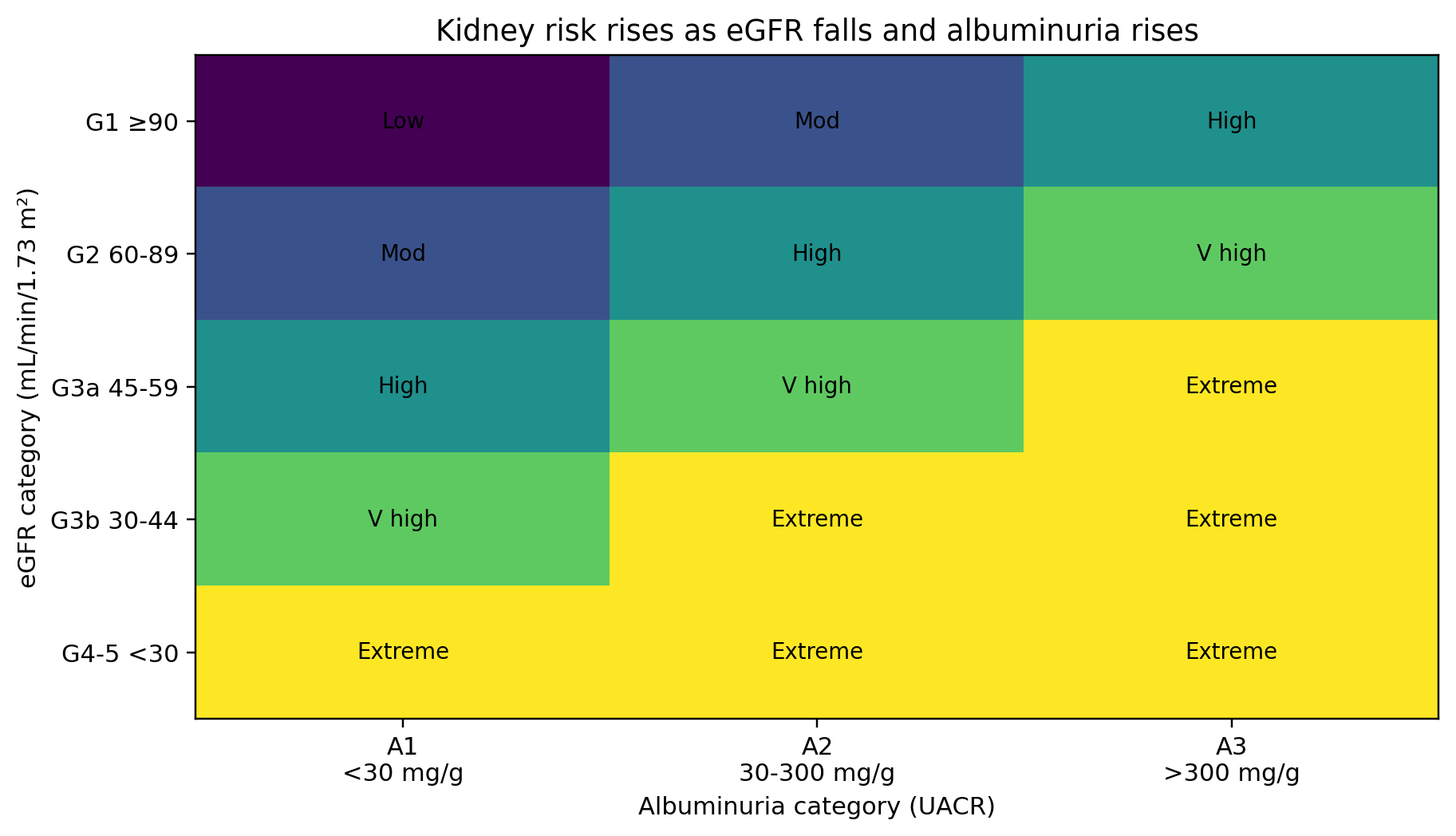
Figure 1. The KDIGO risk concept: lower eGFR and higher albuminuria jointly identify higher kidney and cardiovascular risk.
1. Why CKD is a cardiovascular disease amplifier
CKD increases arterial stiffness, inflammation, oxidative stress, calcification, anemia and neurohormonal activation while frequently coexisting with hypertension, diabetes and dyslipidemia.
Patients with CKD are often more likely to experience cardiovascular events than to progress to dialysis.
2. What to measure
Serum creatinine with eGFR and quantitative UACR are the core screening pair. A normal creatinine does not exclude CKD if albuminuria is present, and a normal UACR does not exclude reduced filtration.
Persistent abnormalities, rather than a single transient result, define chronic disease.
3. SGLT2 inhibitors changed the field
DAPA-CKD enrolled CKD patients with or without diabetes and showed a primary-outcome hazard ratio of 0.61. EMPA-KIDNEY extended protection across a broad CKD population, with a hazard ratio of 0.72 for kidney progression or cardiovascular death.
These benefits are too large to be explained by glucose lowering alone.
4. Lipids in CKD
CKD raises absolute ASCVD risk, so the benefit from reducing ApoB-containing lipoproteins is often substantial. LDL-C/non-HDL-C goals should reflect overall prevention category and the presence of established ASCVD.
Advanced kidney disease and dialysis require more individualized interpretation because trial evidence differs from earlier-stage CKD.
| Risk dimension | Low | Intermediate | High concern |
|---|---|---|---|
| eGFR | ≥60 | 45-59 | <45 mL/min/1.73 m² |
| UACR | <30 mg/g | 30-300 mg/g | >300 mg/g |
| Cardiovascular implication | Baseline risk-dependent | Risk enhancer / CKM disease | High to very high absolute risk |
5. FAQ
Can I have CKD with normal creatinine?
Yes. Albuminuria or structural abnormalities can define CKD even when eGFR is preserved.
Do SGLT2 inhibitors work without diabetes?
Yes. DAPA-CKD and EMPA-KIDNEY demonstrated kidney protection in substantial non-diabetic populations.
Should everyone with CKD take aspirin?
No. Aspirin decisions still depend on secondary vs primary prevention and bleeding risk.
Is kidney disease a reason to avoid statins?
Usually the opposite in non-dialysis CKD: ASCVD risk is higher and lipid lowering is often especially valuable.
References
1. KDIGO 2024 Clinical Practice Guideline for the Evaluation and Management of Chronic Kidney Disease. Kidney Int. 2024;105(Suppl 4S):S117-S314.
2. 2026 AHA/ACC/ADA/ASN Guideline for the Prevention, Detection, Evaluation, and Management of Cardiovascular-Kidney-Metabolic Syndrome.
3. Heerspink HJL, Stefansson BV, Correa-Rotter R, et al. Dapagliflozin in Patients with Chronic Kidney Disease. N Engl J Med. 2020;383:1436-1446.
4. The EMPA-KIDNEY Collaborative Group. Empagliflozin in Patients with Chronic Kidney Disease. N Engl J Med. 2023;388:117-127.
5. American Diabetes Association. Standards of Care in Diabetes—2026. Chronic Kidney Disease and Risk Management.