Executive Summary
Atherosclerosis does not suddenly begin at age 40. Autopsy and imaging studies show that vascular changes can begin in childhood, especially when genetically elevated LDL-C creates years of continuous exposure.
The 2026 ACC/AHA multisociety guideline therefore gives universal pediatric screening a stronger role. Children aged 9–11 who have not previously been screened should have a lipid profile to identify familial hypercholesterolemia and other important lipid disorders.
Waiting until 9–11 is not appropriate when family history is concerning. Cascade screening is reasonable from age 2 when a first- or second-degree relative has premature ASCVD, severe hypercholesterolemia or known FH.
For routine pediatric screening, a nonfasting lipid profile is generally adequate. Fasting is reserved for situations such as triglycerides at least 400 mg/dL, suspected disorders of triglyceride metabolism or a strong family history of hyperlipidemia.
Genetic testing is not required for every child with an abnormal LDL-C. In suspected FH, however, an FH genetic panel can confirm the diagnosis, help cascade screening and inform treatment for relatives who may not know they carry the same inherited risk.
Lifestyle is foundational for every child with dyslipidemia. Medication is targeted primarily to severe or inherited phenotypes. In children at least 8 years old with LDL-C at least 160 mg/dL and a presentation consistent with FH, statin therapy is recommended if 3–6 months of lifestyle treatment does not lower LDL-C sufficiently.
Homozygous FH is an emergency compared with ordinary childhood dyslipidemia. It can cause coronary obstruction in childhood and requires prompt evaluation by pediatric cardiology and an experienced lipid specialist.
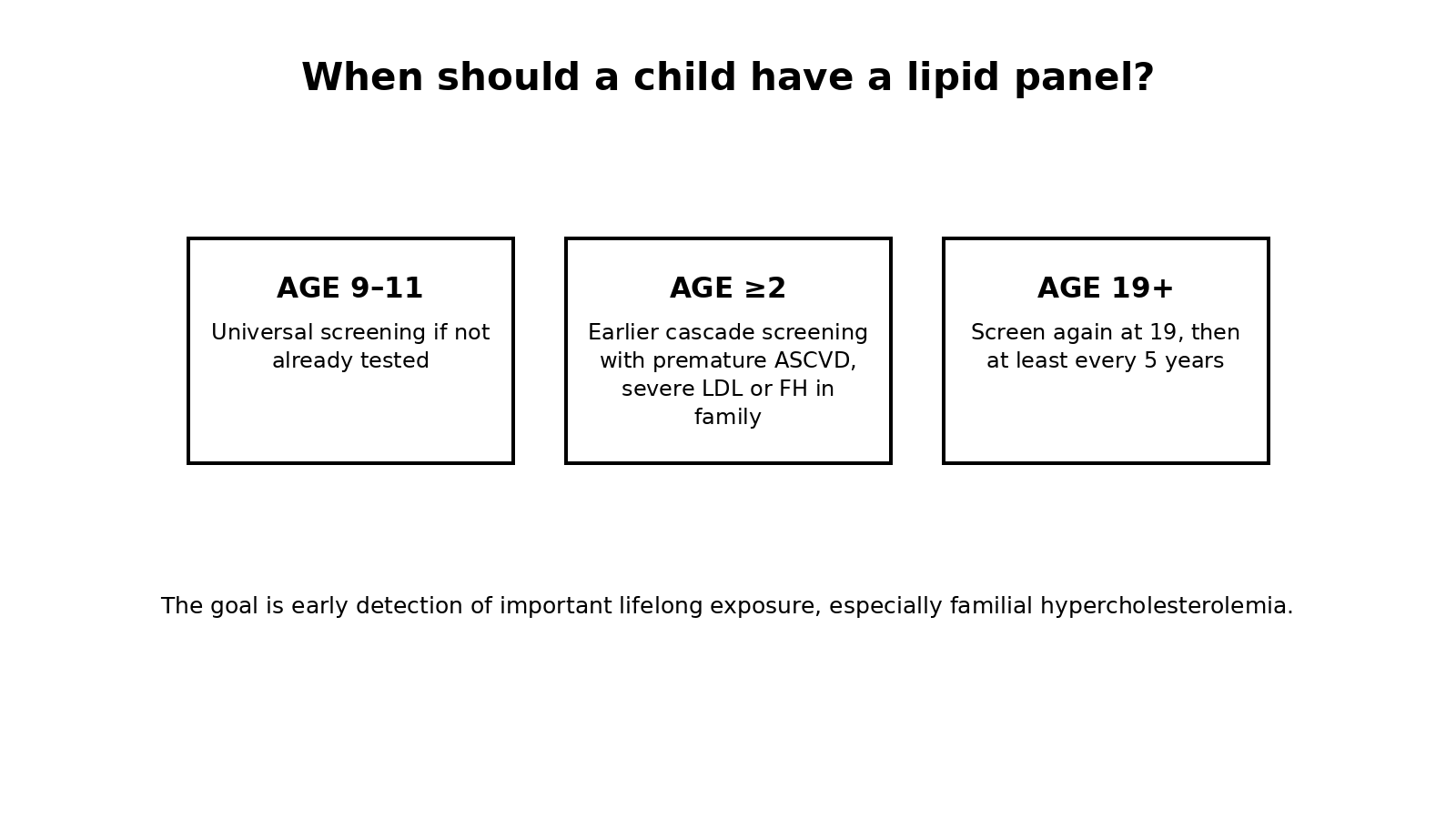
Figure 1. Pediatric lipid screening has two pathways: universal screening at 9–11, and earlier cascade screening from age 2 when family history points toward inherited disease.
1. Why screen children who feel perfectly healthy?
Familial hypercholesterolemia is common enough and underdiagnosed enough that waiting for symptoms fails. Children with FH usually feel completely well while LDL-C exposure accumulates from birth. Finding the child can also uncover an affected parent or sibling.
The 2026 guideline therefore recommends a lipid profile at ages 9–11 for children not previously screened. This timing also precedes the puberty-related fall in LDL-C that can temporarily make an inherited elevation look less obvious.
2. Family history can move screening to age 2
A first- or second-degree relative with premature ASCVD, severe hypercholesterolemia or known FH changes the strategy. In those families, cascade screening from age 2 is reasonable.
Ask for specific events and ages rather than “heart disease runs in the family.” A grandparent’s MI at 88 is not the same signal as a parent’s MI at 39. A known LDL receptor, APOB or PCSK9 pathogenic variant is even more actionable because relatives can be tested systematically.
3. Fasting, nonfasting and advanced tests
Most children can be screened nonfasting. Non-HDL-C remains useful without fasting, and a standard lipid profile is enough for initial case finding. Fasting becomes more important when triglycerides are at least 400 mg/dL or a primary triglyceride disorder is suspected.
Routine advanced lipoprotein testing is not recommended in childhood. The goal is not to order every available biomarker. It is to identify important phenotypes correctly and refer severe or unusual cases to clinicians who manage pediatric lipid disorders.
4. When a child may need a statin
Lifestyle management is recommended for all pediatric dyslipidemia, including diet quality, physical activity, healthy weight, nicotine avoidance, sleep and management of metabolic disease. Many children with obesity-related dyslipidemia improve substantially with those measures.
FH is different because the genetic LDL elevation persists despite excellent behavior. For children at least 8 years old with LDL-C at least 160 mg/dL and a presentation consistent with FH, the 2026 guideline recommends statin therapy when 3–6 months of lifestyle therapy does not sufficiently lower LDL-C. Trials show meaningful LDL lowering with acceptable short- and medium-term safety.
5. What long-term data tell us
A landmark 20-year follow-up of children with FH treated with statins showed slower progression of carotid atherosclerosis and substantially fewer cardiovascular events by young adulthood compared with their affected parents, who had begun statins much later in life.
That study does not mean every child with borderline cholesterol needs medication. It supports the life-course logic of treating a severe inherited LDL burden before decades of arterial exposure accumulate. Suspected homozygous FH requires even more urgent specialist care.
| Question | 2026 answer |
|---|---|
| Universal screening | Ages 9–11 if not previously screened |
| Repeat screening | At age 19, then at least every 5 years |
| Early family-history screening | Reasonable from age ≥2 years |
| Fasting required? | Usually no; reserve fasting for TG ≥400 mg/dL or selected cases |
| Suspected FH | Genetic testing can be useful for diagnosis and cascade screening |
| Statin threshold in FH phenotype | Age ≥8, LDL-C ≥160 mg/dL, after 3–6 months lifestyle if still insufficient |
Write a three-generation family history with ages of heart attack, stroke and coronary procedures, then find the highest known LDL-C values in parents and grandparents. If there is premature disease or severe cholesterol elevation, tell the pediatric clinician explicitly. That can move screening years earlier than routine testing.
6. FAQ
Does my 10-year-old need to fast for cholesterol testing?
Usually not. The 2026 pediatric guidance says nonfasting screening is generally sufficient. Fasting is reserved for very high triglycerides, suspected triglyceride disorders or selected family-history scenarios.
If my child has high LDL, does that mean statins immediately?
No. The cause and severity matter. Lifestyle is foundational. Statins are specifically recommended in children at least 8 with LDL-C at least 160 mg/dL and a phenotype consistent with FH when 3–6 months of lifestyle therapy is insufficient.
Can children have familial hypercholesterolemia with no symptoms?
Yes. That is the usual presentation. FH is detected through LDL levels, family history and sometimes genetic testing long before symptoms occur.
Why test the child if one parent already knows they have FH?
Because FH is inherited. Identifying affected children early allows treatment during the decades when prevention can have the greatest cumulative benefit, and cascade screening can identify additional relatives.
References
1. Blumenthal RS, Morris PB, Gaudino M, et al. 2026 ACC/AHA Multisociety Guideline on the Management of Dyslipidemia. Circulation. 2026;153:e1154-e1276.
2. American Heart Association. Top Take-Home Messages for Pediatric Clinicians: 2026 Guideline on the Management of Dyslipidemia. 2026.
3. Luirink IK, Wiegman A, Kusters DM, et al. 20-Year Follow-up of Statins in Children with Familial Hypercholesterolemia. N Engl J Med. 2019;381:1547-1556. doi:10.1056/NEJMoa1816454.
4. de Ferranti SD, Rodday AM, Mendelson MM, et al. Prevalence of Familial Hypercholesterolemia in the 1999 to 2012 United States NHANES. Circulation. 2016;133:1067-1072.