Executive Summary
In MESA and the Dallas Heart Study, elevated Lp(a) and CAC were independently associated with ASCVD. People with elevated Lp(a) and CAC ≥100 had the highest risk, whereas those with elevated Lp(a) and CAC = 0 had much lower observed risk.
A 2026 multi-cohort analysis of 11,319 participants refined this picture: among CAC = 0, event rates remained low overall but were modestly higher with Lp(a) >50 mg/dL (4.9 vs 3.8 events per 1,000 person-years; HR 1.28). The greatest risk occurred when high Lp(a) coexisted with CAC ≥300.
CAC detects calcified plaque only. Younger people and people with earlier disease may have noncalcified plaque despite CAC = 0. A zero score is therefore not the same as “no atherosclerosis.”
The 2026 dyslipidemia guideline considers very high Lp(a) a risk enhancer that can justify lipid-lowering therapy even when calculated risk is low. CAC = 0 may help personalize intensity but should not erase the Lp(a) signal.
There is no proven lifestyle method that meaningfully lowers genetically determined Lp(a). The actionable strategy is to lower LDL-C/ApoB, control blood pressure, avoid smoking, maintain fitness and treat diabetes/CKD if present.
Repeat CAC is not annual surveillance. For a baseline CAC = 0, the 2026 guideline suggests reassessment in roughly 3-7 years when treatment has been deferred and no higher-risk condition changes the decision.
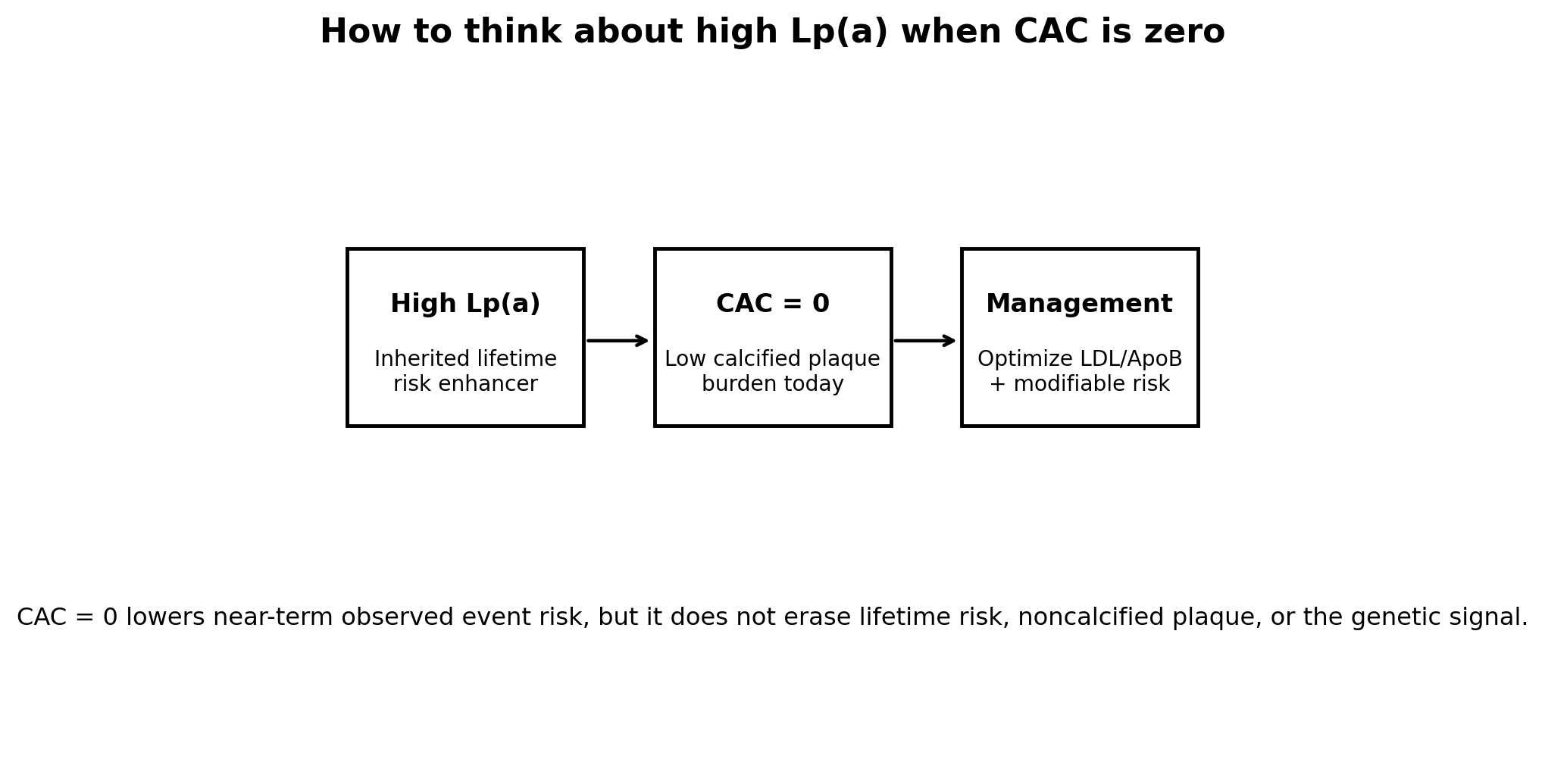
Figure 1. High Lp(a) and CAC = 0 are not contradictory. One is a lifelong inherited risk enhancer; the other is a snapshot of calcified plaque burden.
1. Why CAC = 0 is meaningful
Across large cohorts, CAC = 0 is one of the strongest negative risk markers available in asymptomatic adults. Event rates are low because there is little or no detectable calcified coronary plaque at that moment.
That near-term reassurance is clinically useful, especially when a patient is uncertain about starting medication.
2. Why it does not negate Lp(a)
Lp(a) can promote atherosclerosis, inflammation and calcific aortic valve disease over decades. Its effect is cumulative and genetically determined.
A zero CAC scan at age 45 and a very high Lp(a) level can both be true: the person may have inherited high lifetime risk without yet having accumulated detectable coronary calcium.
3. Should I get CCTA instead?
Not routinely just because Lp(a) is high. CCTA can detect noncalcified plaque, but it uses iodinated contrast and more radiation than CAC, and there is no guideline recommendation for serial CCTA screening solely because Lp(a) is elevated.
CCTA becomes more reasonable when symptoms, an equivocal prior test or a specific clinical question about coronary anatomy is present.
4. What should be treated now?
Treat what can be changed. LDL-C and ApoB are causal and modifiable. The exact LDL target depends on total risk, age, family history and any evidence of subclinical disease.
Blood pressure, smoking, diabetes, exercise, sleep and body composition matter because Lp(a) risk compounds with conventional risk factors.
5. Family implications
Because Lp(a) is largely inherited, first-degree relatives should know that a high value in the family is a reason to measure their own Lp(a), typically once.
Family history of premature ASCVD adds another risk enhancer and can lower the threshold for earlier lipid-lowering therapy.
| Finding | What it means | What it does NOT mean |
|---|---|---|
| High Lp(a) | Lifelong inherited ASCVD risk enhancer | That an event is imminent |
| CAC = 0 | Very low current calcified plaque burden; low near-term observed risk | No noncalcified plaque; zero lifetime risk |
| High Lp(a) + CAC ≥100 | Risk markers stack; higher observed event risk | Automatic need for invasive angiography |
| High Lp(a) + CAC ≥300 | Very high risk phenotype in cohort data | That Lp(a) alone caused all plaque |
Confirm the Lp(a) unit (mg/dL vs nmol/L), document LDL-C and ApoB, check blood pressure/smoking/diabetes status, and make sure first-degree relatives know Lp(a) is worth measuring. A zero CAC score should lower anxiety—not prevention intensity to zero.
6. FAQ
Can high Lp(a) cause a heart attack with CAC 0?
Yes, but the observed near-term rate is low. CAC = 0 cannot exclude all noncalcified plaque or all mechanisms of coronary events.
Should I start a statin if CAC is zero?
That depends on total risk. Very high Lp(a), strong family history, severe hypercholesterolemia, diabetes or smoking can support treatment despite CAC = 0.
How often should I repeat CAC?
If treatment is deferred, the 2026 guideline suggests roughly 3-7 years depending on risk. Do not rescan annually.
Will new Lp(a)-lowering drugs change this?
Possibly. Dedicated outcome trials are designed to show whether large Lp(a) reductions translate into fewer events; management should be updated as those results mature.
References
1. Mehta A, Vasquez N, Ayers CR, et al. Independent Association of Lipoprotein(a) and Coronary Artery Calcification With ASCVD Risk. J Am Coll Cardiol. 2022;79:757-768.
2. Use of Coronary Artery Calcium Scoring in Individuals With Elevated Lipoprotein(a): A Multi-Cohort Study. J Am Coll Cardiol. 2026;87(13 Suppl):abstract.
3. Blumenthal RS, Morris PB, Gaudino M, et al. 2026 ACC/AHA Multisociety Guideline on the Management of Dyslipidemia. Circulation. 2026.
4. Dzaye O, Dardari ZA, Cainzos-Achirica M, et al. Warranty Period of a Calcium Score of Zero: Comprehensive Analysis From MESA. JACC Cardiovasc Imaging. 2021;14:990-1002.